


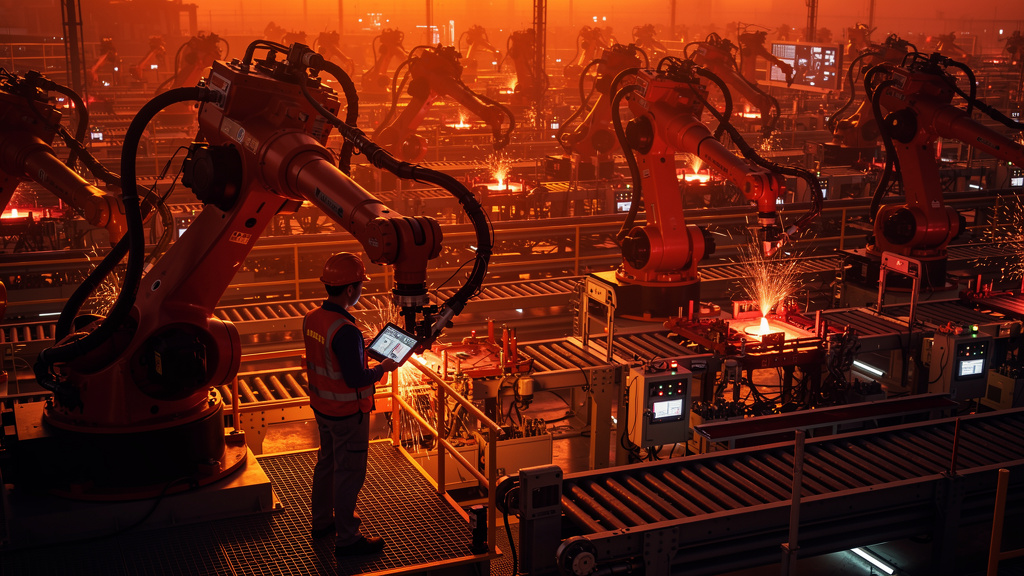
China’s Robot Revolution: How Chinese Manufacturers Are Reshaping Global Robotics
China now dominates the global robotics industry, installing over half of all industrial robots worldwide and producing nearly 90% of humanoid robots sold in 2025. With companies like Unitree, UBTECH, DJI, and XPeng leading innovation across humanoids, drones, and manufacturing automation, Chinese manufacturers have transformed from followers to market leaders in just five years.
TL;DR: Key Takeaways
- China installed 276,288 industrial robots in 2024—51% of global installations and six times more than second-place Japan
- Chinese robot density surged from 97 robots per 10,000 workers (2017) to 470 (2024), nearly a 5x increase
- UBTECH’s Walker S2 has secured $112 million in factory orders with mass production underway
- Unitree G1 humanoid starts at $16,000—making humanoid robots accessible for research and light commercial use
- XPeng Iron features industry-leading 82 degrees of freedom and 2,250 TOPS of on-board AI compute
The Scale of China’s Robotics Dominance
The numbers tell a clear story. According to the International Federation of Robotics (IFR), China’s operational stock of industrial robots hit a record 2.027 million units in 2024—accounting for more than half of global demand. Annual installations climbed to 295,000 units, up 7% from 2023 and marking the highest level ever recorded.
China’s robot density—the metric that measures automation maturity—has exploded from 97 robots per 10,000 manufacturing employees in 2017 to 470 in 2024. That’s a nearly fivefold increase that places China second globally behind only South Korea (1,012), and well ahead of Germany (429) and the United States (295).
The broader Asia-Pacific region drove 74% of new robot deployments in 2024, with Morgan Stanley projecting China’s robotics market will more than double from $47 billion in 2024 to $108 billion by 2028—a compound annual growth rate of 23%.
What This Means for Global Manufacturing
For manufacturers worldwide, China’s robotics surge creates both competition and opportunity. Chinese robot makers have expanded their global presence with exports growing steadily. Domestic firms’ share of China’s local robotics market surged from 29% in 2015 to 47% in 2023, and for the first time in 2024, Chinese robot makers sold more units at home than foreign competitors, with domestic market share rising to 57%.
Total industrial robot production soared from 33,000 units in 2015 to approximately 560,000 in 2024—a 17-fold increase. Service robot output, including robot vacuums and delivery robots, reached 10.5 million units in 2024.
Unitree Robotics: Making Humanoids Accessible
Hangzhou-based Unitree Robotics has become the world’s most-deployed commercial humanoid robot manufacturer by focusing on what other companies ignored: affordability without sacrificing capability.
Unitree G1: The $16,000 Humanoid
Launched in 2024, the Unitree G1 disrupted humanoid pricing. The base model starts at $16,000-$21,600, making it the most affordable production humanoid available. Here’s what you get:
| Specification | Unitree G1 |
|---|---|
| Height | 1.32m (4’4″) |
| Weight | 35kg |
| Degrees of Freedom | 23-43 (base to EDU) |
| Walking Speed | 2 m/s |
| Battery Life | ~2 hours |
| Price Range | $16,000 – $21,600 |
The G1 EDU version adds NVIDIA Jetson Orin compute (275 TOPS), Dex3-1 dexterous hands with 7 DOF per hand, and full SDK access for research institutions. It folds down to 690mm for transport and features 3D LiDAR plus depth cameras for navigation.
Unitree H1: World Speed Record Holder
For serious research and industrial pilot programs, the Unitree H1 holds the world record for humanoid robot walking speed at 3.3 m/s (7.4 mph)—faster than Boston Dynamics Atlas or any Tesla Optimus demonstration.
| Specification | Unitree H1 | Unitree H1-2 |
|---|---|---|
| Price | $90,000+ | $128,900 |
| Height | 1.80m | 1.80m |
| Weight | 47kg | 73kg |
| DOF | 19 | 27 |
| Arm Payload | 5+ kg | Enhanced |
| Best For | Locomotion research | Full-stack humanoid R&D |
The H1-2 adds 7-DOF arms for manipulation research, weighing 73kg to support heavier payloads. With over 5,500 units shipped globally in 2025, the H1 series is the world’s most-deployed commercial humanoid robot.
Unitree R1: Breaking the $5,000 Barrier
In July 2025, Unitree launched the R1 at just $4,900-$5,900—named one of TIME’s Best Inventions of 2025. At 25kg and 1.22m tall, it’s a developer-focused humanoid designed for AI locomotion research. The strategy is clear: capture the developer ecosystem early, then sell upmarket as needs mature.
Unitree filed for a $610 million Shanghai IPO in March 2026, with 335% year-over-year revenue growth in 2025 (reaching ¥1.708 billion). If successful, they’ll be China’s first publicly traded humanoid robotics company.
UBTECH: First to Mass Production
While Unitree dominates research platforms, Shenzhen-based UBTECH Robotics has achieved what others are still promising: mass production of full-size industrial humanoids.
Walker S2: The Factory-Ready Humanoid
The Walker S2, launched July 2025, is the world’s first industrial humanoid robot with autonomous battery swapping—a critical capability that eliminates the 90-minute charging downtimes that plague other humanoids. The robot can remove and replace its own battery, enabling near-continuous operation.
Since early 2025, UBTECH has accumulated orders exceeding 800 million yuan (approximately $112 million USD). Major contracts include:
- 250 million yuan order (September 2025) – single largest humanoid robotics deal of the year
- 159 million yuan deployment at a data collection center in Zigong
- 264 million yuan ($37 million) deal for China-Vietnam border crossing operations
Mass production began in November 2025, with several hundred units already delivered. UBTECH is targeting 500 units by year-end 2025, scaling to 5,000 annually by 2026 and 10,000 by 2027.
Walker S2 Technical Capabilities
The Walker S2 integrates UBTECH’s proprietary Co-Agent intelligent agent system—the first industrial humanoid with closed-loop operational capabilities including:
- Intention understanding and task planning
- Tool usage and manipulation
- Autonomous anomaly detection and handling
- BrainNet 2.0 swarm coordination for multi-robot systems
Industrial partners include BYD, Dongfeng Liuzhou Motor, Geely Auto, FAW-Volkswagen Qingdao, Audi FAW, BAIC New Energy, Foxconn, and SF Express. The robots are actively deployed on automotive production lines, gathering real-world data to refine performance.
DJI: Beyond Drones
Shenzhen-based DJI dominates the global consumer drone market with over 70% market share, but the company’s robotics ambitions extend far beyond aerial photography.
Enterprise and Industrial Expansion
DJI’s Matrice series targets enterprise applications:
- Matrice 4D: Enterprise drones with enhanced AI capabilities for inspection, mapping, and public safety
- Agras T50: Agricultural spraying drones capable of covering 40 acres per hour
- Delivery partnerships: Pilot programs with logistics companies for last-mile drone delivery
The company’s core competency—autonomous navigation, computer vision, and battery management—translates directly to ground robotics. DJI’s RoboMaster educational robotics competitions have cultivated a generation of Chinese robotics engineers, creating talent pipeline advantages.
While DJI hasn’t announced a humanoid robot, their expertise in motors, sensors, and AI software positions them as a potential major player should they enter the market.
XPeng Robotics: The Automotive Approach
XPeng, China’s third-largest EV manufacturer, is applying automotive manufacturing scale to humanoid robotics. Their IRON humanoid represents one of the most technologically ambitious platforms in development.
XPeng Iron Specifications
Unveiled at AI Day 2025, the next-generation IRON features:
| Specification | XPeng Iron |
|---|---|
| Height | 178 cm (5’10”) |
| Weight | 70 kg |
| Degrees of Freedom | 82 body + 22 per hand |
| Compute Power | 2,250 TOPS (3× Turing AI chips) |
| AI Model | VLA 2.0 (Vision-Language-Action) |
| Vision System | 720° perception coverage |
| Battery | All-solid-state (industry first) |
| Estimated Price | ~$150,000 |
| Mass Production Target | Late 2026 |
The IRON’s 82 degrees of freedom enable remarkably human-like movement. At the 2025 unveiling, XPeng representatives cut through the robot’s synthetic skin on stage to prove no human was inside—a demonstration necessitated by the robot’s eerily natural walking gait.
Unlike competitors targeting factories, XPeng is positioning IRON for commercial service roles: retail guidance, reception, and inspection. CEO He Xiaopeng has committed up to ¥100 billion (~$13.8 billion USD) in long-term investment to advance humanoid robotics.
Automotive Manufacturing Advantages
XPeng’s automotive heritage provides structural advantages:
- Existing supply chains for motors, batteries, and sensors
- 300,000+ annual vehicle production experience
- Proven AI systems from autonomous driving (shared VLA architecture)
- 110,000 sqm robotics factory under construction in Guangzhou
However, the company has been candid about challenges. During factory trials, CEO He admitted the robot’s hands “wear out in a month” during intensive tasks—a reminder that humanoid durability remains an industry-wide challenge.
Comparison: Chinese Humanoid Robots
| Robot | Price | Height | DOF | Status | Best For |
|---|---|---|---|---|---|
| Unitree R1 | $4,900-$5,900 | 1.22m | TBD | Pre-sale | Developers, hobbyists |
| Unitree G1 | $16,000-$21,600 | 1.32m | 23-43 | Shipping | Research, education |
| Unitree H1 | $90,000-$129,000 | 1.80m | 19-27 | Shipping | Enterprise research |
| UBTECH Walker S2 | ~$150,000+ (est.) | 1.70m+ | Not disclosed | Mass production | Factory automation |
| XPeng Iron | ~$150,000 (est.) | 1.78m | 82 | 2026 target | Commercial service |
What’s Driving China’s Robotics Success
Several factors explain China’s rapid robotics ascent:
1. Manufacturing Ecosystem
China’s dominance in electronics, batteries, and electric vehicles creates natural supply chain advantages. The same factories producing EV motors and battery packs can pivot to robot components. Lithium-ion battery production hit 29 billion units in 2024, up 20% year-over-year.
2. Government Support
China’s “Made in China 2025” initiative prioritized robotics and automation. Local governments offer subsidies for robot adoption, and state-backed enterprises provide guaranteed initial customers for domestic robot makers.
3. Patent Leadership
China has led global humanoid-related patent filings over the past five years with 5,688 filings compared to 1,483 in the United States, according to Morgan Stanley. This IP foundation supports ongoing innovation.
4. Labor Market Pressures
Rising labor costs and an aging workforce push Chinese manufacturers toward automation. The working-age population peaked in 2014 and has been declining since, creating structural demand for robotic alternatives.
5. AI Integration
Chinese tech giants have partnered aggressively with robotics companies. Baidu integrated its Ernie Bot large language model into UBTECH’s Walker S humanoid. XPeng’s VLA 2.0 model is trained on 100 million video clips across EVs, robotaxis, and robots.
Challenges and Limitations
Despite impressive progress, Chinese robotics faces hurdles:
- Geopolitical scrutiny: US congressional investigations have examined Unitree’s potential military connections. No restrictions have been imposed as of early 2026, but the situation creates uncertainty.
- Durability gaps: Humanoid robots still require frequent maintenance. XPeng’s admission that Iron’s hands wear out in a month reflects industry-wide challenges.
- Software maturity: Hardware capabilities often exceed software reliability. Autonomous task execution remains limited compared to teleoperated demonstrations.
- Export restrictions: Advanced robotics technology faces increasing export controls, limiting market access for Chinese manufacturers.
Actionable Checklist: What to Watch
For robotics professionals and investors tracking China’s market:
- Monitor production volumes: UBTECH’s progress toward 10,000 units annually by 2027 will signal whether mass adoption is achievable
- Watch Tesla’s response: Optimus production targets ($20,000 price point) will pressure Chinese manufacturers on cost
- Track software capabilities: Hardware specs matter less than autonomous task completion rates—demand verified performance data
- Follow policy developments: US and EU regulations on Chinese robotics imports could reshape competitive dynamics
- Evaluate ecosystem play: Companies building developer communities (Unitree’s SDK strategy) may win long-term
FAQ: China’s Robotics Revolution
How many robots does China install annually?
China installed 276,288 industrial robots in 2024—approximately 51% of global installations and six times more than second-place Japan (46,100 units).
What’s the cheapest humanoid robot available?
The Unitree R1, launched July 2025, starts at $4,900—making it the most affordable humanoid robot commercially available. The Unitree G1 starts at $16,000 for a more capable research platform.
Which Chinese humanoid robot is in mass production?
UBTECH’s Walker S2 began mass production in November 2025, with several hundred units already delivered and targets of 500 units by year-end 2025, scaling to 5,000 annually by 2026.
How does China’s robot density compare globally?
China’s robot density reached 470 robots per 10,000 manufacturing employees in 2024, ranking second globally behind South Korea (1,012) and ahead of Germany (429) and the United States (295).
What’s the difference between Unitree G1 and H1?
The G1 ($16,000-$21,600) is a compact 1.32m humanoid for research and education. The H1 ($90,000+) is a full-size 1.8m platform holding the world speed record at 3.3 m/s, designed for serious locomotion research.
Which Chinese robotics company has the most advanced AI?
XPeng Iron features the highest compute capacity at 2,250 TOPS across three proprietary Turing AI chips, running a VLA 2.0 model trained on 100 million video clips.
Are Chinese humanoid robots reliable for industrial use?
UBTECH’s Walker S2 is actively deployed at BYD, Foxconn, and automotive factories with reported 24/7 operation capability through autonomous battery swapping. However, widespread industrial adoption remains early—verify specific use case performance before purchase.
The Bottom Line
China’s robotics revolution isn’t hypothetical—it’s measurable in installation numbers, production volumes, and commercial contracts. Chinese manufacturers have captured 51% of industrial robot installations and 90% of humanoid robot sales in 2025.
For research institutions, Unitree’s G1 and H1 platforms offer the most accessible entry points into humanoid robotics. For industrial applications, UBTECH’s Walker S2 is the only option currently in mass production with proven factory deployments.
The competitive dynamic is shifting. Foreign robot manufacturers’ market share in China fell from over 70% in 2020 to 53% in 2023, while Chinese suppliers achieved double-digit sales growth annually since 2020. As Morgan Stanley projects a $5 trillion global humanoid robotics market by 2050, China is positioned to lead in both technological development and adoption.
The question for Western manufacturers and researchers isn’t whether to engage with Chinese robotics—it’s how to compete, collaborate, or adapt to a landscape where China sets the pace.
This article may contain affiliate links. TheRoboWire may earn a commission at no extra cost to you. Data sourced from IFR World Robotics 2025, Morgan Stanley research, and manufacturer specifications. Last updated: April 2026.
