


This article may contain affiliate links. TheRoboWire may earn a commission at no extra cost to you.
If you’re choosing between a cobot and a traditional industrial robot, here’s the short answer: cobots win for flexibility, low cost, and safe human collaboration — typically $25,000–$60,000 with 6–18 month payback. Traditional industrial robots win for raw speed, heavy payloads (up to 1,000 kg), and high-volume production lines where every cycle-time millisecond counts.
TL;DR — Key Takeaways
- Cobots cost 50–70% less than a fully deployed industrial robot cell when you factor in safety fencing, integration, and floor space.
- Industrial robots handle payloads up to 1,000 kg and cycle at 8–12 picks per minute — cobots top out around 20–25 kg.
- Cobot ROI is faster: 6–18 months vs. 12–36 months for traditional arms.
- Safety is the dividing line: cobots can work alongside humans without caging; industrial robots cannot.
- The cobot market is booming: projected to grow at 23% CAGR through 2033, with Universal Robots, FANUC, and ABB leading the pack.
What Is a Cobot vs. a Traditional Industrial Robot?
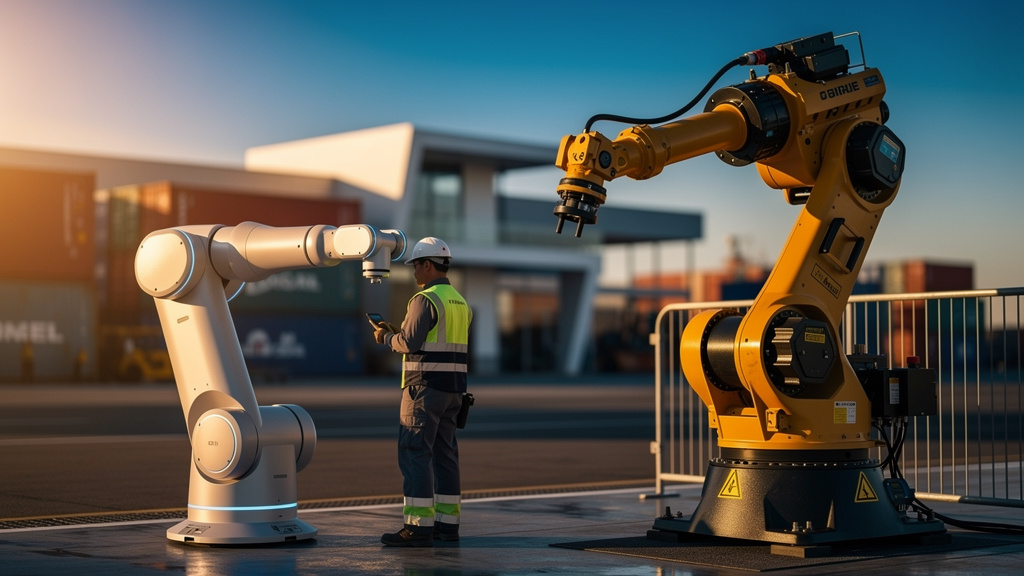
A collaborative robot (cobot) is designed to operate safely alongside human workers without safety fencing. Built-in force sensors and rounded joint covers allow cobots to detect contact and stop immediately — typically within milliseconds. You can program most cobots by physically guiding the arm through motions or dragging instructions on a tablet.
A traditional industrial robot is an autonomous, programmable machine built for maximum speed, precision, and payload in a controlled environment. These robots live behind safety cages and light curtains because they move fast enough — and carry enough weight — to cause serious injury. Programming requires specialized expertise in languages like RAPID (ABB), KRL (KUKA), or TP (FANUC).
The distinction matters because it dictates your facility layout, staffing needs, integration timeline, and total cost of ownership. Choosing wrong costs you either performance you need or money you didn’t have to spend.
Head-to-Head Specs: Cobot vs. Industrial Robot Comparison Table
| Specification | Cobot (e.g., UR20, FANUC CRX-25iA) | Industrial Robot (e.g., FANUC M-20iD/35) |
|---|---|---|
| Payload | 3–25 kg | 12–1,000+ kg |
| Reach | 500–1,750 mm | 700–4,000+ mm |
| Max TCP Speed | Up to 4 m/s (reduced near humans) | Up to 12+ m/s |
| Repeatability | ±0.02–0.05 mm | ±0.02–0.05 mm |
| Safety Fencing | Not required (built-in force limiting) | Required (cages, light curtains) |
| Robot Arm Price | $15,000–$60,000 | $25,000–$150,000+ |
| Total Deployed Cost | $30,000–$150,000 | $100,000–$500,000+ |
| Payback Period | 6–18 months | 12–36 months |
| Programming | Hand-guiding, tablet drag-and-drop | Teach pendant, specialized code |
| Integration Time | Hours to days | Weeks to months |
| IP Rating (typical) | IP54 | IP67 |
| Best For | Mixed-task, low-volume, human-adjacent | High-volume, heavy-duty, 24/7 lines |
When to Choose a Cobot
Cobots are the right choice when flexibility, safety, and fast deployment outweigh raw throughput. Here’s where they shine:
High-mix, low-volume production. If your line changes setups daily or weekly, a cobot’s quick reprogramming — often under an hour — beats the multi-day reconfiguration of a caged industrial cell. Companies like Tesollo and Techman are pushing cobots specifically into high-mix environments.
Small and medium businesses. A $40,000 cobot replacing one operator at $60,000/year (including benefits) pays for itself in roughly 8–10 months. Chinese manufacturers like AUBO and Han’s Robot have pushed entry-level cobots to $15,000–$30,000, making automation accessible to shops with as few as 5–10 employees.
Shared workspaces. In quality inspection, machine tending, or assembly tasks where humans and robots work side by side, cobots eliminate the need for safety caging — saving 30–50% of floor space.
Lab and cleanroom applications. Cobots handle precise, repetitive pipetting, sample prep, and testing tasks without monopolizing an entire room with safety infrastructure.
When to Choose a Traditional Industrial Robot
Industrial robots dominate when speed, payload, or continuous uptime are non-negotiable.
Automotive welding and heavy assembly. Spot-welding a car body requires reaching into tight spaces at high speed with a 50+ kg welding gun. No cobot can match a KUKA KR 1000 titan handling 1,000 kg at speed.
Palletizing at scale. Standard palletizing robots deliver 8–12 cycles per minute. With multi-pick grippers, they effectively multiply throughput 2–4x. If you’re moving 10,000+ cartons per shift, a cobot’s gentler pace doesn’t cut it.
Harsh environments. Industrial robots come rated IP67 and higher — sealed against dust, water jets, and welding spatter. Most cobots max out at IP54. If your floor involves metal shavings, coolant spray, or extreme temperatures, traditional robots last longer.
Continuous 24/7 lines. Traditional robots are engineered for decades of non-stop duty with mean time between failures (MTBF) measured in years. While cobots are catching up, industrial arms still have the edge in brute-force reliability on lines that never stop.
The Real Cost Breakdown: Cobots vs. Industrial Robots
The sticker price of a robot arm is only 25–40% of your total cost. Here’s where the rest goes:
| Cost Category | Cobot Cell | Industrial Robot Cell |
|---|---|---|
| Robot arm | $15,000–$60,000 | $25,000–$150,000 |
| End-of-arm tooling | $2,000–$15,000 | $5,000–$50,000 |
| Safety infrastructure | $0–$3,000 (risk assessment only) | $10,000–$50,000 (caging, PLCs, curtains) |
| Integration & programming | $5,000–$20,000 | $20,000–$100,000+ |
| Floor space impact | Minimal (no cage) | 2–4x footprint with safety zone |
| Training | Hours (drag-and-drop UI) | Weeks (specialized programming) |
| Typical total | $30,000–$150,000 | $100,000–$500,000+ |
That 3–4x cost multiplier for industrial cells is real, but it’s justified when the throughput requirements demand it. A cobot that can’t keep up with your line speed is no bargain at any price.
Pros and Cons at a Glance
Cobots
Pros:
- Safe for human collaboration — no caging needed
- Fast deployment (hours to days, not weeks)
- Lower total cost of ownership
- Easy reprogramming for different tasks
- Faster ROI (6–18 months)
Cons:
- Limited payload (max ~25 kg for most models)
- Slower cycle times in collaborative mode
- Less durable in harsh environments (IP54 typical)
- Not suited for very high-speed, continuous production
Traditional Industrial Robots
Pros:
- Massive payload capacity (up to 1,000+ kg)
- Maximum speed and cycle time performance
- IP67+ ratings for harsh environments
- Decades of proven reliability on 24/7 lines
Cons:
- Requires safety fencing — adds cost and floor space
- Longer, more expensive integration (weeks to months)
- Specialized programming skills needed
- Higher total deployed cost ($100K–$500K+)
- Harder to redeploy to new tasks
Actionable Checklist: Which Robot Does Your Business Need?
- List your payload requirements. If any task exceeds 25 kg, you likely need an industrial robot — or a heavy-duty cobot like the UR30 for borderline cases.
- Calculate your required cycle time. If you need more than 8 cycles per minute sustained, traditional robots are the safer bet.
- Assess human proximity. Will workers be within arm’s reach during operation? If yes, a cobot is the only safe option without extensive (and expensive) safety engineering.
- Estimate redeployment frequency. If you’ll change the robot’s task more than once a quarter, cobot flexibility saves real money.
- Run the ROI math. A $40,000 cobot replacing a $60,000/year labor cost pays back in ~8 months. An industrial cell at $200,000 needs higher throughput gains to justify the investment — make sure you have the volume.
The Market in 2026: Where Things Are Heading
The collaborative robot market hit approximately $2.8 billion in 2026 and is growing at a 23% CAGR. Universal Robots, FANUC, and ABB together hold roughly 45% of unit shipments, but Chinese manufacturers like AUBO, Han’s Robot, and Dobot are aggressively expanding with lower price points.
The line between cobots and industrial robots is blurring. The Universal Robots UR20 delivers 20 kg payload at 1,750 mm reach with speeds up to 4 m/s — specs that would have been firmly in industrial robot territory five years ago. FANUC’s CRX series offers 25 kg payload with 1,889 mm reach. Meanwhile, traditional industrial robot makers are adding collaborative modes to existing arms.
The trend is clear: expect cobots to keep eating into traditional robot territory for medium-payload applications, while industrial robots will remain unchallenged for heavy-duty and ultra-high-speed work.
FAQ: Cobot vs. Industrial Robot
Can a cobot replace an industrial robot?
For tasks under 25 kg payload at moderate speeds, yes. Many manufacturers are successfully replacing older industrial cells with cobots and saving 50–70% on total deployment costs. But for heavy payloads, high-speed welding, or continuous 24/7 operation, industrial robots remain the better choice.
Are cobots safe to work with?
Yes. Cobots meet ISO 10218 and ISO/TS 15066 safety standards. They use force-limiting sensors and rounded joint designs to detect contact and stop within milliseconds. However, a proper risk assessment is still required — the end-of-arm tool (like a sharp blade or hot welding tip) can still be dangerous.
How much does a cobot cost in 2026?
Robot arm prices range from $15,000 (entry-level Chinese models) to $60,000+ (premium UR or FANUC units). Total deployed cost including tooling, integration, and training typically runs $30,000–$150,000 depending on application complexity.
What is the payback period for a cobot?
Most cobots achieve ROI in 6–18 months. A $40,000 cobot replacing one full-time operator at $60,000/year (with benefits) pays for itself in roughly 8–10 months, often faster when accounting for reduced scrap and increased uptime.
Can cobots work in harsh environments?
Most cobots are rated IP54, which handles light dust and splashes but not heavy coolant spray, metal shavings, or extreme temperatures. Some manufacturers offer IP67-rated cobots for tougher environments, but traditional industrial robots remain the default for genuinely harsh conditions.
How long does it take to set up a cobot?
Simple pick-and-place or machine tending tasks can be deployed in hours using hand-guiding and tablet programming. More complex applications with vision systems or multi-station workflows take days to a few weeks — still far faster than the weeks-to-months timeline for a traditional industrial robot cell.
What are the top cobot manufacturers in 2026?
Universal Robots (Denmark) leads the market, followed by FANUC (Japan), ABB (Switzerland), Techman Robot (Taiwan), and AUBO (China). Together, UR, FANUC, and ABB account for approximately 45% of global cobot shipments.
Bottom Line
Choose a cobot if your priority is flexibility, fast deployment, safe human-robot collaboration, and a sub-$150K budget. Choose a traditional industrial robot if you need heavy payloads, maximum cycle speed, harsh-environment durability, or round-the-clock production on a fixed line.
The good news: you don’t always have to pick just one. Many modern facilities run cobots for flexible, human-adjacent tasks and industrial robots for their dedicated high-volume lines. The right answer depends on your specific payload, speed, safety, and budget requirements.
For more on industrial automation trends, check out our coverage of China’s robotics revolution and how new manufacturers are reshaping the competitive landscape.
