


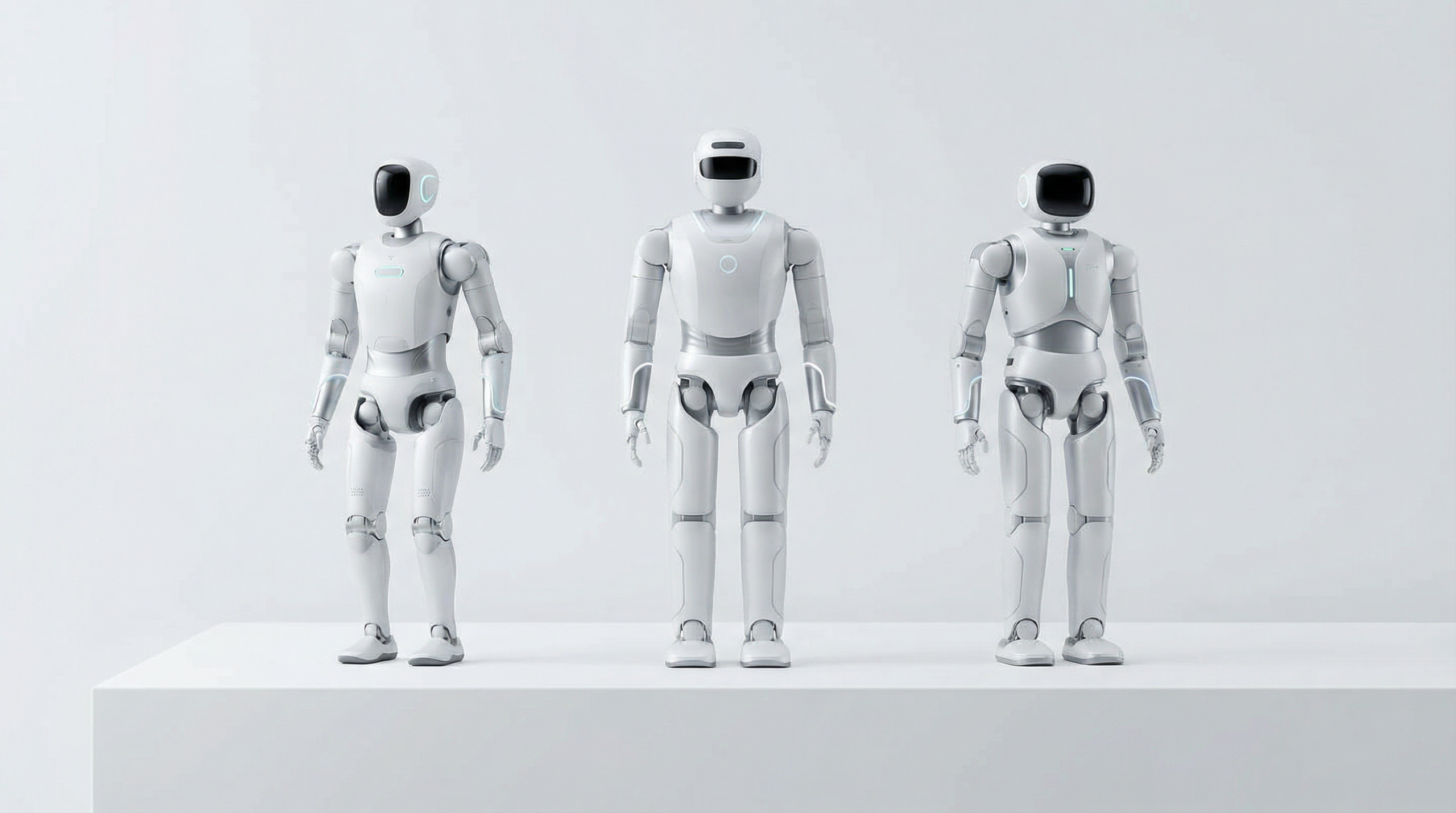
Three of China’s leading humanoid robotics companies — Unitree, Leju, and AgiBot — just showcased their robots at Automation World 2026 in Seoul. And the numbers they brought tell a story the rest of the industry needs to hear.
At AW 2026, Asia’s largest manufacturing automation expo, the Chinese humanoid robot makers demonstrated their latest hardware, outlined commercialization strategies, and participated in the first-ever “China Humanoid Robot Conference” held in South Korea. The message was clear: Chinese humanoid robots aren’t just catching up — they’re shipping at volumes that dwarf the competition.
The Big Three at AW 2026
Unitree Robotics — G1 Humanoid
Unitree is the world’s top-selling humanoid robot company. The company sold 5,500 humanoid robots in 2025 — the first time it disclosed sales figures publicly. At AW 2026, Unitree demonstrated its G1 humanoid robot. Jiang Chengyi, Unitree’s head of solutions, delivered a keynote on commercialization strategy and global expansion plans.
AgiBot — X2 and G2 Humanoids
AgiBot, which claims to be the world’s No. 1 company in global robot shipments and market share, demonstrated both its X2 and G2 humanoid robots at the event. The company sold 5,168 humanoid units in 2025, making it a razor-thin second to Unitree. AgiBot is positioning itself for industrial deployment across factory and logistics environments.
Leju Robot — Kuavo 4th Generation Pro
Leju brought its Kuavo 4th Generation Pro and Kuavo 4 Pro humanoid robots. Ren Guangjie, Leju’s head of solutions, presented the company’s technology roadmap. Leju is ranked among the top five humanoid robot companies globally.
Also confirmed for the event: Fourier and Huawei. Fourier co-founder Zhou Bin and Huawei’s Chief AI Architect for Asia Pacific both spoke at the conference.
The Numbers That Matter
Here’s what makes this showcase significant. The sales data from 2025 paints a stark picture of where the humanoid robotics industry stands:
- Unitree: 5,500 humanoid robots sold in 2025
- AgiBot: 5,168 units sold in 2025
- Chinese companies overall: Nearly 90% of all humanoid robots sold globally
- Top 5 globally: Four of the top five spots held by Chinese firms (AgiBot, Unitree, UBTECH, Leju)
- U.S. companies (Figure AI, Agility Robotics, Tesla): Approximately 150 units each
To put that in perspective: Unitree and AgiBot each individually outsold Tesla’s entire 2025 production target of 5,000 Optimus robots — a target Tesla didn’t meet.
Even Elon Musk acknowledged the competitive landscape at the World Economic Forum: “China is very good at AI, very good at manufacturing, and will definitely be the toughest competition for Tesla. To the best of our knowledge, we don’t see any significant competitors outside of China.”
The EV Playbook, Applied to Robots
Industry analysts see a pattern familiar from another tech sector: electric vehicles. China’s humanoid robotics rise follows the same trajectory that built BYD and other Chinese EV champions:
- Government policy support: Humanoid robots were listed as a key industrial area in China’s 14th Five-Year Plan (2021)
- State funding: Both testing infrastructure and direct company backing
- Mature supply chains: Chinese manufacturers increasingly use domestic components for cost efficiency and supply chain security
- Rapid iteration: Multiple competing companies driving fast development cycles
“Chinese humanoid robotics vendors are using more and more local components in their robotics design, which helps with cost efficiency, supply chain security, and driving local innovation and time to market,” said Lian Jye Su, a tech analyst at Omdia.
AW 2026: The Bigger Picture
Automation World 2026 was the largest edition yet — 500 companies from 24 countries, 2,300 booths, and an expected 80,000 visitors at Seoul’s COEX convention center from March 4-6. The event’s theme, “The Power Driving Autonomization and Sustainability,” reflected a shift from digital transformation to AI-driven autonomous manufacturing.
Beyond the Chinese humanoid makers, notable presences included:
- Hyundai Motor Group Robotics Lab — Korean public debut of MobED, its CES 2026 robotics award winner
- Boston Dynamics — showing its humanoid Atlas robot to the Korean public for the first time
- T-Robotics — unveiled a self-developed industrial humanoid
- Fanuc, Universal Robots, Geekplus — global automation leaders showcasing latest platforms
Over 50 global humanoid and robotics companies participated, making AW 2026 one of the densest concentrations of humanoid robotics activity outside of China.
Market Outlook: Still Early, But Accelerating
The humanoid robotics industry is still in its early stages. The total global market in 2025 was estimated at 13,000 to 18,000 units — small by industrial standards. Most robots are sold for research, retail, or initial industrial deployments rather than mass production.
But the growth trajectory is steep:
- $38 billion estimated global market by 2035 (Goldman Sachs)
- $5 trillion estimated market by 2050 (Morgan Stanley)
- Mass adoption expected by the late 2030s
The companies establishing production capabilities and customer relationships now are positioning themselves for that exponential growth curve.
The Bottom Line
Unitree, Leju, and AgiBot’s showcase at AW 2026 isn’t just a trade show appearance — it’s a signal of where the humanoid robotics industry is headed. Chinese companies are shipping real products in real volumes while much of the Western industry is still in pilot mode. With nearly 90% global market share and the EV playbook as a template, the competitive dynamics of humanoid robotics are becoming clearer by the month. The race isn’t starting — it’s well underway, and the early leaders are already pulling ahead.
Source: DigiTimes | The Robot Report | Rest of World
