


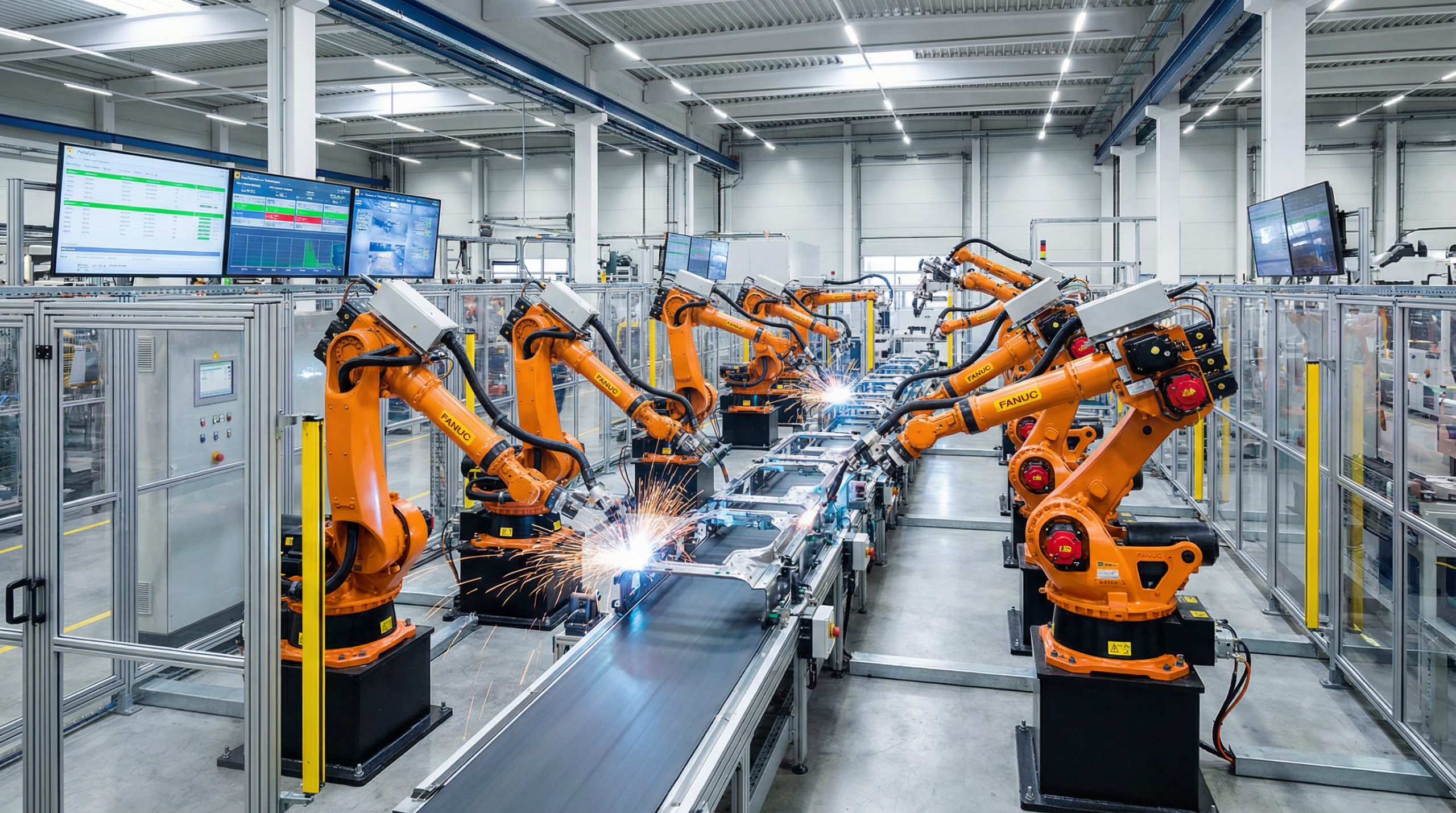
Quick Answer: FANUC leads global industrial robot manufacturing with 32% market share, followed by ABB (18%), KUKA (12%), and Yaskawa (11%). These top four control 73% of the $28.5 billion industrial robotics market, with Universal Robots pioneering collaborative robotics at 8% market share.
Global Industrial Robot Market Analysis
This article contains affiliate links. TheRoboWire may earn a commission on qualifying purchases at no extra cost to you. See our affiliate disclosure for details.
The industrial robotics market reached $28.5 billion in 2025, driven by labor shortages, precision requirements, and Industry 4.0 adoption. Manufacturing automation accelerated post-pandemic, with automotive, electronics, and logistics sectors leading deployment. This comprehensive ranking analyzes the top manufacturers based on revenue, market share, innovation, and global presence.
Our evaluation criteria include annual robot shipments, technological advancement, customer satisfaction scores, service network coverage, and financial stability to provide accurate market positioning.
Market Share and Revenue Analysis
| Rank | Manufacturer | Market Share | 2025 Revenue (Billions) | Units Sold (2025) | Headquarters |
|---|---|---|---|---|---|
| 1 | FANUC | 32% | $9.12 | 185,000 | Japan |
| 2 | ABB | 18% | $5.13 | 98,500 | Switzerland |
| 3 | KUKA | 12% | $3.42 | 65,200 | Germany |
| 4 | Yaskawa | 11% | $3.14 | 62,800 | Japan |
| 5 | Universal Robots | 8% | $2.28 | 48,500 | Denmark |
| 6 | Kawasaki | 5% | $1.43 | 28,200 | Japan |
| 7 | Epson | 4% | $1.14 | 22,400 | Japan |
| 8 | Stäubli | 3% | $0.86 | 17,100 | Switzerland |
| 9 | Doosan | 3% | $0.85 | 16,800 | South Korea |
| 10 | Techman Robot | 2% | $0.57 | 11,200 | Taiwan |
Detailed Manufacturer Analysis
1. FANUC Corporation – Market Leader
Founded: 1958
Headquarters: Yamanashi, Japan
Specialties: CNC controls, industrial robots, factory automation
Notable Products: LR Mate series, M-2000 series, CRX collaborative robots
FANUC maintains market leadership through vertical integration, manufacturing both robots and the CNC systems that control them. The company’s reliability reputation stems from rigorous testing and quality control processes. FANUC robots achieve 99.99% uptime in production environments, making them preferred for automotive assembly lines where downtime costs exceed $50,000 per hour.
Key Strengths:
- Largest install base with over 750,000 robots worldwide
- Superior reliability with mean time between failures exceeding 8 years
- Comprehensive service network covering 108 countries
- Strong R&D investment (8.2% of revenue in 2025)
2025 Highlights: Launched the CRX-25iA collaborative robot with 25kg payload and expanded AI-powered predictive maintenance services. FANUC’s FIELD system now connects over 500,000 machines globally for data analytics.
2. ABB Robotics – Innovation Pioneer
Founded: 1974 (robotics division)
Headquarters: Zurich, Switzerland
Specialties: Industrial automation, power grids, electrification
Notable Products: IRB series, YuMi collaborative robots, Azurion medical robots
ABB pioneered many foundational robotics technologies, including the first all-electric robot in 1974. The company’s strength lies in software integration and system-level solutions. ABB’s RobotStudio™ simulation software enables offline programming and reduces deployment time by 50%.
Key Strengths:
- Strongest software ecosystem with RobotStudio™ and Robot Operating System
- Leadership in collaborative robotics with YuMi and GoFa series
- Extensive industry expertise across automotive, electronics, and logistics
- Strong presence in Europe and North America
2025 Highlights: Acquired Sevensense to enhance autonomous mobile robot capabilities. Launched the IRB 930 SCARA with industry-leading speed and precision for electronics assembly.
3. KUKA AG – German Engineering Excellence
Founded: 1898
Headquarters: Augsburg, Germany
Specialties: Industrial robots, medical technology, warehouse automation
Notable Products: KR series, LBR series, KMR mobile robots
KUKA combines traditional German engineering with modern automation technology. The company excels in heavy-duty applications and custom solutions for complex manufacturing processes. KUKA’s LBR iiwa collaborative robot features integrated sensors in every joint, enabling unprecedented safety and precision.
Key Strengths:
- Superior engineering for high-payload applications (up to 1,300kg)
- Advanced human-robot collaboration technology
- Strong automotive industry relationships
- Comprehensive system integration capabilities
2025 Highlights: Introduced the KR 1000 L950 titan with 1,000kg payload capacity and launched KUKA.AppSpace for simplified robot programming. Chinese parent company Midea increased investment in European operations.
4. Yaskawa Electric Corporation – Motion Control Expertise
Founded: 1915
Headquarters: Kitakyushu, Japan
Specialties: Servo motors, motion controllers, industrial robots
Notable Products: Motoman series, HC series collaborative robots, MPP3 controllers
Yaskawa’s core competency in motion control translates to exceptional robot precision and speed. The company’s Σ-7 servo technology enables smooth, accurate movements essential for precision assembly and material handling applications.
Key Strengths:
- World-leading motion control technology
- Strong presence in Asia-Pacific markets
- Excellent price-performance ratio
- Comprehensive training and support programs
2025 Highlights: Launched the HC30PL collaborative robot series and expanded manufacturing capacity in China and the United States. Yaskawa’s i³-Mechatronics solution now integrates AI-powered optimization.
5. Universal Robots – Collaborative Pioneer
Founded: 2005
Headquarters: Odense, Denmark
Specialties: Collaborative robots (cobots), programming software
Notable Products: UR3e, UR5e, UR10e, UR16e, UR20
Universal Robots created the collaborative robot market and maintains leadership through ease of use and safety innovation. UR cobots can be programmed by non-experts and safely work alongside humans without safety cages.
Key Strengths:
- Largest collaborative robot market share (65%)
- Industry-leading ease of programming and deployment
- Extensive ecosystem of certified accessories and partners
- Strong ROI for small and medium manufacturers
2025 Highlights: Launched the UR20 with 20kg payload and introduced PolyScope X software platform. Universal Robots Academy now offers certification programs in 15 languages.
6. Kawasaki Heavy Industries – Precision and Power
Founded: 1969 (robotics)
Headquarters: Kobe, Japan
Specialties: Industrial robots, aerospace, shipbuilding
Notable Products: duAro series, RS series, CX series
Kawasaki leverages aerospace and precision engineering expertise in robotics applications. The company’s duAro dual-arm robots excel in confined spaces and complex assembly tasks.
Key Strengths:
- Innovative dual-arm collaborative robot design
- Strong precision and reliability
- Excellent support for automotive applications
- Growing presence in medical and cleanroom applications
7. Epson Robots – SCARA Specialists
Founded: 1981
Headquarters: Tokyo, Japan
Specialties: SCARA robots, 6-axis robots, vision systems
Notable Products: LS series, VT series, T series SCARA robots
Epson dominates the SCARA robot market with precision engineering derived from their watch-making heritage. The company’s robots excel in electronics assembly and small parts handling.
Key Strengths:
- Market leader in SCARA robots (45% market share)
- Exceptional precision and repeatability (±0.02mm)
- Integrated vision and force guidance systems
- Strong position in electronics manufacturing
8. Stäubli International AG – Clean Technology
Founded: 1892
Headquarters: Pfäffikon, Switzerland
Specialties: Industrial robots, textile machinery, electrical connectors
Notable Products: TX2 series, TS2 series, HE series
Stäubli specializes in cleanroom and hazardous environment applications. Their robots meet stringent FDA and pharmaceutical industry requirements for sterile manufacturing.
Key Strengths:
- Leadership in cleanroom and pharmaceutical applications
- Superior build quality and longevity
- Excellent performance in harsh environments
- Strong European market presence
9. Doosan Robotics – Emerging Asian Power
Founded: 2015
Headquarters: Seoul, South Korea
Specialties: Collaborative robots, AI integration
Notable Products: M-Series, A-Series collaborative robots
Doosan rapidly gained market share through aggressive pricing and AI integration. Their cobots feature built-in sensors and AI capabilities for autonomous operation.
Key Strengths:
- Competitive pricing with high-quality features
- Advanced AI and machine learning integration
- Growing global distribution network
- Strong focus on collaborative robotics market
10. Techman Robot – Vision-Guided Innovation
Founded: 2016
Headquarters: Taoyuan, Taiwan
Specialties: Vision-guided collaborative robots
Notable Products: TM series collaborative robots with built-in vision
Techman Robot pioneered built-in vision systems for collaborative robots, enabling intelligent pick-and-place operations without external vision systems.
Key Strengths:
- Integrated vision systems for intelligent automation
- User-friendly programming interface
- Competitive pricing for vision-guided applications
- Rapid growth in Asian markets
Regional Market Analysis
Asia-Pacific Dominance
Asia-Pacific represents 75% of global industrial robot installations, led by China (52%), Japan (10%), and South Korea (7%). Chinese manufacturers like SIASUN and ESTUN are gaining domestic market share but remain regionally focused.
European Innovation Hub
European manufacturers emphasize advanced technology and premium applications. Germany leads with KUKA, while Switzerland contributes ABB and Stäubli. The region focuses on Industry 4.0 integration and collaborative robotics.
North American Market
The US and Canada primarily deploy robots from Asian and European manufacturers, with limited domestic production. Focus areas include automotive reshoring and warehouse automation driven by e-commerce growth.
Technology Trends Shaping Rankings
Collaborative Robotics Growth
Collaborative robots represent the fastest-growing segment at 45% annual growth. Universal Robots maintains leadership, but traditional manufacturers are rapidly developing competitive offerings.
AI and Machine Learning Integration
Advanced algorithms enable autonomous decision-making and adaptive behavior. FANUC’s AI servo technology and ABB’s machine learning optimization represent industry directions.
Edge Computing and Connectivity
Industry 4.0 requirements drive integration of edge computing, 5G connectivity, and cloud-based analytics. Manufacturers investing in digital platforms gain competitive advantages.
Customer Satisfaction and Support Analysis
| Manufacturer | Customer Satisfaction | Service Network | Training Programs | Uptime Guarantee |
|---|---|---|---|---|
| FANUC | 4.7/5 | 108 countries | Comprehensive | 99.9% |
| ABB | 4.6/5 | 100+ countries | Excellent | 99.5% |
| KUKA | 4.5/5 | 85 countries | Very Good | 99.3% |
| Yaskawa | 4.4/5 | 75 countries | Good | 99.2% |
| Universal Robots | 4.8/5 | 65 countries | Outstanding | 98.5% |
Future Market Predictions
The industrial robotics market will reach $42 billion by 2028, driven by labor shortages and Industry 4.0 adoption. Collaborative robots will capture 25% market share as safety regulations evolve and costs decrease.
Emerging Competitors
Chinese manufacturers Siasun and ESTUN are expanding globally, while new entrants like Agility Robotics focus on humanoid applications. Software companies including NVIDIA and Amazon are developing robotics platforms.
Consolidation Trends
Market consolidation continues as manufacturers acquire specialized companies for specific technologies. ABB’s mobile robot acquisitions and FANUC’s AI partnerships exemplify this trend.
Buying Decision Framework
Application-Based Selection
- Automotive assembly: FANUC or KUKA for reliability and precision
- Electronics manufacturing: Epson for SCARA applications
- Collaborative applications: Universal Robots for ease of use
- Heavy industrial: KUKA for high payload requirements
- Cleanroom applications: Stäubli for pharmaceutical compliance
Total Cost of Ownership
Beyond initial purchase price, consider:
- Maintenance and service costs over 10-year lifecycle
- Training and programming requirements
- Energy consumption and operational efficiency
- Resale value and technology obsolescence risk
Frequently Asked Questions
Which industrial robot manufacturer offers the best reliability?
FANUC leads in reliability metrics with 99.99% uptime and mean time between failures exceeding 8 years. Their vertical integration of components and rigorous quality control processes result in superior durability. However, ABB and KUKA also achieve excellent reliability ratings above 99.5% uptime in production environments.
What’s the difference between traditional industrial robots and collaborative robots?
Traditional industrial robots operate in safety-caged areas with high speed and precision, while collaborative robots (cobots) can safely work alongside humans without barriers. Cobots feature force limiting, rounded edges, and advanced safety sensors. Universal Robots pioneered this market, though all major manufacturers now offer collaborative options.
How do I choose between FANUC, ABB, and KUKA for automotive applications?
All three excel in automotive applications but with different strengths. FANUC offers superior reliability and the largest service network. ABB provides the best software tools and system integration capabilities. KUKA excels in heavy-duty applications and custom solutions. Your choice should depend on specific application requirements and existing system compatibility.
Are Chinese robot manufacturers competitive with established players?
Chinese manufacturers like SIASUN and ESTUN offer competitive products at lower prices, particularly for domestic applications. However, they generally lag in advanced features, global service support, and proven reliability compared to established manufacturers. Quality has improved significantly, but most global manufacturers still prefer proven suppliers for critical applications.
What’s the typical lifespan and ROI of industrial robots?
Quality industrial robots typically operate for 15-20 years with proper maintenance. ROI varies by application but generally achieves payback within 1-3 years for automotive and electronics applications. Factors include labor cost savings, quality improvements, increased throughput, and reduced waste. Collaborative robots often show faster ROI due to easier integration and lower infrastructure requirements.
