


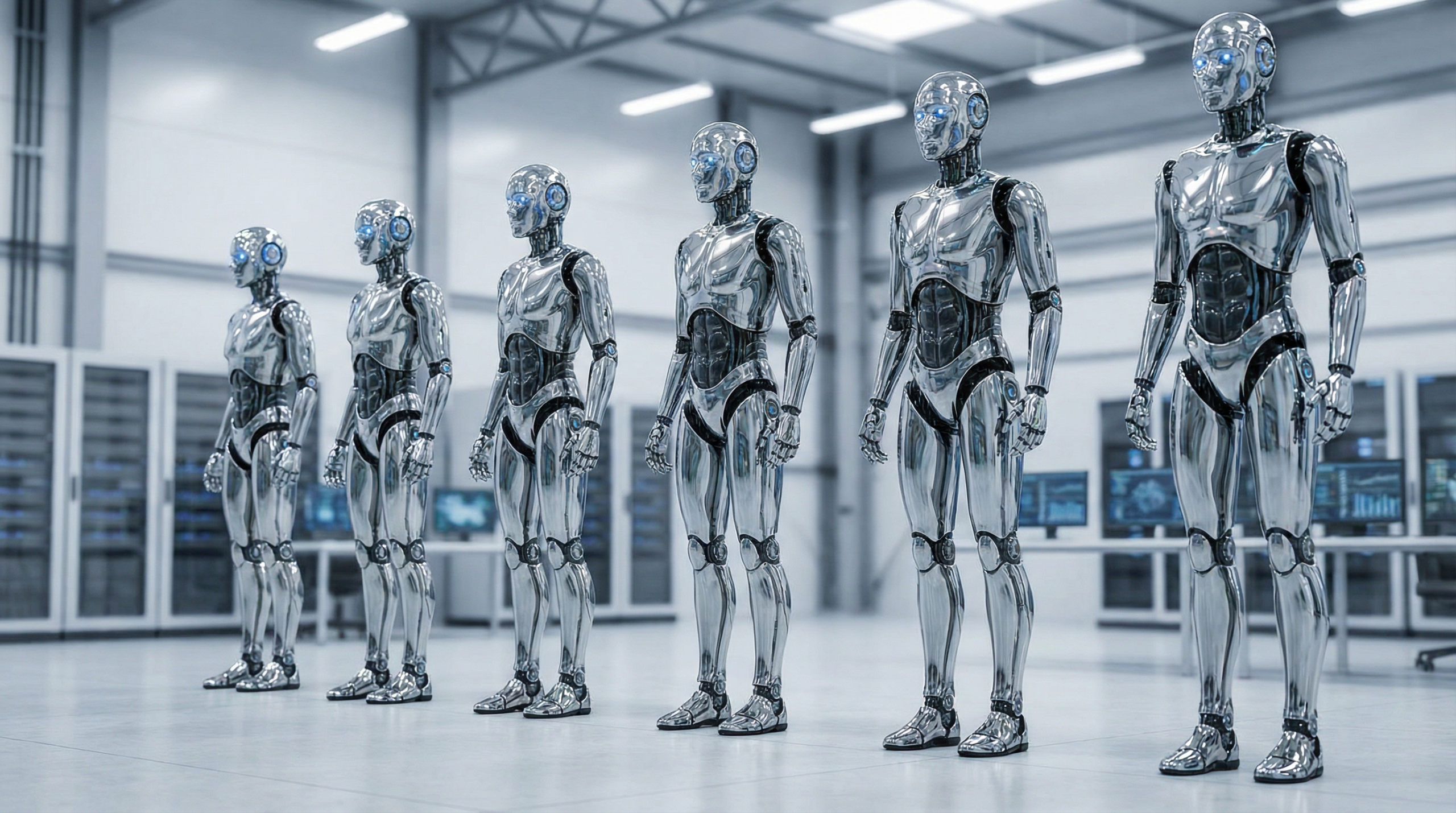
The Age of Humanoid Robots Has Arrived
For decades, humanoid robots existed primarily in science fiction and research labs. In 2026, that’s changed dramatically. Tesla’s Optimus is performing factory tasks, Boston Dynamics’ Atlas has gone fully electric, Figure’s robots are working alongside BMW employees, and a wave of Chinese manufacturers is racing to bring humanoid robots to market. The humanoid robot industry, valued at approximately $3.5 billion in 2025, is projected to exceed $38 billion by 2035.
This isn’t just about technology anymore — it’s about economics, labor markets, and the fundamental question of what work looks like in the future. Here’s everything you need to know about the humanoid robots that are reshaping our world.
Tesla Optimus: The Mass-Market Vision
From Concept to Production
When Elon Musk unveiled “Optimus” at Tesla’s AI Day in 2022, many dismissed it as a marketing stunt — the first prototype was barely functional. By 2024, Optimus Gen 2 was walking smoothly, handling eggs without breaking them, and performing simple factory tasks. In 2025, Tesla began deploying Optimus units in its own factories for real production work.
In 2026, Optimus Gen 3 represents a significant leap. The robot stands 5’8″ (173 cm), weighs approximately 130 pounds (59 kg), and can carry loads up to 45 pounds (20 kg). It features 28 degrees of freedom in its hands alone, enabling dexterous manipulation of tools, parts, and everyday objects. The actuators are Tesla-designed and manufactured, keeping costs lower than competitors who rely on third-party components.
What Optimus Can Do
Tesla has focused Optimus development on practical tasks rather than impressive demos. Current capabilities include sorting and moving batteries on production lines, picking and placing components with precision, walking on varied terrain including factory floors and outdoor areas, folding laundry (demonstrated but not yet production-ready), and basic navigation using Tesla’s FSD-derived vision system.
The robot’s AI runs on a custom Tesla chip and uses the same neural network architecture that powers Full Self-Driving. This is Tesla’s key advantage — the company has more real-world vision training data than anyone else, thanks to its fleet of millions of cars constantly collecting visual data.
Price and Availability
Musk has stated that Tesla aims to sell Optimus for $20,000-$30,000 — less than a car. While this target is ambitious, Tesla’s vertically integrated manufacturing approach makes it plausible at scale. Limited external sales are expected to begin in late 2026 or 2027, starting with industrial applications.
Boston Dynamics Atlas: The Agility Champion
A New Generation
Boston Dynamics retired its hydraulic Atlas platform in 2024 and revealed an all-electric successor that stunned the robotics world. The new Atlas uses electric actuators throughout, making it lighter, quieter, and more energy-efficient than its predecessor. What makes it unique is its superhuman range of motion — joints that rotate 360 degrees, a torso that can twist in ways no human body can, and movements that are simultaneously precise and fluid.
Capabilities
The electric Atlas can perform complex manipulation tasks with custom gripper hands, navigate unstructured environments including construction sites and warehouses, lift and carry heavy objects with coordinated full-body movements, recover from pushes and trips with remarkable balance, and perform acrobatic movements for entertainment and demonstrations.
Boston Dynamics has positioned Atlas primarily for industrial applications through its partnership with Hyundai (which acquired the company in 2021 for $1.1 billion). The robot is being tested in Hyundai and Kia manufacturing facilities for tasks that are ergonomically challenging or dangerous for human workers.
What Makes Atlas Different
While many humanoid robots focus on looking and moving like humans, Atlas prioritizes capability over human-likeness. Its joints aren’t limited to human ranges of motion, which gives it advantages in reaching awkward positions, fitting into tight spaces, and performing tasks from angles that would be impossible for a person. Boston Dynamics calls this approach “beyond human form factor.”
Figure: The Startup Making Waves
Rapid Rise
Figure AI, founded in 2022 by Brett Adcock, has raised over $750 million from investors including Microsoft, NVIDIA, Intel, Amazon, and Jeff Bezos. The company’s Figure 02 robot has advanced from walking demonstrations to performing real tasks in BMW’s Spartanburg manufacturing facility in record time.
The BMW Partnership
Figure’s partnership with BMW is one of the most significant humanoid robot deployments in the automotive industry. Figure 02 robots are performing specific tasks on the production line, including inserting sheet metal parts into fixtures, handling body panels, and assisting with quality inspection. BMW has reported that the robots have successfully completed over 100,000 task cycles in the factory environment.
AI Integration
Figure’s robots use a combination of proprietary AI and an OpenAI-powered language model for natural language interaction. Workers can speak to the robot to give instructions, and the robot can describe what it sees and explain its actions. This conversational interface dramatically reduces the training time needed to deploy the robot for new tasks.
The Chinese Humanoid Wave
UBTECH Walker S
Shenzhen-based UBTECH Robotics has deployed its Walker S humanoid robot in several Chinese automotive factories, including partnerships with Dongfeng Motor and NIO. The Walker S can perform quality inspection using onboard cameras and AI, handle and transport parts, operate standard factory equipment, and work alongside human workers in collaborative settings. UBTECH’s advantage is its extensive experience in consumer robotics (the company is one of the world’s largest educational robot makers) and its close ties to Chinese manufacturing ecosystems.
Unitree H1 and G1
Unitree Robotics, known for its affordable quadruped robots, entered the humanoid space with the H1 and the more compact G1. The G1 is notable for its extremely competitive price point — starting at approximately $16,000, it’s one of the most affordable humanoid robots available. While its capabilities are more limited than premium competitors, it’s opening the door for smaller companies and research institutions to work with humanoid robots.
Fourier Intelligence GR-2
Fourier’s GR-2, developed with a focus on human-robot interaction, features force-controlled joints that make it safe for close collaboration with people. The company has positioned the GR-2 for healthcare and rehabilitation applications in addition to manufacturing.
Agibot and Others
Agibot (backed by major Chinese investors), XPeng Robotics (from the EV maker), and several other Chinese companies are developing humanoid robots at a pace that mirrors China’s rapid advancement in EVs and autonomous driving. The Chinese government has declared humanoid robotics a strategic industry, providing significant funding and policy support.
What Humanoid Robots Can (and Can’t) Do in 2026
Current Capabilities
- Walking and mobility: Most humanoid robots can walk at 3-5 mph on flat surfaces, climb stairs, and navigate around obstacles. Some can handle uneven terrain.
- Object manipulation: Picking up, moving, and placing objects of various sizes and weights. Dexterous tasks like using tools, opening doors, and pressing buttons.
- Repetitive tasks: Performing the same sequence of movements reliably for hours — ideal for manufacturing.
- Visual recognition: Identifying objects, people, and environments using camera-based AI systems.
- Voice interaction: Understanding spoken commands and providing verbal responses (with LLM integration).
Current Limitations
- Battery life: Most humanoid robots operate for 2-4 hours on a charge — insufficient for a full work shift.
- Fine motor skills: While improving rapidly, tasks requiring human-level dexterity (threading a needle, tying knots) remain very difficult.
- Unstructured environments: Robots perform well in controlled factory settings but struggle in unpredictable home or outdoor environments.
- Cost: Even “affordable” humanoid robots cost $16,000-$100,000+, limiting deployment to well-funded organizations.
- Adaptability: Robots are trained for specific tasks and can’t easily generalize to completely new situations without retraining.
- Speed: Humanoid robots are significantly slower than human workers for most tasks, though they can work 24/7 without breaks.
The Economic Impact: Labor, Jobs, and Productivity
The Labor Shortage Argument
Proponents of humanoid robots point to global labor shortages as the primary driver. Many developed nations face aging populations, declining birth rates, and difficulty filling manual labor positions. Japan, Germany, South Korea, and China are all experiencing workforce shortages in manufacturing, warehousing, and elder care.
Goldman Sachs estimates that humanoid robots could fill 4% of U.S. manufacturing labor shortages by 2030 and up to 25% by 2040. The economic value of this labor replacement is estimated at $6 trillion annually by 2040.
The Job Displacement Concern
Labor economists and unions express legitimate concerns about job displacement. While humanoid robots are initially targeting tasks that are dangerous, dirty, or difficult to fill, the technology will inevitably expand to roles currently held by human workers. The key question isn’t whether job displacement will happen, but how quickly and how society manages the transition.
Historical parallels offer some comfort — ATMs didn’t eliminate bank tellers (they actually increased demand for branches), and industrial robots in the 1980s-2000s ultimately created more manufacturing jobs than they displaced. However, the pace and breadth of humanoid robot deployment could make this transition more disruptive than past automation waves.
New Industries and Opportunities
The humanoid robot industry is creating entirely new job categories: robot trainers who teach robots new tasks through demonstration, maintenance technicians who service and repair humanoid platforms, AI developers who build the software that gives robots intelligence, and human-robot interaction designers who create intuitive interfaces. These are generally higher-skilled, higher-paying roles than the manual jobs being automated.
Humanoid Robots in Daily Life: When Will You Meet One?
2026-2028: Industrial Phase
For the next 2-3 years, humanoid robots will primarily exist in factories, warehouses, and controlled commercial environments. You might see one at a tech conference, in a showroom, or in a viral video, but they won’t be part of everyday life.
2028-2032: Commercial Expansion
As costs decrease and capabilities improve, expect humanoid robots in customer-facing roles: hotel concierges, warehouse workers, hospital assistants, and security patrols. Retail stores may use them for inventory management and customer assistance.
2032-2040: Home Arrival
Tesla’s $20,000-$30,000 target price, if achieved, could make home humanoid robots viable by the early 2030s. Initial home applications would include household chores (cleaning, laundry, dishes), elder care assistance, home security, and personal assistance. However, the home environment is far more unpredictable than a factory, so home deployment will require significant advances in AI adaptability.
Safety, Ethics, and Regulation
Physical Safety
Humanoid robots operating near humans must meet strict safety standards. The ISO 15066 standard for collaborative robots specifies force and speed limits to prevent injury. Most humanoid robots incorporate force-limited actuators, emergency stop systems, and collision detection to minimize risk. However, standards specifically designed for humanoid robots are still being developed — the current framework was designed for robot arms, not full-body humanoids.
Ethical Considerations
The rise of humanoid robots raises profound ethical questions. Should robots that look human be clearly identifiable as machines? What happens when people form emotional attachments to humanoid robots? Who is liable when a humanoid robot causes injury or damage? How do we ensure humanoid robots don’t amplify existing biases through their AI systems?
These questions don’t have easy answers, and the regulatory framework is racing to keep up with technological development.
Regulatory Landscape
The EU’s AI Act, which went into effect in phases starting in 2024, includes provisions relevant to humanoid robots, particularly around transparency (robots must identify themselves as machines) and safety (high-risk AI systems require conformity assessments). China has published its own humanoid robot development guidelines, focusing on industry standards and safety certification. The U.S. approach remains more market-driven, with industry-led safety standards rather than comprehensive regulation.
The Road Ahead
The humanoid robot revolution isn’t coming — it’s here. The technology has crossed the threshold from research project to commercial product, and the investment flowing into the sector ensures rapid continued improvement. Within a decade, humanoid robots will be as common in factories as robotic arms are today. Within two decades, they may be as common in homes as smartphones.
The companies that will win this race aren’t necessarily the ones with the most impressive demos — they’re the ones that can manufacture reliably at scale, develop AI that adapts to real-world complexity, and build robots that ordinary people actually want to use. Tesla, Boston Dynamics, Figure, and the Chinese manufacturers each have different strengths in this equation, and the competition between them is accelerating progress for everyone.
Whether you view humanoid robots with excitement or apprehension, understanding them is no longer optional. They’re already reshaping manufacturing, and they’re coming for everything else next.
