


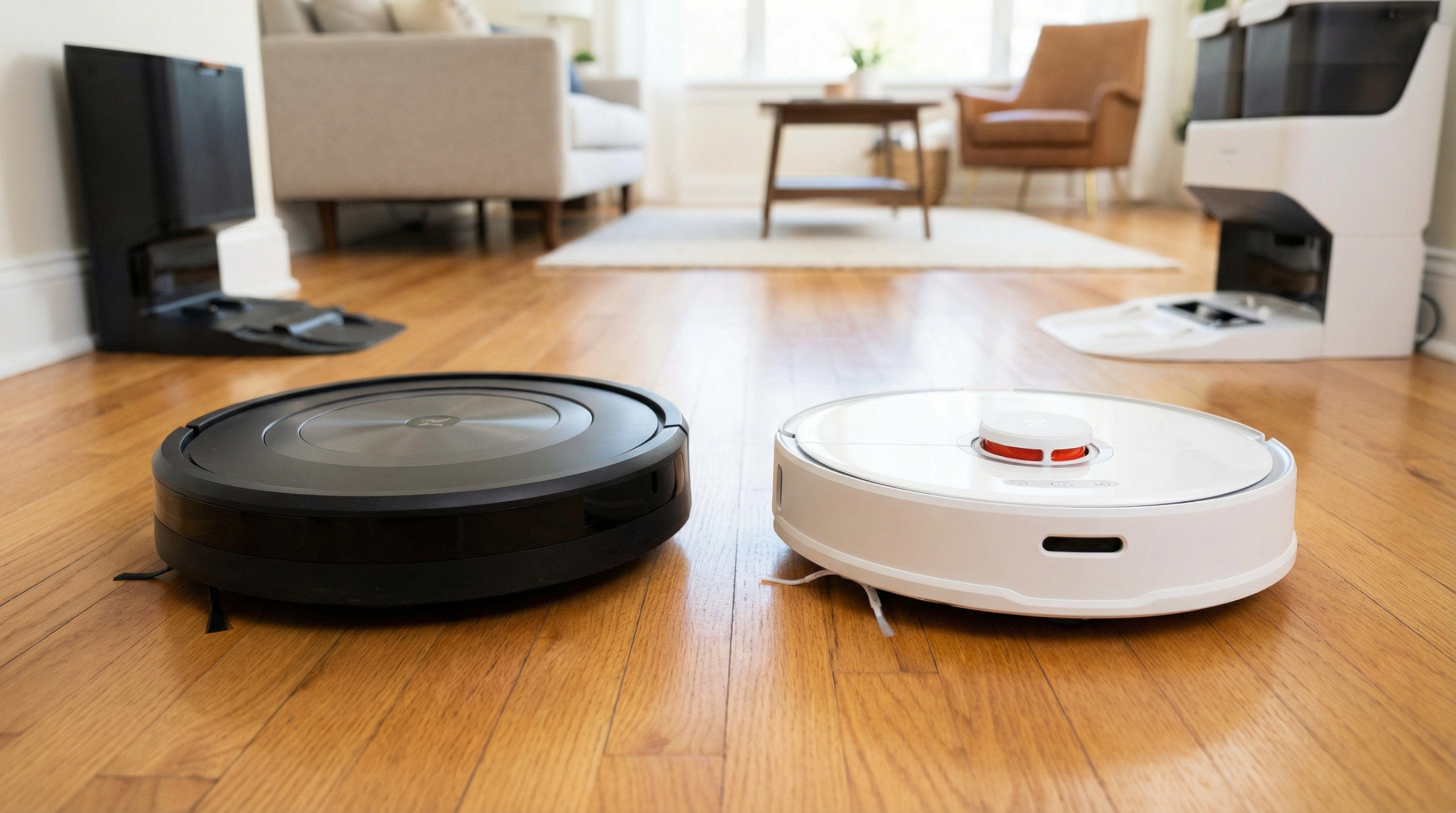
Why Roomba vs Roborock Is the Biggest Debate in Robot Vacuums
If you’re shopping for a robot vacuum in 2026, chances are you’ve narrowed your search down to two brands: iRobot’s Roomba and Roborock. These two giants dominate the market, but they take fundamentally different approaches to cleaning your home. Roomba pioneered the category and built decades of brand trust, while Roborock stormed in with cutting-edge technology at aggressive price points.
In this head-to-head comparison, we’ll break down every aspect that matters — from navigation and suction power to app features, mopping capabilities, and long-term value. By the end, you’ll know exactly which brand deserves a spot in your home.
Brand Overview: Two Different Philosophies
iRobot Roomba: The Pioneer
iRobot launched the first Roomba in 2002, essentially creating the robot vacuum category. Based in Bedford, Massachusetts, the company has sold over 40 million robots worldwide. In 2024, after Amazon’s acquisition attempt fell through due to regulatory concerns, iRobot underwent significant restructuring. By 2026, the company has refocused on its core strengths: reliable cleaning performance, an intuitive user experience, and a robust ecosystem of accessories.
Roomba’s current lineup includes the entry-level Roomba Essential series, the mid-range Roomba Combo (vacuum + mop), and the flagship Roomba Combo j9+ with its auto-empty and auto-fill dock. The brand philosophy emphasizes “it just works” simplicity, with smart mapping that learns your home over time.
Roborock: The Disruptor
Founded in 2014 in Beijing, Roborock began as a Xiaomi ecosystem partner before establishing itself as an independent premium brand. The company made its name by packing flagship-level features into competitively priced robots. By 2026, Roborock has become the go-to brand for tech enthusiasts who want the latest innovations first.
Roborock’s 2026 lineup spans from the budget-friendly Q series to the mid-range S8 family and the flagship S8 MaxV Ultra. The brand consistently pushes boundaries with features like FlexiArm side brush extensions, VibraRise mopping systems, and advanced 3D structured-light obstacle avoidance.
Navigation and Mapping: How They Find Their Way
Roomba’s Approach
Modern Roomba models use iRobot’s PrecisionVision Navigation, which combines a forward-facing camera with onboard sensors. The Roomba j9+ and Combo j9+ create detailed maps of your home, identifying rooms and major furniture pieces. iRobot’s iAdapt 3.0 system allows the robot to navigate around obstacles and adapt to changing environments.
One standout Roomba feature is Imprint Smart Mapping, which lets you label rooms, set cleaning preferences per room, and create Keep Out Zones directly in the app. The system supports up to 10 floor plans, making it suitable for multi-story homes. Roomba also introduced Dirt Detective in 2025, an AI feature that predicts which rooms are likely dirtiest based on historical data and adjusts cleaning schedules automatically.
Roborock’s Approach
Roborock uses LiDAR-based navigation across most of its lineup, supplemented by cameras and structured-light 3D sensors on premium models. The S8 MaxV Ultra features Reactive AI 2.0 obstacle avoidance, which uses RGB cameras and neural processing to identify and avoid obstacles like shoes, cables, pet waste, and small objects.
Roborock’s mapping is exceptionally detailed. The app displays precise floor plans with furniture placement, room labels, and customizable no-go zones. The system supports multi-floor mapping (up to 4 floors) and offers real-time 3D mapping that shows the robot’s exact position and cleaning path. Quick Mapping mode can scan an entire floor in minutes without cleaning.
The Verdict on Navigation
Roborock wins on raw navigation technology. LiDAR-based systems are inherently more precise than camera-based ones in most conditions, and the 3D obstacle avoidance on the S8 MaxV models is best-in-class. However, Roomba’s system is more intuitive for non-technical users, and Dirt Detective adds genuine smart home value. Edge: Roborock for precision, Roomba for simplicity.
Suction Power and Cleaning Performance
Raw Suction Numbers
Roborock has consistently led the suction power race. The S8 MaxV Ultra delivers up to 10,000 Pa of suction, while the newer models push even higher. Roomba doesn’t publish Pa ratings, preferring to emphasize its proprietary Power-Lifting Suction system. Independent tests suggest top Roomba models deliver approximately 3,000-4,000 Pa equivalent.
However, raw suction isn’t everything. Roomba’s dual rubber brush extractors are remarkably effective at loosening and lifting debris from carpets, often matching or exceeding Roborock’s performance on deep carpet cleaning despite lower suction figures. The tangle-free design is also a major advantage for homes with long hair or pet fur.
Hard Floor Performance
Both brands excel on hard floors. Roborock’s high suction and efficient side brush sweep debris effectively into the main brush path. Roomba’s rubber extractors do an equally good job, though some users report that Roomba models occasionally scatter lightweight debris on hard floors due to the extractors’ aggressive rotation.
Carpet Performance
This is where the differences emerge. Roomba’s rubber extractors are specifically designed for carpet agitation, and they perform exceptionally well on medium to high-pile carpets. The automatic carpet boost feature increases suction when carpet is detected. Roborock uses a combination of a main rubber/bristle brush and significantly higher suction power. On low-pile carpets, Roborock’s approach is very effective. On thicker carpets, Roomba’s extractors often edge ahead in debris extraction rates.
Edge-to-Edge Cleaning
Roborock’s FlexiArm side brush, available on the S8 MaxV Ultra, extends outward when the robot detects walls or corners, dramatically improving edge cleaning. This is a genuine innovation that gives Roborock a measurable advantage in edge-cleaning performance. Roomba relies on a standard side brush, which does an adequate but not outstanding job along walls.
Edge: Tie. Roborock leads on hard floors and edges. Roomba leads on deep carpet cleaning. Your floor type should guide your choice.
Mopping Capabilities: The New Battleground
Roomba Combo j9+
The Roomba Combo j9+ features a retractable mopping pad that automatically lifts onto the robot’s top when carpet is detected. This is a clever design that means you never need to manually swap modules. The mopping system uses a controlled water flow and vibrating pad to scrub floors. It’s effective for light maintenance mopping but won’t replace a manual deep mop.
Roborock S8 MaxV Ultra
Roborock’s mopping system is significantly more advanced. The VibraRise 2.0 system uses dual vibrating pads that scrub at 4,000 RPM, applying consistent downward pressure. The pads automatically lift 20mm when carpet is detected — high enough to clear most low-pile carpets. The dock automatically washes the mop pads with hot water, dries them with hot air, and can even add cleaning solution from a refillable tank.
The Verdict on Mopping
Edge: Roborock, by a significant margin. The dual vibrating pads, higher lift clearance, and superior dock cleaning features make Roborock the clear choice if mopping matters to you.
Dock Stations: The Home Base Experience
Roomba Clean Base / Combo Dock
The Roomba Combo j9+’s dock handles auto-emptying and, for mopping-equipped models, refills the water tank. The dustbin can hold up to 60 days of debris. The dock is relatively compact compared to competitors. However, it doesn’t wash or dry the mop pad — that’s a manual task.
Roborock’s Multifunctional Dock
Roborock’s Ultra dock is an all-in-one station that empties the dustbin, refills clean water, drains dirty water, washes mop pads with hot water (up to 60°C), and dries them with hot air. Some models also include automatic cleaning solution dispensing. The dock is larger than Roomba’s but eliminates virtually all manual maintenance.
Edge: Roborock. The hot-water mop washing and hot-air drying are features Roomba simply can’t match in 2026.
App Experience and Smart Features
iRobot Home App
iRobot’s app has been refined over years and offers a clean, intuitive interface. Key features include room-specific cleaning preferences, scheduling, Keep Out Zones, Clean While I’m Away (using phone location to start cleaning when you leave), and detailed cleaning reports. Integration with Alexa and Google Home is seamless.
iRobot OS, the software platform powering modern Roombas, includes Smart Suggestions that learn your habits and propose automated routines. For example, it might suggest vacuuming the kitchen after it notices you typically cook dinner, or increase cleaning frequency during high-pollen seasons.
Roborock App
Roborock’s app is feature-rich, arguably more so than iRobot’s. It offers multi-floor mapping with 3D views, room-by-room customization, no-go zones and invisible walls, real-time robot tracking, and per-room suction and water flow settings. The app also supports video streaming on camera-equipped models, though some users have privacy concerns about this feature.
Roborock integrates with Alexa, Google Home, and supports Matter/Thread for future smart home interoperability. The app also includes detailed maintenance reminders for brushes, filters, and sensors.
Edge: Tie. iRobot’s app is more polished and user-friendly; Roborock’s offers more granular control. Power users prefer Roborock; casual users prefer Roomba.
Price Comparison: What You Get for Your Money
Price is where Roborock has historically dominated. Here’s how the 2026 lineups compare at different tiers:
Budget Tier ($200-$400)
Roomba: Roomba Essential / Combo Essential — basic navigation, decent suction, limited smart features. Around $250-$350.
Roborock: Q Revo series — LiDAR navigation, vacuum + mop, auto-empty dock available. Around $300-$400.
At this price point, Roborock offers significantly more value with LiDAR navigation and mopping capabilities.
Mid-Range ($400-$800)
Roomba: Roomba Combo j5+ — camera navigation, vacuum + mop, auto-empty dock. Around $500-$700.
Roborock: S8 / S8+ — LiDAR + camera, high suction, VibraRise mopping, auto-empty dock. Around $500-$700.
Both brands offer strong value here, but Roborock typically includes more features at the same price.
Flagship ($800-$1,500)
Roomba: Roomba Combo j9+ — top-of-line camera navigation, retractable mop, Dirt Detective AI, auto-empty dock. Around $1,000-$1,200.
Roborock: S8 MaxV Ultra — LiDAR + 3D structured light, 10,000 Pa suction, VibraRise 2.0, FlexiArm, all-in-one dock with hot wash/dry. Around $1,000-$1,300.
At the flagship level, Roborock offers more cleaning features for comparable money.
Edge: Roborock on value across all price tiers.
Reliability and Long-Term Ownership
Build Quality
Both brands build solid robots, but their approaches differ. Roomba’s rubber extractors last longer than traditional bristle brushes and are nearly maintenance-free. The simpler sensor suite means fewer components that can fail. Roborock’s more complex sensor arrays (LiDAR turret, cameras, structured-light projector) have more potential failure points, though reliability data shows they hold up well under normal use.
Replacement Parts and Accessories
iRobot’s official replacement parts are more expensive than Roborock’s. A set of Roomba rubber extractors costs $25-$30, while Roborock’s main brush costs $15-$20. Third-party accessories are widely available for both brands, significantly reducing long-term maintenance costs.
Software Support
iRobot has a solid track record of supporting older models with software updates. Roborock also provides good ongoing support, though some older models have been deprecated more quickly. Both brands offer 1-2 year warranties, with extended warranty options available.
Edge: Roomba slightly, for proven long-term reliability and simpler maintenance.
Privacy and Data Security
Both robots collect mapping data and usage statistics. iRobot has made public commitments about not selling user data and provides granular privacy controls in the app. After the failed Amazon acquisition raised privacy concerns, iRobot doubled down on privacy messaging.
Roborock stores data on servers primarily in China and Europe. Camera-equipped models raise additional privacy considerations, particularly the remote viewing feature. However, Roborock allows users to disable camera features and provides local processing options for obstacle avoidance.
Edge: Roomba, for greater transparency and Western data storage.
Who Should Buy Roomba?
- Carpet-heavy homes: Roomba’s rubber extractors excel on medium and high-pile carpets
- Simplicity seekers: If you want a robot that works without fiddling with settings
- Long hair households: Tangle-free extractors save significant maintenance time
- Privacy-conscious buyers: iRobot’s data handling is more transparent
- Apple/HomeKit users: Roomba has better Apple ecosystem integration
Who Should Buy Roborock?
- Hard floor or mixed-floor homes: Superior mopping and edge cleaning shine here
- Tech enthusiasts: More features, more customization, more control
- Budget-conscious buyers: Better value at every price tier
- Pet owners who need mopping: The all-in-one dock with hot-water mop washing is transformative
- Large homes: LiDAR navigation is more efficient for covering big spaces
Our Final Recommendation
For most buyers in 2026, Roborock offers better overall value. The combination of LiDAR navigation, superior mopping, higher suction power, and the all-in-one dock makes it the more complete package at every price point. The S8 MaxV Ultra is our top pick for anyone who wants the best robot vacuum-mop combo available today.
However, Roomba remains the better choice for specific scenarios: homes with lots of thick carpet, users who prioritize simplicity over features, and those who want minimal privacy concerns. The Roomba Combo j9+ is still an excellent robot that cleans effectively and requires almost no thought to operate.
The robot vacuum market is more competitive than ever, and honestly, you can’t go wrong with either brand. The best robot vacuum is the one that matches your specific home, floors, and lifestyle. Use the comparison points above to identify which factors matter most to you, and let that guide your decision.
Key Specs at a Glance
| Feature | Roomba Combo j9+ | Roborock S8 MaxV Ultra |
|---|---|---|
| Navigation | PrecisionVision (Camera) | LiDAR + 3D Structured Light |
| Suction | ~3,500 Pa (est.) | 10,000 Pa |
| Mopping | Retractable vibrating pad | Dual VibraRise 2.0 pads |
| Mop Lift | Full retraction to top | 20mm lift |
| Dock Features | Auto-empty, water refill | Auto-empty, wash, dry, refill, drain |
| Brush Type | Dual rubber extractors | DuoRoller rubber + bristle |
| Runtime | ~120 min | ~180 min |
| Noise Level | ~65 dB | ~67 dB |
| Smart Features | Dirt Detective AI | Reactive AI 2.0, Video |
| Price (MSRP) | ~$1,099 | ~$1,199 |
