


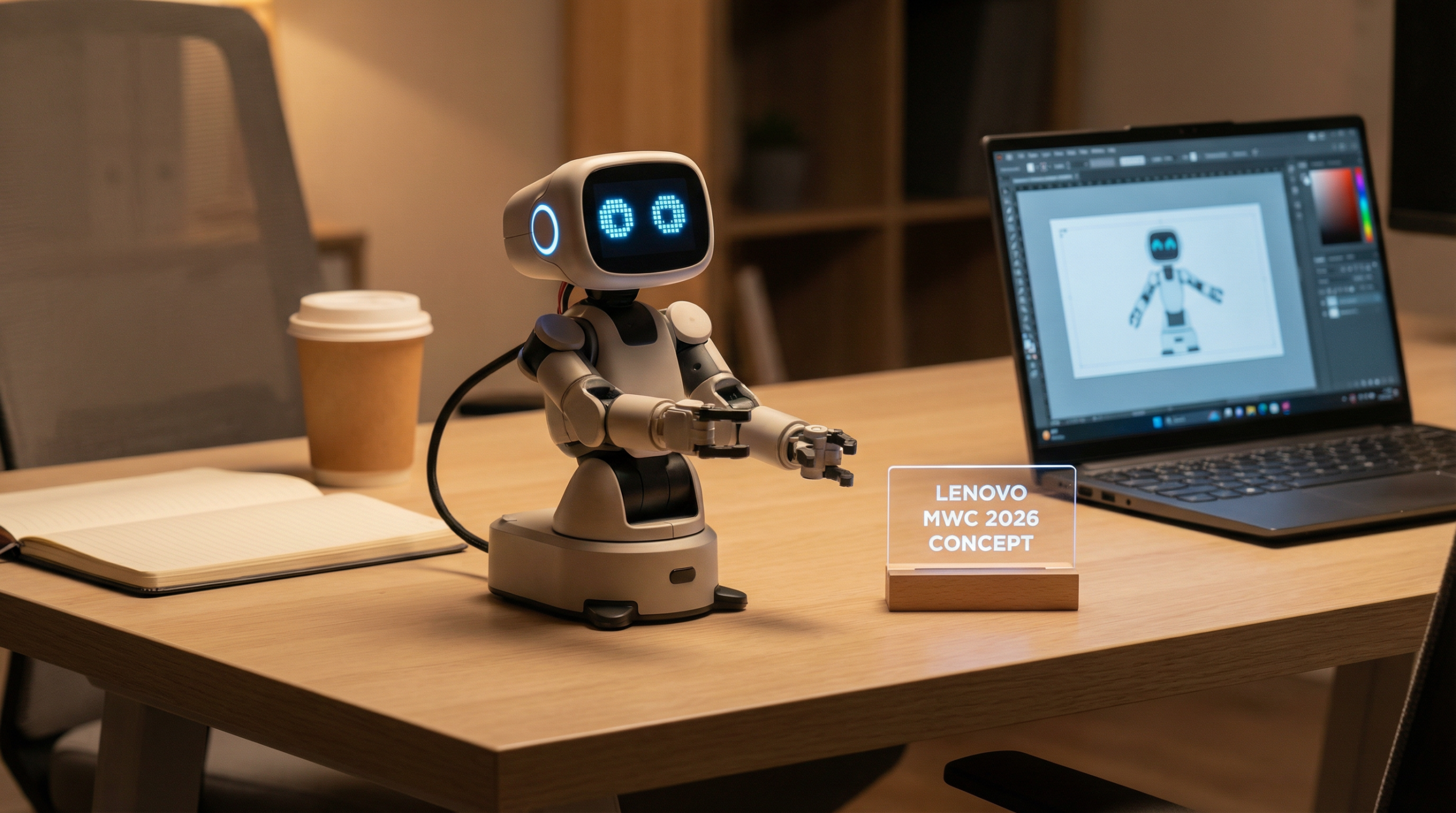
Lenovo thinks your desk needs a robot companion — and they might be right. At MWC 2026, the company unveiled two AI-powered concept devices designed to sit on your desk and boost productivity: the Lenovo AI Workmate Concept, a robotic arm with an expressive screen displaying puppy dog eyes, and the AI Work Companion Concept, a smart desk hub that manages your schedule and fights burnout. Both are concepts, not products you can buy yet — but Lenovo has a solid track record of turning concepts into real things.
AI Workmate Concept: Your Robotic Desk Buddy
The AI Workmate is the one that’s turning heads. Picture a small robotic arm mounted on a swiveling base, with a 3.4-inch LCD screen on the end displaying animated puppy dog eyes. Those eyes aren’t just cute — they’re functional, flickering with different expressions to indicate whether the device is listening, thinking, or reacting to your input.
Here’s what it actually does:
- Voice interaction: You talk to it like a smart assistant, powered by local AI processing
- Gesture recognition: It responds to physical gestures, not just voice commands
- Document scanning: A camera below the screen can scan handwritten notes and documents
- AI summarization: Scanned documents are automatically summarized and organized
- Presentation generation: Turn your notes directly into slide presentations
- Built-in projector: Project documents onto your desk or a nearby wall
The robotic arm gives the Workmate a physical presence that regular smart speakers lack. It can turn to face you when you speak, look at documents you’re showing it, and use the projector to display information exactly where you need it. Lenovo describes it as an “always-on desk companion” — think of it as a more capable and charismatic voice assistant with eyes and a body.
AI Work Companion Concept: The Anti-Burnout Hub
The second concept takes a different approach. The AI Work Companion looks like a bedside alarm clock with a large screen, but it’s designed to be a productivity and wellness hub for your office desk.
Its primary function is schedule management. The Companion syncs tasks and calendars from all your devices and uses AI to generate a balanced daily plan. But the interesting twist is the wellness angle — it actively monitors your screen time and suggests breaks throughout the day to prevent burnout.
Additional features include:
- Animated faces for playful interactions throughout the workday
- End-of-week celebrations with reports of completed tasks
- Laptop dock functionality: HDMI output to multiple displays
- USB hub: Multiple ports for charging and connecting peripherals
- Desktop decluttering: Reduces the need for separate docks and hubs
By combining a docking station with an AI schedule manager, Lenovo is trying to solve the “too many devices on the desk” problem while adding intelligence to the mix.
Why Desk Robots Matter More Than You Think
On the surface, a robot arm with puppy eyes sounds like a solution looking for a problem. But there’s a real trend here that Lenovo is tapping into.
The modern knowledge worker interacts with AI through screens — typing prompts into ChatGPT, talking to Alexa, or clicking through smart home automations. All of these interactions are fundamentally disembodied. You’re talking to a speaker or typing into a box.
Lenovo is betting that giving AI a physical form factor — even a simple one — changes how people interact with it. The puppy dog eyes aren’t just cute; they provide visual feedback that a voice-only assistant can’t. You can see when it’s thinking, when it’s listening, when it understands. That feedback loop makes the interaction more natural and, frankly, more engaging.
This same philosophy drives the growing interest in humanoid robots and the broader trend of embodied AI. Lenovo is just applying it to the desk instead of the living room or factory floor.
The document scanning and projection features are also practical for a real office scenario. Imagine scanning a whiteboard, having AI summarize the key points, and immediately projecting an organized version onto your desk. That’s a workflow improvement that doesn’t require changing how you work — it just makes existing workflows faster.
Will These Actually Ship?
This is the big question. Lenovo has a better track record than most with concept-to-product conversions. The ThinkBook Plus Gen 6 with its rollable extending screen was shown as a concept and actually launched as a real product in 2025. That gives these concepts more credibility than the typical “look what we made for the trade show” demos.
However, Lenovo has not confirmed that either the AI Workmate or the AI Work Companion will become commercial products. They’re officially “concepts” — which in tech-speak means “we built this to gauge interest and test the technology.”
If they do ship, expect them to land in Lenovo’s ThinkBook or ThinkCentre product lines, targeting enterprise and business users rather than consumers. The document scanning, presentation generation, and docking features clearly point toward professional use cases.
The Competition
Desktop AI companions are an emerging category with few direct competitors:
- Amazon Echo Show: Has a screen and camera but no robotic movement — it’s a stationary smart display
- Samsung Ballie: A rolling robot companion shown at CES, but it’s designed for the home, not the office
- Various Chinese desk robots: Emo and similar products offer personality-driven desk robots, but without the productivity features Lenovo is targeting
Lenovo’s approach is unique in combining productivity tools (scanning, projection, docking) with the emotional engagement of an expressive robot form factor. It’s not just a toy — it’s a tool that happens to have puppy eyes.
The Bottom Line
Lenovo’s MWC 2026 concepts are equal parts adorable and practical. The AI Workmate’s robotic arm with expressive eyes represents a genuinely different approach to desktop AI interaction — one that goes beyond voice commands and screen taps to include physical presence and visual feedback.
Whether these become real products depends on market response and Lenovo’s internal priorities. But the underlying idea — that AI assistants should have a physical form, not just a voice — is one that the entire tech industry is moving toward. Lenovo is just getting there from the desk instead of the factory floor.
Source: The Verge
