


Quick Answer
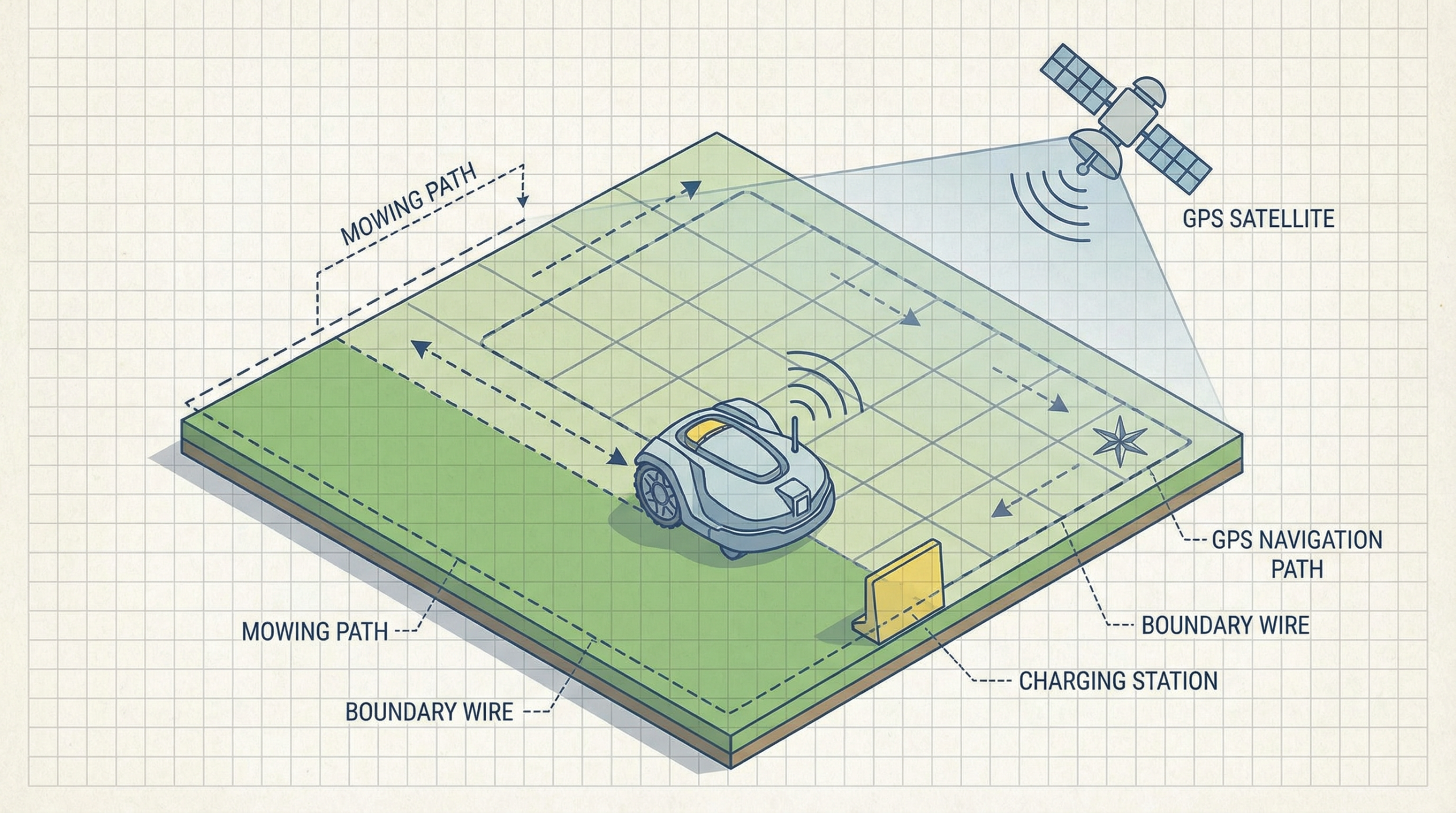
Robot mowers use three main navigation systems: boundary wire (magnetic field detection, 90% of models), GPS positioning (satellite-based mapping, premium models), and RTK-GPS (centimeter-accurate surveying, newest technology). Wire systems cost less but require installation, GPS enables advanced patterns but needs clear sky view, while RTK eliminates wires entirely with professional-grade accuracy. Each system affects cutting patterns, installation complexity, and overall performance.
This article contains affiliate links. TheRoboWire may earn a commission on qualifying purchases at no extra cost to you. See our affiliate disclosure for details.
The Evolution of Robot Mower Navigation
Robot mower navigation has evolved dramatically since the first Husqvarna® Automower debuted in 1995. Early models relied purely on bump sensors and random cutting patterns, resulting in uneven coverage and frequent stuck situations. Modern systems combine multiple navigation technologies to achieve systematic cutting patterns and reliable autonomous operation.
Understanding navigation technology helps buyers select appropriate models for their specific yard conditions and maintenance preferences. Each system offers distinct advantages and limitations that significantly impact user experience and cutting performance.
Professional landscapers increasingly specify robot mowers based on navigation capabilities, recognizing that proper navigation ensures consistent results and reduces service calls. The technology choice affects everything from installation complexity to long-term reliability.
Boundary Wire Navigation: The Foundation Technology
Boundary wire systems form the backbone of most robot mower navigation, used in approximately 90% of current models. This proven technology creates electromagnetic perimeters that define cutting areas and protect landscaping features from mower damage.
How Boundary Wire Works:
The charging station generates a low-frequency electromagnetic signal (typically 1-10 kHz) that travels through the boundary wire loop. The robot mower contains electromagnetic sensors that detect this signal strength and direction, enabling precise perimeter following and obstacle avoidance.
Signal strength varies with distance from the wire, providing gradient information that helps the mower maintain optimal cutting patterns. When signal strength drops below threshold levels, the robot recognizes it has reached the boundary and executes a turn sequence to remain within the designated area.
Advanced boundary wire systems can create multiple zones with different signal frequencies, enabling complex cutting schedules and area-specific maintenance programs.
Installation Requirements:
Boundary wire installation typically requires 2-6 hours for average residential properties, depending on complexity and obstacle density. Professional installation costs $200-500 but ensures optimal signal coverage and system reliability.
Wire can be laid on the surface temporarily or buried 1-2 cm underground for permanent installation. Surface installation enables easy modifications but increases damage risk from foot traffic or maintenance equipment.
Obstacle wires create no-go zones around flower beds, trees, and delicate landscaping features. These secondary loops use the same signal but create exclusion areas that the robot automatically avoids.
Advantages:
- Proven reliability with over 25 years of development
- Works in all weather conditions and lighting
- Supports complex yard layouts with multiple zones
- Lower cost compared to GPS-based systems
- Minimal ongoing maintenance requirements
Limitations:
- Installation time and complexity
- Wire damage from landscaping activities
- Limited flexibility for layout changes
- Signal interference from electrical equipment
- Difficulty with temporary seasonal modifications
GPS Navigation: Satellite-Guided Precision
GPS navigation systems utilize satellite positioning to create sophisticated cutting patterns and enable advanced mapping capabilities. Premium models from Husqvarna, Gardena®, and other manufacturers incorporate GPS as a supplementary navigation aid rather than primary guidance.
GPS Integration Methods:
Most GPS-enabled robot mowers use satellite positioning alongside boundary wire systems to optimize cutting patterns and prevent repetitive tracking. The GPS creates virtual maps of the cutting area and ensures systematic coverage without missing areas or over-cutting specific zones.
Advanced algorithms analyze GPS data to identify high-traffic areas, seasonal growth patterns, and optimal cutting schedules. This intelligence enables automatic adjustment of cutting frequency based on grass growth rates and weather conditions.
GPS anti-theft features provide real-time location tracking and alert systems when robots are moved outside designated areas. This capability is particularly valuable for unsecured installations or high-theft areas.
Cutting Pattern Optimization:
GPS enables sophisticated cutting patterns that minimize wheel tracking and promote healthier grass growth. Traditional random patterns can create visible wear tracks, while GPS-guided systematic patterns ensure even coverage.
Spiral cutting patterns work outward from central points, ensuring complete coverage while minimizing directional bias. Parallel cutting patterns similar to traditional mowing create professional appearance but require careful edge handling.
Weather-adaptive patterns adjust cutting frequency and direction based on precipitation, temperature, and seasonal growth rates. These algorithms can extend battery life while maintaining optimal cutting quality.
Technical Requirements:
GPS navigation requires clear satellite reception with minimal interference from trees, buildings, or weather conditions. Performance degrades significantly under heavy cloud cover or in areas with limited sky visibility.
Most systems require 4-8 satellite connections for reliable positioning, with accuracy typically ranging from 1-3 meters. This precision is sufficient for cutting pattern optimization but inadequate for precise boundary detection.
Battery consumption increases with GPS operation, potentially reducing cutting time by 10-15% compared to wire-only systems. However, improved cutting efficiency often compensates for reduced runtime.
RTK-GPS: Professional-Grade Accuracy
Real-Time Kinematic GPS represents the cutting edge of robot mower navigation, providing centimeter-level positioning accuracy that eliminates boundary wire requirements entirely. This professional surveying technology is becoming accessible in consumer robot mowers.
RTK Technology Principles:
RTK-GPS uses base station corrections to achieve positioning accuracy within 1-2 centimeters, compared to standard GPS accuracy of 1-3 meters. This precision enables virtual boundary creation and obstacle avoidance without physical infrastructure.
The system combines satellite positioning with ground-based correction signals transmitted from nearby base stations or cellular networks. Real-time corrections compensate for atmospheric interference and satellite clock errors that limit standard GPS accuracy.
Multi-constellation support includes GPS, GLONASS, Galileo, and BeiDou satellites for improved reliability and faster position fixes. This redundancy ensures operation even with partial satellite blockage from trees or buildings.
Implementation Examples:
The Husqvarna Automower® 550 EPOS pioneered consumer RTK implementation with professional-grade positioning and virtual boundary creation. Users define cutting areas by walking the perimeter with a smartphone, eliminating wire installation entirely.
LUBA™ 2 AWD uses Multi-Fusion RTK combining satellite positioning with computer vision for enhanced reliability. The vision system provides backup navigation when satellite signals are temporarily blocked.
Professional installations can utilize permanent RTK base stations for multiple robot coordination and fleet management. This approach enables large-scale commercial applications with centralized monitoring and control.
Virtual Boundary Creation:
RTK systems create virtual boundaries through smartphone apps that record GPS coordinates while walking the desired perimeter. These virtual boundaries can be modified instantly without physical infrastructure changes.
No-go zones and seasonal areas are easily configured through mobile apps, enabling temporary modifications for landscaping projects or seasonal decorations. Changes take effect immediately without tools or technical knowledge.
Multi-zone management enables different cutting schedules and grass height settings for various yard areas. Sports areas might require shorter cutting heights while ornamental areas use longer settings.
Computer Vision and Camera Systems
Advanced robot mowers increasingly incorporate computer vision systems that complement GPS and wire navigation with optical obstacle detection and terrain analysis. These systems represent the future of autonomous mowing technology.
Vision System Components:
Forward-facing cameras capture real-time images of the cutting path, enabling identification of obstacles, terrain features, and grass conditions. Advanced models use multiple cameras for 360-degree awareness.
Machine learning algorithms process visual data to distinguish between permanent obstacles (trees, structures) and temporary objects (toys, branches) that require different avoidance strategies.
Depth perception systems using stereo cameras or LiDAR provide three-dimensional environmental mapping for complex obstacle navigation and slope detection.
Practical Applications:
Vision systems excel at detecting irregular obstacles that traditional sensors might miss, such as garden hoses, low branches, or decorative elements. This capability reduces damage and improves cutting reliability.
Grass condition analysis enables automatic adjustment of cutting height and speed based on growth density and moisture levels. Sparse areas receive lighter treatment while thick growth gets additional attention.
Weather adaptation uses visual cues to assess ground conditions and modify operation accordingly. Wet grass detection prevents damage and ensures optimal cutting quality.
Sensor Fusion: Combining Multiple Technologies
Modern robot mowers employ sensor fusion, combining multiple navigation technologies to achieve superior performance and reliability compared to any single system. This approach provides redundancy and optimization across varying conditions.
Integration Strategies:
Primary navigation might use boundary wire for basic guidance while GPS optimizes cutting patterns and provides theft protection. This hybrid approach combines proven reliability with advanced features.
Computer vision supplements other systems during complex obstacle navigation or when primary signals are compromised. Visual backup ensures continued operation in challenging conditions.
Inertial measurement units (IMUs) provide precise orientation and movement data that enhance all other navigation systems. Gyroscopes and accelerometers detect slope changes and movement patterns.
Adaptive Algorithms:
Machine learning systems analyze performance data to optimize navigation strategies for specific yard conditions. These algorithms improve over time as they learn optimal cutting patterns and obstacle locations.
Seasonal adaptation modifies behavior based on grass growth patterns, weather conditions, and usage requirements. Winter storage preparation and spring startup optimization reduce maintenance requirements.
Error correction systems automatically compensate for sensor drift, signal interference, or temporary navigation failures. Multiple system redundancy ensures continued operation even with component failures.
Comparing Navigation Performance
| Navigation Type | Accuracy | Installation Time | Cost Impact | Reliability | Flexibility |
|---|---|---|---|---|---|
| Boundary Wire | ±10-20 cm | 2-6 hours | Baseline | Excellent | Moderate |
| GPS Enhanced | ±1-3 meters | 2-4 hours | +$300-800 | Good | High |
| RTK-GPS | ±1-2 cm | 30-60 minutes | +$800-2000 | Excellent | Very High |
| Computer Vision | ±5-15 cm | 1-2 hours | +$500-1500 | Good | High |
| Sensor Fusion | ±1-5 cm | 1-3 hours | +$1000-3000 | Superior | Very High |
Troubleshooting Navigation Issues
Understanding common navigation problems enables quick resolution and optimal performance from robot mower systems regardless of technology type.
Wire System Issues:
Signal interference from electrical equipment, irrigation systems, or metal objects can disrupt boundary wire operation. Relocating wire away from interference sources typically resolves these problems.
Wire breaks from landscaping activities or animal damage create gaps in the electromagnetic field. Wire break detectors and careful routing prevent most damage incidents.
Connector corrosion affects signal transmission and causes intermittent operation. Weather-resistant connectors and periodic inspection prevent connection failures.
GPS Problems:
Satellite signal blockage from trees, buildings, or weather reduces positioning accuracy and may cause navigation errors. Clearing sight lines or waiting for improved conditions restores functionality.
Atmospheric interference affects GPS accuracy during solar storms or severe weather. These temporary conditions typically resolve within hours without intervention.
Multipath errors from signal reflection off buildings or metal structures can cause position drift. Antenna positioning and signal filtering minimize these effects.
Vision System Challenges:
Lighting conditions significantly affect camera performance, with very bright or dark conditions reducing obstacle detection accuracy. Automatic exposure control and infrared capabilities help address lighting issues.
Lens contamination from grass clippings, mud, or weather reduces vision system effectiveness. Regular cleaning and protective covers maintain optical clarity.
Processing limitations may cause delays in complex environments with many obstacles. Adequate computing power and optimized algorithms prevent performance issues.
Future Navigation Developments
Robot mower navigation continues evolving with emerging technologies that promise even greater autonomy and performance. Understanding development trends helps inform purchasing decisions and long-term planning.
5G and Edge Computing:
Next-generation cellular networks enable real-time communication between robot mowers and cloud-based artificial intelligence systems. This connectivity provides access to weather data, traffic information, and coordinated operation with other garden equipment.
Edge computing capabilities allow complex processing tasks to be performed locally while maintaining cloud connectivity for updates and optimization. This approach reduces latency while preserving advanced features.
Artificial Intelligence Integration:
Machine learning algorithms are becoming more sophisticated, enabling prediction of optimal cutting schedules based on grass species, weather patterns, and usage requirements. These systems learn from experience and improve performance over time.
Natural language processing may enable voice control and conversational interaction with robot mowers through smart home systems and mobile assistants.
Swarm Intelligence:
Multiple robot coordination enables larger properties to be maintained by fleets of smaller, specialized units. Swarm algorithms optimize coverage and reduce individual robot complexity while improving overall performance.
FAQ
Do robot mowers with GPS work without internet connections?
Yes, GPS satellites provide positioning signals independently of internet connectivity. However, advanced features like weather integration, remote monitoring, and software updates require internet access. Basic GPS navigation and cutting patterns function offline, but smart features need connectivity for optimal performance.
Can boundary wire systems be damaged by lawn care activities?
Boundary wires can be damaged by aggressive aerating, power raking, or deep cultivation. Surface-laid wire is more vulnerable than buried installation. Most damage occurs during spring cleanup or renovation projects. Using wire detectors and marking wire locations prevents accidental damage during maintenance.
How accurate is RTK-GPS compared to survey equipment?
Consumer RTK-GPS systems achieve 1-2 centimeter accuracy, comparable to entry-level surveying equipment. Professional survey instruments may achieve sub-centimeter accuracy but cost significantly more. RTK accuracy is more than sufficient for robotic mowing applications and virtual boundary definition.
What happens when GPS signals are blocked by trees or buildings?
GPS-only systems may experience navigation errors or stop functioning in areas with poor satellite reception. Hybrid systems using boundary wire backup continue operating normally. Advanced systems with sensor fusion use alternative navigation methods until GPS signals return. Most quality systems handle temporary signal loss gracefully.
Can I modify virtual boundaries after initial setup?
RTK and GPS systems allow easy boundary modifications through mobile apps without physical work. Changes typically take effect immediately. Wire-based systems require physical wire relocation for boundary changes. Virtual systems excel for seasonal modifications, temporary no-go zones, or landscape changes.
Which navigation system is most reliable in all weather conditions?
Boundary wire systems provide most consistent performance across all weather conditions since they don’t rely on satellite signals or optical systems. GPS performance can degrade during heavy cloud cover or precipitation. Computer vision systems struggle with fog, heavy rain, or snow. Sensor fusion systems provide best overall reliability by combining multiple technologies.
