


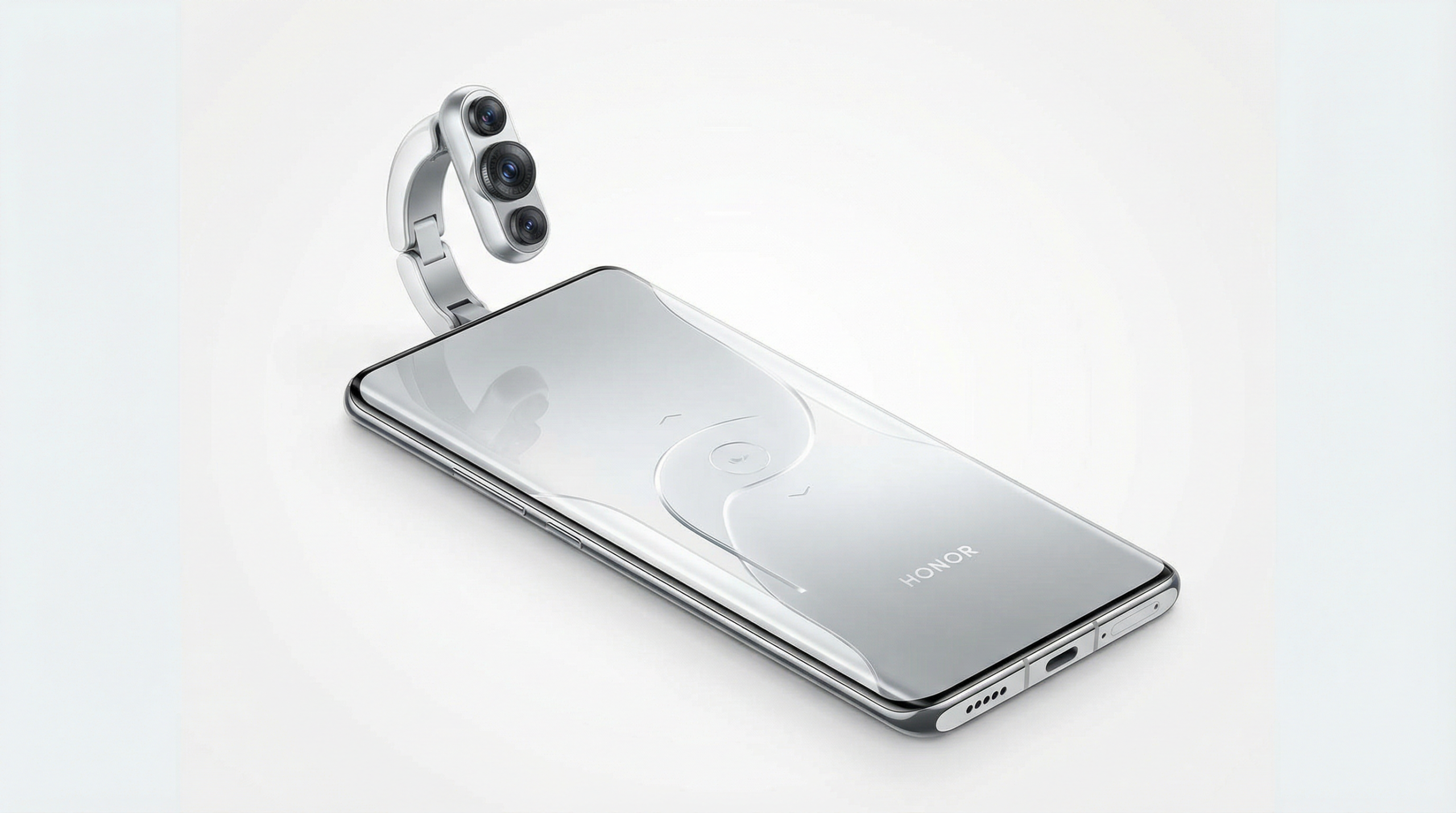
Honor just unveiled the weirdest — and possibly most innovative — smartphone concept at MWC 2026. The Honor Robot Phone features a camera that physically moves, tracks subjects, dances to music, and even nods or shakes its head in response to your questions. It sounds like a gimmick until you see what the engineering actually enables. Honor says it’s launching in the second half of 2026.
What Exactly Is the Honor Robot Phone?
At its core, the Honor Robot Phone is a smartphone with a 200-megapixel camera mounted on a three-axis gimbal arm that can physically rotate, tilt, and pan independently of the phone body. Think of it as a motorized camera on a stick — except the stick is the world’s smallest micro motor system, and it’s built into a phone.
Key technical specs of the robotic camera system:
- 200MP main camera on a motorized three-axis gimbal
- Four degrees of freedom for movement
- World’s smallest micro motor developed by Honor specifically for this device
- 2800 MPa tensile strength materials — same as the Honor Magic V6’s hinge
- AI-powered subject tracking trained on millions of scene simulations
- Super Steady mode for video stabilization
- Spinshot feature — 90° or 180° camera rotation for cinematic shots
The gimbal arm doesn’t just stabilize footage like a software solution would. It physically moves the camera lens to follow subjects, compensate for hand shake, and create dynamic shots that would normally require dedicated filmmaking equipment.
More Than a Gimmick: Real-World Use Cases
The “dancing camera” headline is fun, but the practical applications are where this gets interesting. Honor demonstrated several scenarios at MWC that go beyond party tricks:
Video calls with real tracking: During a video call, the robotic camera follows you as you move around the room. If you’ve used Apple’s Center Stage or Google’s similar feature, imagine that — but with physical camera movement instead of digital cropping. The result is a wider effective field of view without losing resolution, since the camera actually points at you rather than cropping a wide-angle feed.
Baby and pet monitoring: Set the phone down and the camera tracks movement autonomously. It’s essentially turning your phone into a security camera with mechanical pan-and-tilt, similar to dedicated home monitoring devices but using your phone’s superior processing and camera hardware.
Cinematic content creation: The Spinshot feature rotates the camera 90° or 180° during recording, creating smooth rotation shots that typically require a motorized gimbal rig. For content creators, this could replace hundreds of dollars worth of accessory equipment.
AI-powered personality: This is the wildest part. Honor has programmed the camera arm with emotional responses. Ask it a question through the voice assistant, and the camera nods for yes or shakes for no. Play music, and it dances to the beat. It can react to your mood and respond with head movements. It’s part phone, part desk companion — blurring the line between smartphone and personal robot.
The Engineering Behind It
Fitting a four-degree-of-freedom gimbal system inside a phone body is genuinely difficult engineering. Honor says it borrowed techniques from its foldable phone division — specifically the hinge mechanisms used in the Honor Magic V6 — to make the robotic arm both compact and durable.
The micro motor that powers the camera movements is described as the world’s smallest of its kind. Honor trained the AI tracking system on millions of simulated scenes so the camera can anticipate subject movement rather than just react to it. That’s a meaningful distinction — predictive tracking means smoother footage with fewer jerky corrections.
The materials choice matters too. At 2800 MPa tensile strength, the arm components are built to withstand the repeated stress of constant movement without degrading over time. This is the same concern that plagues foldable phone hinges, so Honor’s experience in that space clearly informed the design.
Competition and Context
No other smartphone manufacturer has attempted anything quite like this. The closest comparisons are:
- ASUS ZenFone with flip camera: Had a motorized camera module that flipped from rear to front, but with limited movement range
- Samsung Galaxy S series: Uses software-based subject tracking with digital crop — no physical movement
- DJI Osmo Pocket: A dedicated gimbal camera, not a phone — but achieves similar physical stabilization
Honor is essentially trying to merge the smartphone and the gimbal camera into one device. It’s a bold bet at a time when most smartphone innovation has stagnated around incremental camera sensor upgrades and AI photo processing.
At MWC 2026, Honor also launched the Magic V6 foldable, the MagicPad 4 tablet, and the MagicBook 14 laptop. But it was the Robot Phone that dominated the show floor conversation — Mashable, ZDNET, and CNBC all flagged it as one of the standout devices of the event.
Availability and Pricing
Honor confirmed a second half of 2026 launch window. No specific markets or pricing have been announced yet. Given Honor’s positioning as a premium-but-accessible brand (cheaper than Samsung flagships, more premium than budget Chinese brands), expect pricing in the $800–$1,200 range — comparable to flagship competitors but with a unique hardware differentiator.
The phone will presumably launch first in China before expanding to global markets, following Honor’s typical release pattern.
The Bottom Line
The Honor Robot Phone is either the future of smartphone cameras or a fascinating dead end — and we won’t know which until real users get their hands on it. The engineering is impressive, the use cases are legitimate, and the emotional personality features add a layer of interaction we haven’t seen in phones before.
What makes this genuinely interesting isn’t the dancing. It’s the convergence of robotics, AI tracking, and smartphone technology into a single pocket-sized device. If Honor executes well on durability and software polish, this could start a new category. If not, it’ll still be the most interesting thing at MWC 2026.
Source: TechCrunch
