


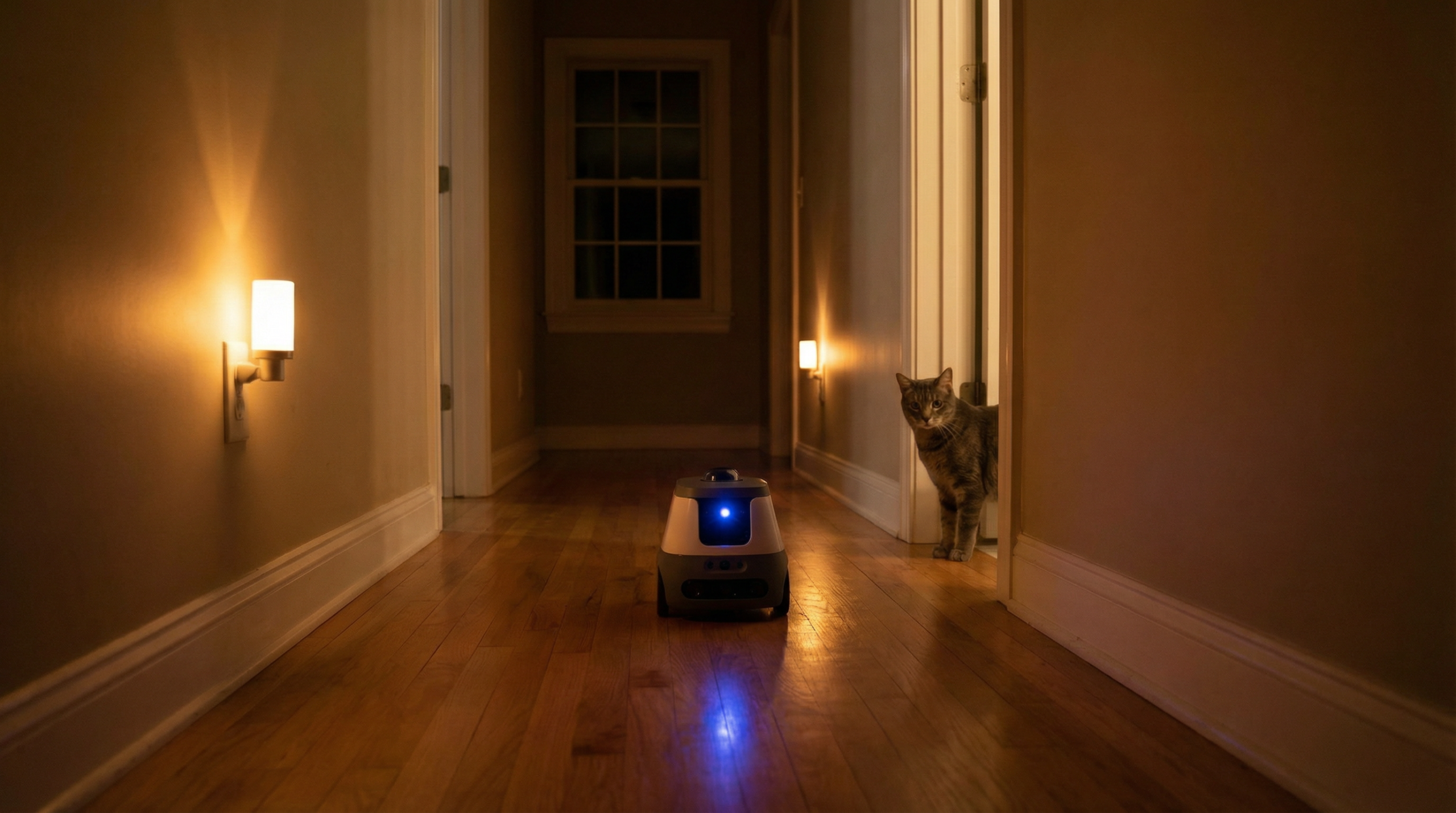
Beyond Cameras: How Robots Are Changing Home Security
Home security has followed the same formula for decades: mount cameras, add sensors on doors and windows, connect to a monitoring service, and hope for the best. In 2026, a new category of security device is changing the equation — home security robots. These autonomous machines patrol your property, detect intrusions, investigate anomalies, and provide a physical deterrent that fixed cameras simply can’t match.
From Amazon’s flying indoor drone to outdoor patrol robots and AI-powered camera systems, this guide explores the evolving world of robotic home security — what’s available, what actually works, and whether these devices deserve a place in your home protection strategy.
Why Fixed Cameras Have Limitations
Traditional security cameras are effective but inherently limited. They only cover fixed angles, creating blind spots. They can be defeated by simple countermeasures — a well-placed sticker or spray paint renders a camera useless. They can’t investigate — a camera sees a shadow move in the backyard but can’t go check if it’s a raccoon or an intruder. And they generate enormous amounts of footage that’s tedious to review.
Security robots address these limitations by adding mobility, AI-driven analysis, and in some cases, active deterrence. A robot can patrol different areas at different times, investigate alerts autonomously, and position itself for the best view of any situation.
Indoor Security Robots
Amazon Ring Always Home Cam
Amazon’s Ring Always Home Cam is perhaps the most ambitious consumer security robot — a small autonomous drone that flies through your home to check on things. Originally announced in 2020 and finally reaching broader availability, the device lives in a charging dock and launches when triggered by a Ring Alarm event or user command.
The drone flies predetermined paths through your home, streaming live 1080p video to your phone. It can check every room in minutes, something that would require a camera in every room with a traditional setup. When not flying, it sits in its dock with the camera physically blocked for privacy.
Pros: Covers your entire home with a single device, physical camera shutter when docked ensures privacy, integrates with the Ring ecosystem.
Cons: Noise during flight (it sounds like a large insect), limited flight time per charge, can’t navigate stairs between floors, requires clear flight paths (not ideal for cluttered homes), subscription required for video storage.
Price: ~$250
Samsung Ballie
Samsung’s Ballie, first teased at CES 2020 and progressively refined, is a rolling spherical robot with a built-in projector and camera. While not positioned exclusively as a security device, Ballie includes home monitoring capabilities: it can patrol your home autonomously, detect unusual activity, send alerts with video clips, and even project security warnings (like a fake TV flickering effect to simulate occupancy when you’re away).
Ballie’s broader smart home integration means it also serves as a companion robot, projector for entertainment, and smart home controller. This multi-purpose approach may appeal to users who want security features without a dedicated security device.
Pros: Multi-functional beyond just security, built-in projector, rolls on floors without flight noise, Samsung ecosystem integration.
Cons: Premium price point, limited availability, can’t handle stairs, still early in commercial deployment.
Robot Vacuums as Security Devices
Several robot vacuum brands have added security-adjacent features. Roborock’s camera-equipped models can provide remote video viewing through the app. Ecovacs has promoted its robots’ ability to patrol and monitor when not cleaning. While these aren’t dedicated security devices, they offer a degree of indoor monitoring for people who already own them.
However, using your robot vacuum as a security camera raises significant privacy concerns. The cameras on these devices aren’t designed with the same security hardening as dedicated security cameras, and having an always-accessible camera rolling around your home creates unique vulnerabilities.
Outdoor Security Robots
Sunflower Labs Home Awareness System
Sunflower Labs offers one of the most comprehensive outdoor security robot systems. The system includes ground-embedded sensors that detect motion and vibration around your property’s perimeter, and an autonomous drone (the Bee) that launches from a hive-like charging station to investigate alerts.
When sensors detect something, the drone automatically flies to the location, streams HD video to your phone, and follows the activity with AI-powered tracking. The system can differentiate between animals, people, and vehicles, reducing false alarms. After investigating, the drone returns to its hive to recharge.
Pros: Comprehensive perimeter coverage, autonomous investigation, reduces false alarms through AI analysis, significant deterrent effect.
Cons: Very expensive ($9,500+ for the complete system), requires professional installation, weather limitations (high winds, heavy rain), regulatory considerations for drone flight in some jurisdictions, limited to properties with adequate space.
Ring Car Cam and Astro
Amazon’s Astro robot, originally designed as a home companion, has evolved to include security features. Astro can patrol your home on a schedule, streaming video and detecting unusual sounds or activity. When paired with Ring’s security ecosystem, it provides intelligent alerts and can investigate disturbances autonomously.
The robot navigates using a combination of cameras, depth sensors, and SLAM (Simultaneous Localization and Mapping) technology. It learns your home’s layout and can move between rooms, avoiding obstacles and pets. A periscoping camera extends to see over countertops and tables.
Pros: Integrates with Ring/Alexa ecosystem, navigates autonomously, periscoping camera for elevated views, serves multiple purposes beyond security.
Cons: Indoor only (can’t handle stairs without help), significant privacy considerations, high price point, limited availability.
Knightscope K1 and K3
While primarily designed for commercial security (shopping malls, corporate campuses, parking lots), Knightscope’s autonomous security robots represent the cutting edge of robotic patrol. The K3 is a 5-foot-tall, 400-pound autonomous robot that patrols outdoor areas using a suite of sensors including 360-degree cameras, thermal imaging, LIDAR, weather sensors, and license plate recognition.
Knightscope robots operate as a service (Robot-as-a-Service), with clients paying approximately $6-$12 per hour for robotic patrol — less than human security guard wages in most markets. While not designed for residential use, the technology demonstrates where outdoor security robots are heading.
Relevance to homeowners: Community versions of patrol robots are beginning to appear in gated communities and HOA-managed neighborhoods. Within a few years, shared patrol robot services could be a viable security option for residential areas.
AI-Powered Camera Systems: Robots Without Bodies
What Counts as a “Security Robot”?
The line between smart security cameras and security robots is blurring. Modern AI-powered cameras can pan, tilt, and zoom autonomously to follow detected movement. They use neural networks to distinguish between people, animals, vehicles, and packages. They can coordinate multiple cameras to track a person moving through your property. And they can make autonomous decisions about when to alert you, when to activate deterrents, and when to ignore a false alarm.
In many ways, these systems exhibit robotic behavior without robotic bodies — and for many homeowners, they may be more practical than a physical security robot.
Notable AI Camera Systems
Google Nest Cam with AI: Google’s cameras use on-device machine learning for person detection, face recognition, and activity zones. The system can recognize familiar faces and alert you only to unfamiliar visitors. Integration with Google Home enables automated responses — turning on lights, sounding alarms, or activating sprinklers when an intruder is detected.
Ring Spotlight and Floodlight Cameras: Ring’s outdoor cameras combine motion detection, two-way audio, bright lights, and a siren. The AI can differentiate between people and other motion sources. The Ring Alarm Pro adds an Eero mesh router with built-in security monitoring, creating a unified network and security platform.
Arlo Pro with AI: Arlo’s wire-free cameras use AI to detect people, animals, vehicles, and packages. The Arlo Smart subscription adds advanced features like activity zones, e911 emergency calling, and 30-day cloud recording. The Arlo Essential Indoor Camera can pan and tilt to follow detected movement.
DIY Security Robot Options
Robot Vacuum + Camera Integration
Some tech-savvy homeowners repurpose robot vacuums with cameras as mobile security devices. By scheduling the robot to run at specific times (especially when away from home), they get periodic video coverage of their home’s interior. This isn’t a replacement for dedicated security, but it’s a creative add-on.
Open-Source and Maker Projects
For hobbyists, platforms like ROS (Robot Operating System) combined with affordable hardware (Raspberry Pi, Arduino, NVIDIA Jetson) enable custom security robot builds. These projects can include autonomous patrol robots using LIDAR navigation, camera drones with automated launch and patrol capabilities, sensor networks with mobile robot investigation, and AI-powered analysis using open-source computer vision.
While these projects require significant technical skill, they offer unmatched customization and avoid the privacy concerns of cloud-connected commercial products.
Privacy Concerns with Security Robots
The Camera Everywhere Problem
Mobile security cameras raise unique privacy considerations that fixed cameras don’t. A robot that patrols your home has the potential to capture intimate moments in every room. Cloud-connected robots transmit this footage over the internet, creating hacking risks. Family members, houseguests, and domestic workers may feel uncomfortable with a mobile camera in the home.
Data Storage and Access
Most security robots require cloud subscriptions for video storage and AI processing. This means your home video footage is stored on corporate servers, accessible to the company’s employees (potentially) and to law enforcement (with a warrant or, in some cases, without one). Understanding each company’s data policies is essential before deploying a security robot.
Best Practices for Privacy
- Choose devices with physical camera shutters or privacy modes
- Set clear boundaries — designate certain rooms as off-limits for patrol
- Inform all household members and regular visitors about security robots
- Review and understand the manufacturer’s data retention policies
- Consider local-only storage options when available
- Regularly review and delete stored footage
- Keep firmware updated to patch security vulnerabilities
Effectiveness: Do Security Robots Actually Deter Crime?
The Deterrent Effect
Research on traditional security cameras shows a significant deterrent effect — visible cameras reduce property crime by 13-50% depending on the study. Security robots, with their visible presence and active patrol behavior, likely enhance this deterrent. The psychological impact of a robot that actively tracks and follows suspicious behavior is greater than a passive camera.
Knightscope reports that their commercial security robots have been associated with crime reductions of 46-70% at deployment locations, though these figures should be treated with caution as they come from the manufacturer.
Response Capabilities
Unlike fixed cameras that can only record, security robots can take active measures such as sounding sirens and alarms, activating bright lights, broadcasting warnings through speakers (two-way audio), following and tracking intruders while streaming video to authorities, and providing real-time aerial or ground-level views to responding police.
Limitations
Security robots cannot physically intervene. They can detect, deter, and document, but they can’t stop an intruder. Battery life limits patrol duration. Weather affects outdoor robots. And sophisticated criminals can potentially defeat or disable robotic systems.
Cost Analysis: Security Robots vs Traditional Systems
Traditional Security System
- 4-8 cameras: $200-$600
- Alarm system: $200-$500
- Professional monitoring: $15-$45/month ($180-$540/year)
- Installation: $100-$500
- Total Year 1: $680-$2,140
Security Robot (Indoor)
- Ring Always Home Cam: $250
- Ring Protect subscription: $4-$20/month ($48-$240/year)
- Complementary cameras/sensors: $100-$300
- Total Year 1: $398-$790
Security Robot (Outdoor/Premium)
- Sunflower Labs system: $9,500+
- Professional installation: included
- Ongoing subscription: varies
- Total Year 1: $10,000+
For most homeowners, a combination approach makes the most sense: traditional cameras and sensors for comprehensive coverage, supplemented by one or two robotic devices for investigation and deterrence in key areas.
The Future of Home Security Robots
Near-Term (2026-2028)
Expect more affordable indoor patrol robots from major brands, better AI that significantly reduces false alarms, tighter integration with existing smart home platforms through Matter, and improved battery life and quieter operation.
Medium-Term (2028-2032)
Outdoor patrol robots will become viable for residential use, multi-robot systems will coordinate for comprehensive coverage, AI will enable predictive security (identifying potential threats before they escalate), and costs will drop to consumer-friendly levels.
Long-Term (2032+)
Humanoid security robots that can physically interact with the environment (locking doors, investigating sounds), fully autonomous outdoor patrols with drone and ground robot coordination, neighborhood-scale shared security robot services, and integration with law enforcement response systems.
Should You Buy a Home Security Robot?
In 2026, home security robots are promising but still early. The Ring Always Home Cam is the most accessible option for most homeowners, offering genuine utility at a reasonable price. For tech enthusiasts and early adopters, Amazon’s Astro and Samsung’s Ballie provide broader functionality beyond just security.
For most homeowners, the best approach right now is a solid traditional security system (cameras, sensors, monitoring) supplemented by AI-powered camera features. Security robots make sense as an add-on for specific use cases: checking on your home remotely, investigating alerts without calling the police for every raccoon, and providing an additional deterrent layer.
The technology is advancing rapidly, and within a few years, autonomous security patrols will likely become a standard feature of home protection. For now, start with the fundamentals and add robotic capabilities where they genuinely enhance your security rather than replacing proven approaches.
