


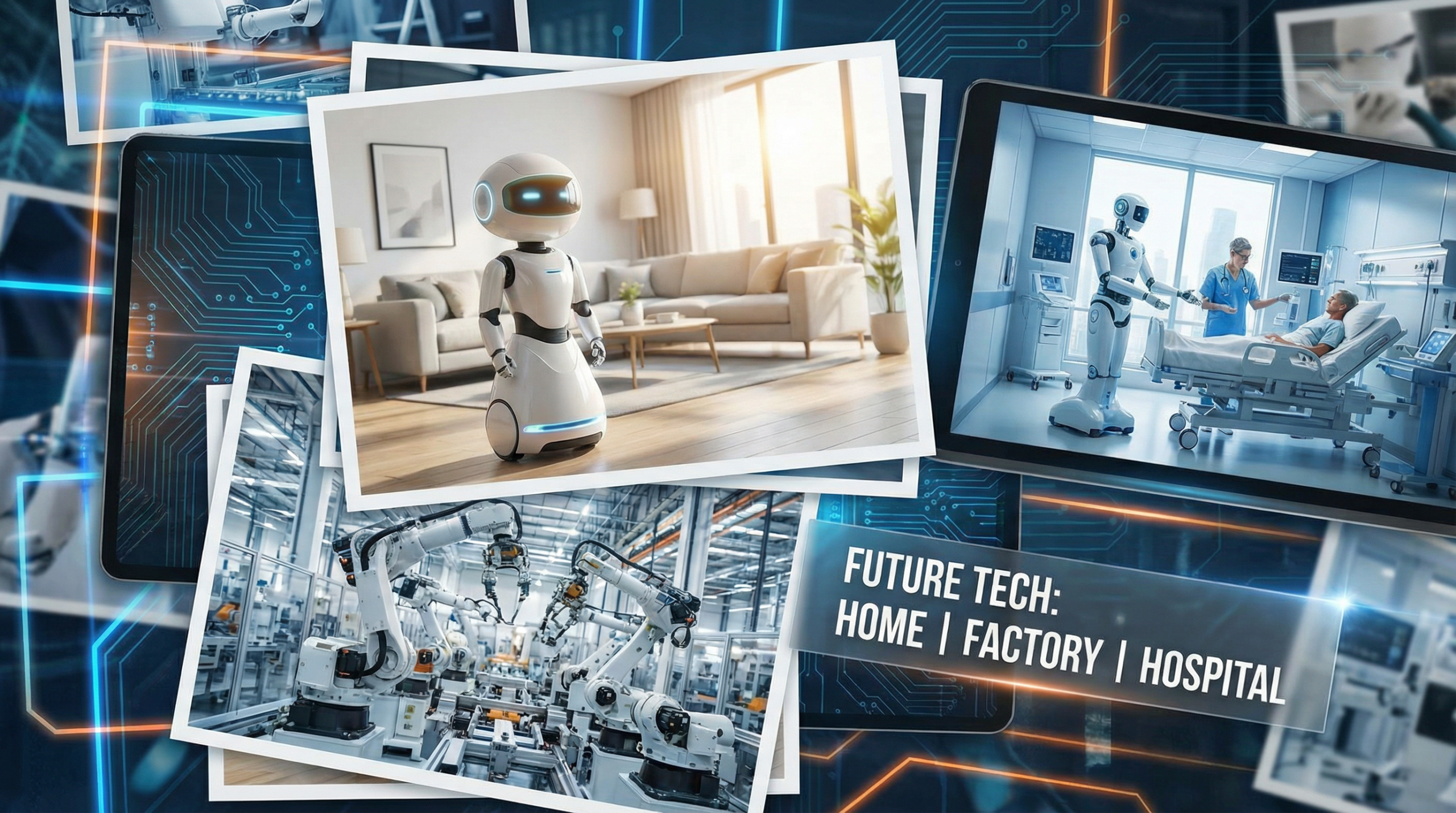
Quick Answer: Robotics Future 2026-2030
The next five years will see robotics transformed by AI integration, mass-produced humanoid robots under $20,000, autonomous surgical systems, agricultural automation, space robotics expansion, and widespread home assistants. Key drivers include labor shortages, aging populations, climate change, and advances in computer vision, LLMs, and battery technology.
The Robotics Revolution Accelerates
The period 2026-2030 represents a critical inflection point for robotics technology. Converging advances in artificial intelligence, materials science, battery technology, and manufacturing processes are creating unprecedented opportunities for robotic applications across industries and daily life.
Market projections indicate explosive growth:
- Global robotics market: $147 billion by 2025 → $283 billion by 2030
- Service robots: $47 billion market by 2030 (28% CAGR)
- Humanoid robots: $17 billion market emerging by 2030
- Robot density: 200+ robots per 10,000 workers globally
- Consumer robots: 67 million households by 2030
AI Integration: The Game-Changing Catalyst
Artificial intelligence is transforming robots from programmed machines to adaptive, learning systems capable of complex decision-making and natural interaction.
Large Language Models in Robotics
Integration of LLMs like GPT-4, Claude, and specialized robotics models enables robots to understand natural language instructions, explain their actions, and learn new tasks through conversation.
Breakthrough Applications:
- Conversational Interfaces: “Clean the kitchen but avoid the cat’s food bowl”
- Task Learning: Teaching robots through demonstration and verbal instruction
- Error Explanation: Robots explaining what went wrong and how to fix it
- Dynamic Planning: Adapting to changing conditions and priorities
Real-World Implementation: Companies like Boston Dynamics, Tesla®, and Figure AI are incorporating LLMs to create more intuitive human-robot interaction.
Computer Vision Advances
Next-generation computer vision systems enable robots to understand complex environments with human-like perception.
Key Technologies:
- 3D Scene Understanding: Comprehensive spatial awareness and object relationships
- Multi-Modal Perception: Combining visual, audio, and tactile information
- Predictive Vision: Anticipating object movement and human behavior
- Fine-Grained Recognition: Distinguishing similar objects and materials
Edge AI Processing
Powerful onboard processing reduces latency and enables autonomous operation without constant cloud connectivity.
Hardware Developments:
- NVIDIA® Jetson Orin series for robot AI processing
- Qualcomm® Robotics RB6 platform for mobile robots
- Apple® M-series chips adapted for robotics applications
- Custom neuromorphic chips for ultra-low power AI
Humanoid Robots: From Prototype to Production
The 2026-2030 period will see humanoid robots transition from research projects to commercially viable platforms for various industries.
Mass Production and Cost Reduction
Manufacturing scale-up and design optimization are driving dramatic cost reductions for humanoid robots.
Cost Timeline Projections:
| Year | Prototype Cost | Production Cost | Target Market |
|---|---|---|---|
| 2024 | $100,000-200,000 | N/A | Research/Demo |
| 2026 | $50,000-80,000 | $30,000-50,000 | Industrial pilot |
| 2028 | $25,000-40,000 | $15,000-25,000 | Commercial adoption |
| 2030 | $15,000-25,000 | $8,000-15,000 | Mass market |
Leading Humanoid Robot Developments
Tesla® Optimus:
- 2026: Limited production for Tesla factories
- 2027: Commercial availability for manufacturing
- 2028: Consumer market entry
- Target price: $20,000 by 2027
Boston Dynamics Atlas:
- Enhanced AI integration and manipulation capabilities
- Focus on logistics and construction applications
- Partnership development for specialized industries
Figure AI Figure 02:
- Commercial deployment expanding beyond BMW®
- Advanced OpenAI™ integration for natural interaction
- Scaling production for broader manufacturing adoption
Applications Driving Adoption
Manufacturing and Warehousing:
- Flexible automation replacing rigid production lines
- Human-robot collaboration in assembly tasks
- Dynamic reconfiguration for different products
- 24/7 operation with minimal supervision
Healthcare and Eldercare:
- Patient assistance and mobility support
- Medication management and health monitoring
- Companionship and mental health support
- Physical therapy and rehabilitation assistance
Surgical Robotics: Precision Medicine Revolution
Robotic surgery is evolving toward fully autonomous procedures, enhanced precision, and minimally invasive techniques.
Autonomous Surgical Systems
AI-guided surgical robots capable of performing routine procedures with minimal human intervention.
Near-Term Autonomous Applications:
- Cataract Surgery: Lens replacement with sub-millimeter precision
- Dental Procedures: Cavity preparation and crown placement
- Biopsy Operations: Tissue sampling with optimal pathways
- Suturing: Consistent, optimal wound closure
Technology Enablers:
- Real-time tissue analysis and decision making
- Haptic feedback for force-sensitive operations
- Multi-arm coordination for complex procedures
- Integration with imaging systems (MRI, CT, ultrasound)
Micro and Nano Robotics
Miniaturized robots for targeted drug delivery and cellular-level interventions.
Applications in Development:
- Targeted Cancer Therapy: Drug delivery directly to tumor cells
- Cardiovascular Treatment: Plaque removal and stent placement
- Neural Interfaces: Brain-computer interface implantation
- Regenerative Medicine: Stem cell placement and tissue engineering
Agricultural Robotics: Feeding the Future
Climate change, labor shortages, and food security concerns are driving rapid adoption of agricultural robotics.
Precision Farming Robots
Autonomous systems for crop monitoring, planting, and harvesting with minimal environmental impact.
Crop Management Systems:
- Weed Detection and Elimination: AI-powered selective herbicide application
- Pest Monitoring: Early detection and targeted intervention
- Soil Analysis: Real-time nutrient and moisture monitoring
- Yield Optimization: Data-driven planting and harvesting decisions
Market Leaders and Technologies:
- John Deere®: Autonomous tractors and combine harvesters
- Blue River Technology (Bayer®): See & Spray precision weeding
- Iron Ox: Hydroponic farming robots
- Bowery Farming: Indoor vertical farming automation
Livestock Management Automation
Robotic systems for animal health monitoring, feeding, and welfare management.
Emerging Applications:
- Automated Milking: 24/7 dairy operation with health monitoring
- Feed Management: Optimized nutrition delivery
- Health Surveillance: Early disease detection through behavior analysis
- Breeding Management: AI-assisted genetic optimization
Space Robotics: The Final Frontier
Space exploration and commercialization are creating new frontiers for robotic applications beyond Earth.
Mars Exploration and Colonization
Advanced robotic systems for Mars mission support and eventual human settlement.
Next-Generation Mars Robots:
- Sample Return Missions: Autonomous collection and Earth return
- Construction Robots: Habitat preparation for human missions
- Resource Extraction: Water, oxygen, and mineral harvesting
- Exploration Teams: Coordinated multi-robot surveys
Timeline and Missions:
- 2026: Mars Sample Return mission launch
- 2027: Advanced rover deployment with AI capabilities
- 2028: Construction robot prototypes for habitat building
- 2030: Resource extraction pilot programs
Orbital Manufacturing and Maintenance
Robotic systems for satellite servicing, space debris cleanup, and manufacturing in microgravity.
Commercial Applications:
- Satellite Servicing: Fuel refilling and component replacement
- Debris Cleanup: Space junk removal and orbital safety
- Manufacturing: Zero-gravity production of specialized materials
- Assembly Operations: Large structure construction in space
Home Robotics: The Personal Assistant Revolution
Domestic robots are evolving from single-purpose devices to comprehensive household assistants.
Multi-Purpose Home Robots
Integration of cleaning, security, and assistance functions in unified platforms.
Capability Evolution:
- 2026: Enhanced navigation and object recognition
- 2027: Basic manipulation and object handling
- 2028: Conversational AI and task learning
- 2029: Integrated home management systems
- 2030: Proactive assistance and predictive behavior
Leading Home Robot Platforms:
- Amazon® Astro: Home monitoring and communication
- Samsung® JetBot AI+: Cleaning with object recognition
- Enabot EBO: Pet care and home surveillance
- Toyota® HSR: Healthcare assistance and mobility support
Elder Care and Accessibility
Specialized robots addressing aging population needs and accessibility challenges.
Assistive Technologies:
- Medication Management: Automated dispensing and reminders
- Fall Detection: Emergency response and prevention
- Cognitive Support: Memory assistance and routine management
- Social Interaction: Companionship and mental health support
Autonomous Vehicle Integration
Robotics and autonomous vehicles converge to create comprehensive transportation and logistics solutions.
Last-Mile Delivery Ecosystems
Integration of autonomous vehicles with delivery robots for complete logistics automation.
System Components:
- Hub Vehicles: Autonomous vans carrying multiple delivery robots
- Deployment Robots: Sidewalk and building-access delivery units
- Return Systems: Automated pickup and vehicle reloading
- Coordination AI: Route optimization and fleet management
Urban Mobility Integration
Robots integrated into smart city infrastructure for traffic management and public services.
Applications:
- Traffic Monitoring: Real-time congestion analysis and management
- Infrastructure Maintenance: Automated repair and upkeep
- Public Safety: Emergency response and crowd management
- Environmental Monitoring: Air quality and noise pollution tracking
Ethical Considerations and Challenges
The rapid advancement of robotics raises important ethical, social, and economic questions that society must address.
Employment and Economic Impact
Job Displacement Concerns:
- Manufacturing, logistics, and service job automation
- Need for workforce retraining and education programs
- Economic inequality potential from automation benefits
Mitigation Strategies:
- Human-robot collaboration rather than replacement
- Creation of new job categories in robotics and AI
- Universal basic income discussions
- Emphasis on uniquely human skills (creativity, empathy)
Privacy and Security
Data Protection Challenges:
- Home robots collecting intimate personal data
- Workplace surveillance through robotic monitoring
- Cybersecurity vulnerabilities in connected systems
Regulatory Development:
- Privacy by design requirements for robotic systems
- International cooperation on robotics governance
- Ethical AI guidelines for robot behavior
Human-Robot Relationship Ethics
Social and Psychological Impacts:
- Emotional attachment to robotic companions
- Impact on human social skills and relationships
- Autonomy and decision-making authority questions
Technology Infrastructure Requirements
Widespread robotics adoption requires significant infrastructure development and standardization.
Connectivity and Standards
5G and Beyond:
- Ultra-low latency for real-time robot control
- Massive device connectivity for robot swarms
- Edge computing for distributed AI processing
Standardization Efforts:
- ROS (Robot Operating System): Common software platform
- Matter Protocol: Interoperability for home robots
- IEEE Standards: Safety and performance guidelines
Energy and Sustainability
Power System Advances:
- Solid-state batteries with higher energy density
- Wireless charging infrastructure for robot fleets
- Solar-powered autonomous systems
- Fuel cell technology for long-duration operation
Investment and Market Dynamics
Robotics investment patterns are shifting toward practical applications and scalable business models.
Funding Trends 2026-2030
Investment Focus Areas:
- Healthcare Robotics: $15+ billion in funding expected
- Agricultural Automation: $8 billion market opportunity
- Service Robotics: $25 billion consumer market potential
- Industrial Automation: $45 billion upgrade market
Geographic Investment Leaders:
- China: Manufacturing and consumer robotics scaling
- United States: AI integration and space robotics
- Europe: Industrial automation and ethical AI frameworks
- Japan: Elder care and service robotics innovation
Frequently Asked Questions
When will humanoid robots be affordable for average consumers?
Mass-market humanoid robots priced under $20,000 are expected by 2027-2028, with entry-level models potentially reaching $10,000-15,000 by 2030. Initial adoption will focus on specific use cases like elder care and household assistance before becoming general-purpose platforms.
Will robots replace most human jobs by 2030?
Robots will automate specific tasks rather than replace entire jobs. While some positions will be eliminated, new roles in robot maintenance, programming, and human-robot collaboration will emerge. The key is preparing the workforce for this transition through education and training programs.
How advanced will AI in robots become by 2030?
By 2030, robots will feature conversational AI comparable to human assistants, capable of learning new tasks through demonstration and natural language instruction. They’ll have sophisticated environmental understanding but will still require human oversight for complex decisions and ethical considerations.
What are the biggest obstacles to widespread robot adoption?
Key challenges include cost reduction, safety and reliability concerns, regulatory frameworks, public acceptance, and infrastructure development. Technical limitations in manipulation, power systems, and AI reasoning also need continued advancement.
Preparing for the Robotic Future
The 2026-2030 period represents a transformative era for robotics technology. Success in this evolving landscape requires:
For Businesses: Strategic planning for human-robot collaboration, investment in workforce development, and early adoption of proven robotic solutions.
For Individuals: Developing complementary skills that work alongside robots, staying informed about technological developments, and participating in discussions about ethical robotics deployment.
For Society: Creating regulatory frameworks that promote innovation while protecting workers and consumers, investing in education and infrastructure, and addressing ethical considerations proactively.
The robotics revolution is not a distant future possibility—it’s happening now. Those who prepare thoughtfully and adapt strategically will thrive in an increasingly automated world where humans and robots work together to solve complex challenges and improve quality of life.
