


This article may contain affiliate links. TheRoboWire may earn a commission at no extra cost to you.
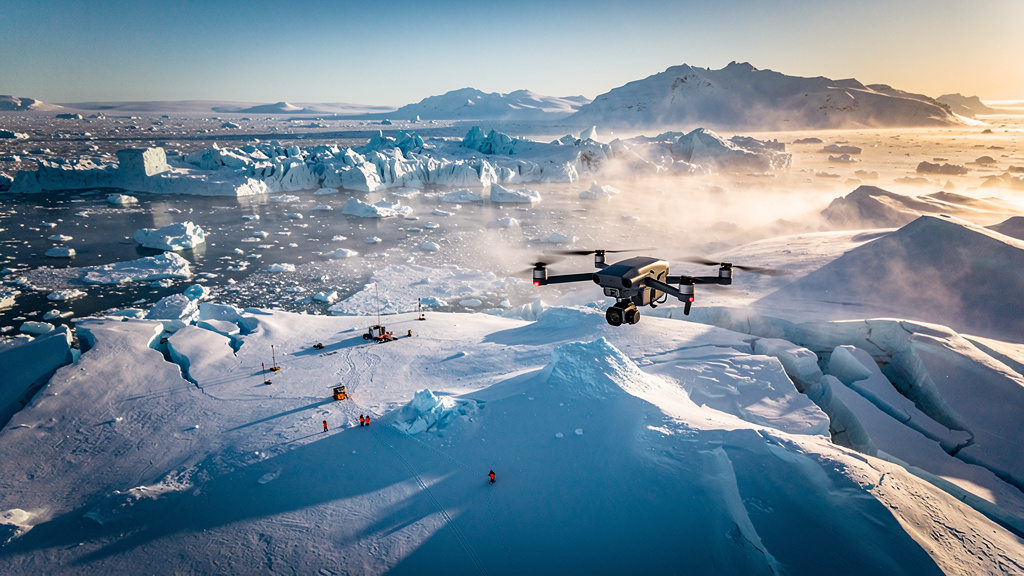
Scientists are using DJI drones to map Greenland’s glaciers with detail satellites can’t match. A July 2025 expedition aboard the research sailboat Perseverance deployed a DJI Mavic 3 Enterprise to create 3D models of ice formations, track glacial fractures, and capture iceberg calving events — generating data that could reshape how we predict sea-level rise.
TL;DR
- A July 2025 Greenland expedition used the DJI Mavic 3 Enterprise to capture ultra-detailed 3D models of Arctic glaciers
- The team mapped Eqip Sermia and Sermeq Kujalleq, one of Earth’s fastest-moving glaciers
- Drone imagery revealed cracks, crevasses, and structural weaknesses that satellites simply can’t resolve
- Data is being analyzed with the University of Aberdeen to understand iceberg calving and sea-level impacts
- Explorer Jean-Louis Étienne led the expedition aboard Perseverance, the world’s largest oceanographic research sailboat
- Drones are democratizing climate science — delivering results once requiring specialized aircraft at a fraction of the cost
Why Satellites Aren’t Enough for Greenland’s Ice
Satellites have been the backbone of glaciology for decades. They give us the big picture: ice sheet extent, overall mass loss, broad movement patterns. But here’s the problem — they can’t tell us why or how things are happening at the surface level.
Greenland is warming faster than most of the planet. Its ice sheet — the second largest in the world — is the single largest contributor to global sea-level rise. According to NOAA, Greenland lost approximately 55 gigatons of ice and snow between fall 2023 and fall 2024 alone. To understand what’s driving that loss, scientists need centimeter-level detail of fracture patterns, crevasse morphology, and calving front geometry.
That’s exactly the gap drones are filling. While a satellite might show you a glacier is retreating, a drone hovering 50 meters above the ice can show you the specific cracks that will cause the next massive iceberg to break off.
The Greenland Expedition: DJI Mavic 3 Enterprise in Action
In July 2025, legendary French explorer Jean-Louis Étienne led a team of researchers along Greenland’s icy coastline aboard Perseverance — the world’s largest oceanographic research sailboat. The mission blended satellite expertise with cutting-edge drone technology, and the star of the show was the DJI Mavic 3 Enterprise.
This compact drone — weighing just over 900 grams — packs a 4/3 CMOS sensor capable of 20MP stills and supports centimeter-level positioning with its RTK module. For this expedition, it was used to capture thousands of high-resolution aerial images of two critical glaciers:
- Eqip Sermia — a major outlet glacier on Greenland’s west coast known for dramatic calving events
- Sermeq Kujalleq (Jakobshavn Isbræ) — one of the fastest-moving glaciers on the planet, flowing at roughly 1,800 feet per year
Those thousands of images were stitched together using photogrammetry to create precise 3D models of the glacier surfaces. The results revealed intricate details of cracks, crevasses, and structural weaknesses — the kind of data that helps predict when and how massive chunks of ice will calve into the ocean.
3D Iceberg Models: A Game-Changer for Climate Science
One of the expedition’s most significant breakthroughs was creating 3D models of icebergs floating in the water. This isn’t just a cool visual — it’s genuinely new science.
These models help researchers measure not just how fast ice melts, but how quickly it disintegrates. That meltwater doesn’t just vanish — it changes ocean circulation patterns, affects salinity levels, and impacts marine ecosystems. What happens to a single iceberg can send ripples across entire ocean systems.
The expedition data is now being analyzed in collaboration with the University of Aberdeen, where glaciologists are studying how glaciers melt, fracture, and interact with surrounding ocean waters. This partnership between field data collection and academic analysis represents exactly the kind of workflow that modern drone technology enables.
Previous research at Cambridge’s Scott Polar Institute has demonstrated similar capabilities. In 2018, researchers used drones to observe the real-time drainage of a glacial lake on Greenland’s ice sheet — watching 1.3 billion gallons of water drain through a fracture in just five hours. The drone captured before-and-after imagery that revealed how the water acted as a lubricant, temporarily lifting a kilometer of ice by roughly 22 inches.
Why the DJI Mavic 3 Enterprise Is the Right Tool
You might wonder why a research expedition would choose a commercial drone over specialized scientific equipment. The answer is practical: the Mavic 3 Enterprise hits a sweet spot of capability, portability, and cost that purpose-built alternatives can’t match.
Key specs that matter for glaciology work:
- 45-minute flight time — enough to cover significant glacier sections in a single sortie
- RTK module support — centimeter-level positioning accuracy for precise 3D reconstruction
- 4/3 CMOS sensor — high enough resolution for photogrammetric stitching
- Compact form factor — critical when operating from a sailboat in Arctic conditions
- Operating temperature range down to -20°C — essential for polar fieldwork
Just a decade ago, this kind of research would have required massive funding, specialized aircraft, and large teams. Today, a compact drone and a skilled operator can deliver similar — and sometimes better — results. That’s transformative for climate science. It means more researchers, in more locations, can gather high-quality data faster and at lower cost.
Drones in Glaciology: A Growing Track Record
This Greenland expedition isn’t an isolated case. Drones have been steadily building credibility in cryospheric research:
- Dr. Joseph Cook (University of Sheffield) has used DJI Mavic Pro drones in Greenland to map algae growth on ice surfaces — a feedback loop that darkens ice and accelerates melting
- CU Boulder researchers used custom-designed drones to collect the first-ever detailed measurements of water vapor above the Greenland ice sheet, published in JGR Atmospheres in March 2025
- Cambridge Scott Polar Institute teams have deployed drones to track real-time lake drainage events on the ice sheet
- UAV photogrammetry studies at Sermeq Avannarleq glacier have demonstrated sub-decimeter accuracy across 85 km² survey areas using PPK-equipped drones
The trend is clear: drones have moved from “nice to have” to essential field equipment for polar scientists. As Dr. Cook put it, drones “provide a bridge between the measurements scientists can make manually on the ground at the scale of centimeters and the measurements made by orbiting satellites at the scale of tens to hundreds of meters.”
What This Means for Climate Predictions
The data coming out of these drone-enabled expeditions isn’t just academic curiosity — it directly feeds into climate models that predict future sea-level rise.
Iceberg calving is one of the biggest unknowns in sea-level projections. We know Greenland is losing ice, but predicting exactly when and where massive calving events will occur requires understanding fracture mechanics at a level satellites can’t provide. The 3D models generated by drone surveys are filling that knowledge gap.
By combining satellite imagery (for broad coverage) with drone-based 3D modeling (for fine detail), researchers now have both the macro and micro views of what’s happening. It’s a powerful combination — and it’s happening at a critical time, given the accelerating pace of Arctic warming.
FAQ
What drone was used in the Greenland glacier expedition?
The July 2025 expedition used the DJI Mavic 3 Enterprise, chosen for its high-resolution imaging, compact size, RTK positioning capability, and ability to operate in extreme cold conditions down to -20°C.
How do drones map glaciers?
Drones capture thousands of overlapping high-resolution photographs while flying systematic grid patterns over glacier surfaces. These images are processed using photogrammetry software to create precise 3D models that reveal surface features like cracks, crevasses, and calving fronts at centimeter-level resolution.
Why can’t satellites do this alone?
Satellites provide excellent large-scale coverage but lack the spatial resolution needed to study fine surface features. Drones can achieve centimeter-scale detail while satellites typically operate at meter-to-tens-of-meters resolution — a difference that matters when studying fracture mechanics and calving dynamics.
Who led the Greenland drone mapping expedition?
The expedition was led by French explorer Jean-Louis Étienne aboard Perseverance, the world’s largest oceanographic research sailboat. The data is being analyzed in partnership with the University of Aberdeen.
How does this research affect sea-level predictions?
Iceberg calving is one of the largest uncertainties in sea-level rise models. Detailed 3D drone mapping of fracture patterns and calving fronts helps scientists understand when and how ice breaks off, improving the accuracy of future sea-level projections.
The Bottom Line
The Greenland expedition proves what many in the drone community have been saying for years: drones aren’t just consumer gadgets or commercial tools — they’re serious scientific instruments. A sub-$5,000 DJI Mavic 3 Enterprise delivered glacier data that would have cost six figures with traditional methods just a decade ago.
As Greenland continues warming at an accelerated rate, the need for detailed, frequent, and affordable glacier monitoring will only grow. Drones are already meeting that need — and the data they’re generating could be the key to understanding exactly how fast our coastlines will change in the decades ahead.
Source: DroneDJ
