


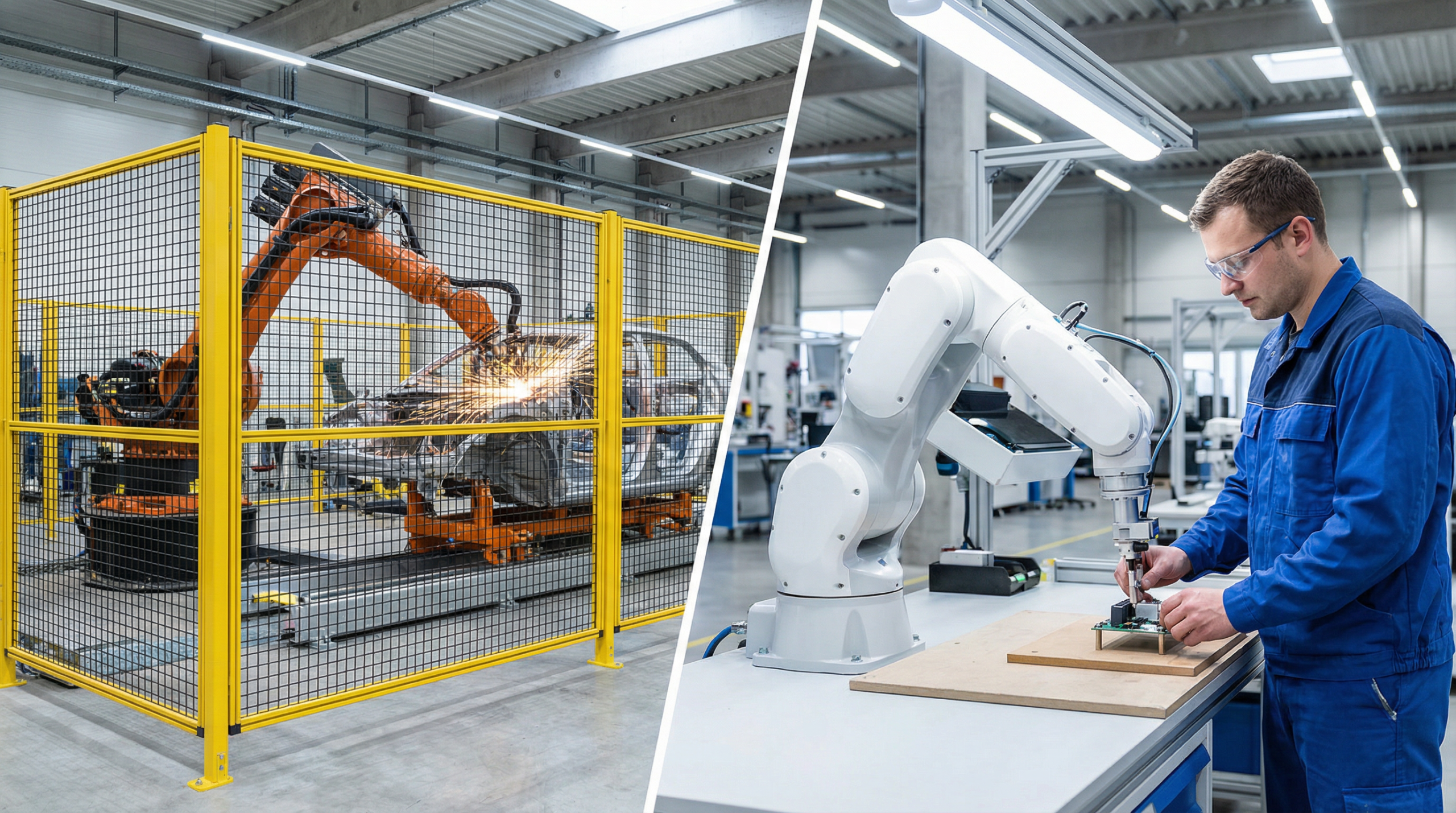
Quick Answer: Traditional industrial robots excel in high-speed, high-precision, and heavy-duty applications (automotive, electronics) with 15-20 year lifespans, while collaborative robots (cobots) shine in flexible, human-collaborative environments with easier programming and lower upfront costs. Choose traditional for volume production, cobots for adaptability.
Understanding the Robot Revolution
This article contains affiliate links. TheRoboWire may earn a commission on qualifying purchases at no extra cost to you. See our affiliate disclosure for details.
The industrial automation landscape has evolved from traditional safety-caged robots to collaborative robots working alongside humans. This fundamental shift reflects changing manufacturing needs: mass customization, flexible production, and skilled labor shortages. Understanding when to choose traditional industrial robots versus collaborative robots (cobots) can determine project success and ROI.
Our analysis examines real-world deployments across automotive, electronics, medical device, and food processing industries to provide actionable guidance for manufacturers evaluating automation options.
Comprehensive Comparison Table
| Factor | Traditional Industrial Robots | Collaborative Robots (Cobots) |
|---|---|---|
| Payload Capacity | 1kg – 1,300kg | 0.5kg – 35kg |
| Speed | Up to 12 m/s | Limited to 250mm/s near humans |
| Precision/Repeatability | ±0.02mm – ±0.1mm | ±0.05mm – ±0.3mm |
| Safety Requirements | Safety cages, light curtains, e-stops | Built-in safety features, no cages needed |
| Initial Cost | $50,000 – $500,000+ | $25,000 – $150,000 |
| Installation Cost | $25,000 – $200,000 | $5,000 – $25,000 |
| Programming Complexity | Requires specialized training | Intuitive, hand-guiding possible |
| Deployment Time | 3-12 months | 1 day – 4 weeks |
| Flexibility | Fixed installation, complex to reprogram | Easily moveable, quick reprogramming |
| Typical ROI Timeline | 6 months – 2 years | 3 months – 18 months |
| Lifecycle | 15-20 years | 8-12 years |
| Human Interaction | Prohibited during operation | Designed for human collaboration |
Traditional Industrial Robots: Power and Precision
Core Advantages
Traditional industrial robots excel in environments demanding maximum speed, precision, and payload capacity. Their rigid construction and powerful servo motors enable applications impossible for collaborative alternatives.
Speed Superiority: High-speed robots like the ABB IRB 910SC achieve velocities up to 12 m/s, essential for automotive spot welding lines producing 60+ vehicles per hour. Cobots cannot match this speed while maintaining safety compliance.
Precision Engineering: SCARA robots from Epson achieve ±0.02mm repeatability, critical for electronics assembly where component placement tolerances are measured in micrometers. This precision enables applications like semiconductor wafer handling and precision optics assembly.
Payload Capabilities: Heavy-duty robots like KUKA’s KR 1000 L950 titan handle 1,000kg payloads, enabling automotive body-in-white welding and aerospace component machining. No collaborative robot approaches this capability.
Optimal Applications
- Automotive manufacturing: Spot welding, painting, assembly line operations
- Electronics production: Pick-and-place, testing, precision assembly
- Heavy manufacturing: Material handling, machining, foundry operations
- High-volume production: Continuous operation with minimal human intervention
- Hazardous environments: Chemical processing, nuclear facilities, extreme temperatures
Implementation Considerations
Traditional robots require comprehensive planning including safety assessments, facility modifications, and specialized training. Installation typically involves:
- Safety cage construction and perimeter protection
- Power and air supply infrastructure
- Integration with existing control systems
- Programming by certified technicians
- Extensive testing and validation
Lead times often extend 6-12 months from purchase to production, with costs beyond the robot including integration, safety systems, and facility modifications.
Collaborative Robots: Flexibility and Accessibility
Revolutionary Safety Design
Cobots incorporate safety as a core design principle rather than an external addition. Key safety technologies include:
Force Limiting: Advanced torque sensors in every joint detect contact forces and stop movement within milliseconds. Universal Robots’ UR series stops within 2mm of contact at maximum speed.
Rounded Design: Smooth surfaces and rounded edges minimize injury risk. Unlike angular industrial robots, cobots feature organic shapes that reduce impact forces.
Speed Monitoring: Built-in algorithms continuously monitor speed and automatically reduce velocity when humans approach work areas.
Programming Revolution
Cobot programming democratizes automation, enabling non-experts to create robot applications:
Hand Guiding: Operators physically move the robot arm to teach positions, eliminating complex coordinate programming. This “show and tell” approach reduces programming time from days to hours.
Graphical Interfaces: Tablet-based programming uses drag-and-drop logic rather than code. KUKA’s Sunrise.OS and Universal Robots’ PolyScope enable visual programming without robotics expertise.
Pre-built Applications: Manufacturers provide application packages for common tasks like palletizing, machine tending, and quality inspection, reducing deployment time.
Deployment Flexibility
Cobots excel in dynamic manufacturing environments requiring frequent reconfiguration:
- Mobile installations: Cobots on mobile platforms move between production lines as needed
- Multi-shift operations: Different programs run automatically based on production schedules
- Small batch production: Quick changeovers between product variants without extensive reprogramming
- Prototype development: Rapid deployment for testing new processes before full automation
Financial Analysis and ROI Comparison
Total Cost of Ownership
| Cost Component | Traditional Robot | Collaborative Robot |
|---|---|---|
| Robot Purchase | $50,000 – $500,000 | $25,000 – $150,000 |
| Safety Infrastructure | $15,000 – $75,000 | $2,000 – $8,000 |
| Installation & Integration | $25,000 – $200,000 | $5,000 – $25,000 |
| Programming & Training | $10,000 – $50,000 | $2,000 – $10,000 |
| Annual Maintenance | $3,000 – $15,000 | $1,500 – $5,000 |
| 10-Year Total | $130,000 – $890,000 | $49,500 – $248,000 |
ROI Calculation Examples
Traditional Robot – Automotive Welding:
Initial investment: $250,000
Annual labor savings: $180,000 (3 shifts × $60,000)
ROI: 18 months
Cobot – Machine Tending:
Initial investment: $75,000
Annual labor savings: $50,000 (1 operator × $50,000)
ROI: 18 months
While absolute savings favor traditional robots in high-volume applications, cobots offer similar ROI percentages with lower risk due to reduced investment.
Application-Specific Analysis
Automotive Manufacturing
Traditional robots dominate: Spot welding, painting, and heavy assembly require speed and precision beyond cobot capabilities. BMW’s Munich plant uses 1,200+ traditional robots for body welding.
Cobot opportunities: Final assembly, quality inspection, and parts feeding benefit from flexibility. Ford uses Universal Robots for door seal installation, working alongside human assemblers.
Electronics Assembly
Traditional robots excel: High-speed pick-and-place operations for surface-mount components require precision and speed. SCARA robots place 50,000+ components per hour.
Cobot advantages: Prototype assembly, small batch production, and final testing leverage flexibility. Apple suppliers use cobots for iPhone component inspection alongside human quality control.
Medical Device Manufacturing
Cobot preference: Sterile environments, small batches, and regulatory compliance favor collaborative approaches. Intuitive Surgical uses cobots for surgical instrument assembly in cleanroom environments.
Traditional applications: High-volume disposable production like syringes and catheters benefits from traditional automation speed and consistency.
Food and Beverage Processing
Traditional dominance: High-speed packaging lines require traditional robots. Coca-Cola’s bottling lines use ABB robots for case packing at 1,200 cases per hour.
Cobot emergence: Food preparation, decoration, and artisanal production benefit from gentle handling and flexibility. Domino’s Pizza tests cobots for pizza preparation.
Technical Limitations and Constraints
Speed and Productivity Trade-offs
Safety regulations limit cobot speeds when humans are present. ISO 10218 requires power and force limiting that inherently reduces productivity compared to traditional robots.
Cycle Time Comparison:
– Traditional robot welding: 15-20 seconds per weld
– Cobot welding: 45-60 seconds per weld
This 3:1 productivity difference makes cobots unsuitable for high-volume production despite lower costs.
Payload and Reach Limitations
Physical constraints of safety-compliant design limit cobot capabilities:
- Maximum payload: 35kg (vs 1,300kg for traditional robots)
- Reach limitations due to joint torque constraints
- Reduced precision at maximum payload and reach
Hybrid Deployment Strategies
Cell-Based Automation
Smart manufacturers combine both robot types within production systems:
Traditional robots handle: High-speed material movement, precision operations, and heavy lifting
Cobots manage: Quality inspection, delicate assembly, and human-robot handoffs
BMW’s Spartanburg plant exemplifies this approach, using traditional robots for car body welding while cobots assist with final assembly tasks.
Sequential Automation
Phased deployment reduces risk and spreads investment:
- Phase 1: Deploy cobots for immediate productivity gains
- Phase 2: Analyze workflows and identify high-volume applications
- Phase 3: Add traditional robots for proven high-ROI processes
Future Technology Convergence
Speed-Safe Technology
Advanced sensor technology enables “speed and separation monitoring” allowing cobots to operate faster when humans maintain safe distances. This hybrid approach bridges the speed gap while maintaining safety.
AI-Powered Adaptation
Machine learning algorithms enable robots to optimize safety and productivity dynamically. FANUC’s AI servo technology and ABB’s machine learning controllers represent convergence trends.
Modular Robotics
Emerging modular designs allow reconfiguration between collaborative and industrial modes. Techman Robot’s TM series demonstrates this flexibility with removable safety features.
Decision Framework for Business Leaders
Choose Traditional Industrial Robots When:
- Production volume exceeds 50,000 units annually
- Cycle times must be under 30 seconds
- Payloads exceed 20kg regularly
- Precision requirements are under ±0.05mm
- Hazardous environments prohibit human presence
- ROI requirements justify 6-month payback periods
Choose Collaborative Robots When:
- Production runs vary frequently (batch sizes under 10,000)
- Human expertise remains essential for quality judgment
- Facility constraints prevent safety cage installation
- Programming changes occur weekly or more frequently
- Workforce training resources are limited
- Initial capital investment must remain under $100,000
Implementation Best Practices
Risk Assessment Protocol
- Conduct thorough application analysis including cycle times, precision requirements, and safety considerations
- Evaluate total cost of ownership over 5-10 year periods
- Consider workforce capabilities and training requirements
- Assess facility constraints and modification costs
- Plan for technology evolution and upgrade paths
Pilot Program Strategy
Successful automation begins with carefully planned pilot deployments:
- Select non-critical applications for initial testing
- Measure baseline productivity before automation
- Track comprehensive metrics including quality, safety, and efficiency
- Gather operator feedback and adjust accordingly
- Scale successful deployments to similar applications
Frequently Asked Questions
Can collaborative robots achieve the same productivity as traditional industrial robots?
No, cobots cannot match traditional robot productivity in high-speed applications due to safety limitations. Cobots are typically 2-3 times slower than traditional robots when both operate at maximum capability. However, cobots excel in applications requiring flexibility, gentle handling, or human collaboration where traditional robots would be unsuitable.
What are the ongoing maintenance differences between traditional robots and cobots?
Traditional industrial robots require more maintenance due to higher operating speeds and forces, with annual costs averaging $3,000-$15,000. Cobots have lower maintenance requirements ($1,500-$5,000 annually) due to gentler operation and simpler mechanical systems. However, traditional robots typically last 15-20 years versus 8-12 years for cobots.
How long does it take to program a cobot versus a traditional robot?
Cobot programming is significantly faster, often requiring hours versus days for traditional robots. Simple cobot applications can be programmed in 30-60 minutes using hand-guiding techniques. Traditional robots require specialized training and complex coordinate programming, typically taking 2-5 days for equivalent applications. However, traditional robots offer more sophisticated programming capabilities for complex applications.
Are there safety regulations that favor one type over the other?
ISO 10218 and ISO 15066 govern robot safety, with specific provisions for collaborative operations. Traditional robots must operate within safety barriers, while cobots can work alongside humans if they meet power and force limiting requirements. Some industries like automotive have established traditional robot safety protocols that may favor existing approaches over cobot adoption.
Which type offers better ROI for small and medium manufacturers?
Cobots typically offer better ROI for SMEs due to lower initial investment, faster deployment, and reduced infrastructure requirements. Total investment for cobot systems ranges from $30,000-$200,000 versus $100,000-$800,000 for traditional systems. However, ROI depends heavily on application volume and complexity. High-volume, repetitive applications may favor traditional robots despite higher upfront costs.
