


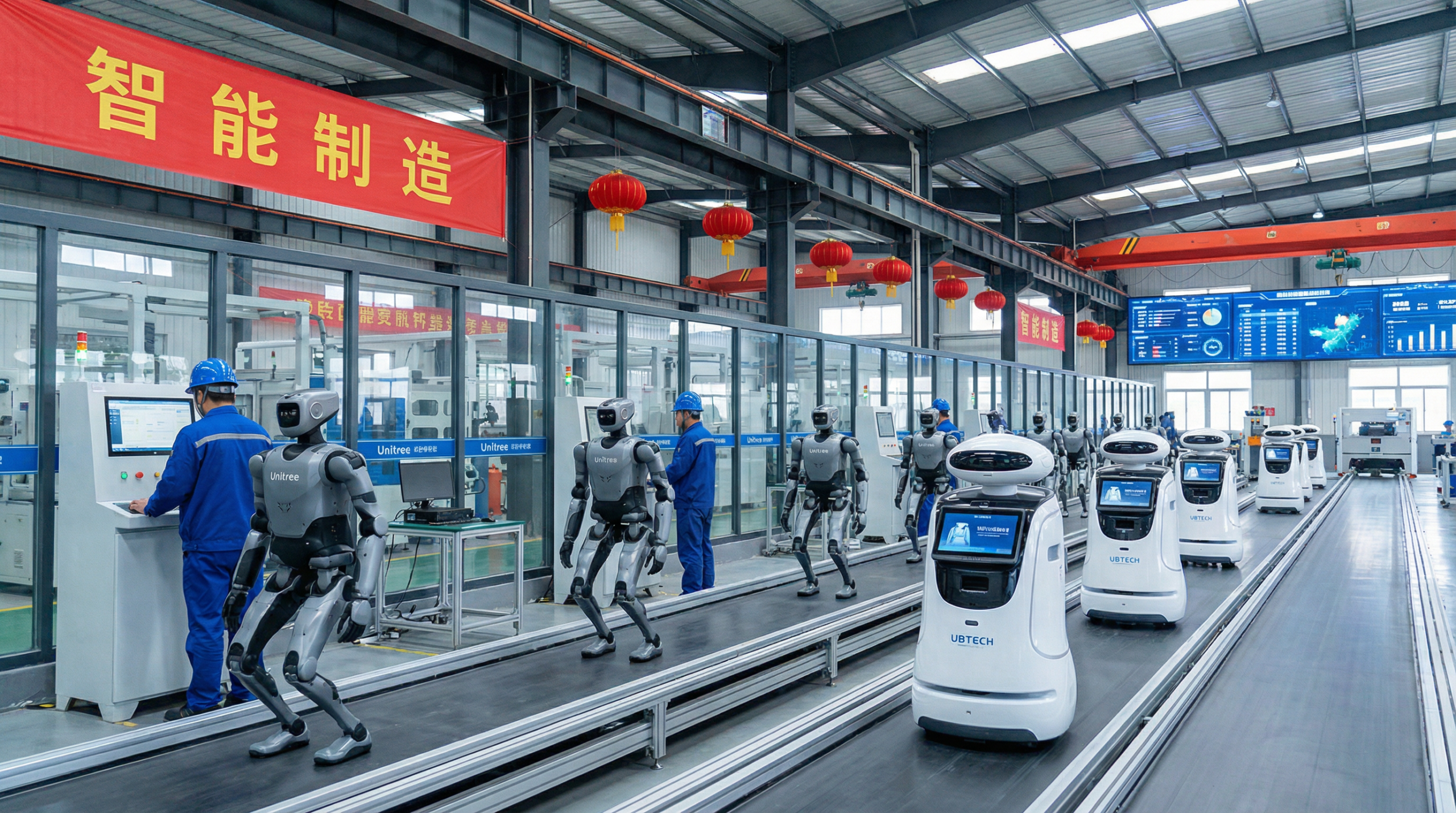
Quick Answer: China’s Robotics Dominance
China has emerged as the world’s largest robotics market, representing 52% of global robot installations in 2025. Leading manufacturers like Unitree, UBTECH, DJI™, XPeng, and Fourier Intelligence are driving innovation in humanoid robots, autonomous delivery, and AI-powered automation. The sector is projected to reach $43 billion by 2027.
China’s Robotics Market Overview
China’s robotics industry has experienced explosive growth, transforming from a manufacturing hub to an innovation leader. The country’s “Made in China 2025” strategy prioritizes robotics as a key technology for economic advancement and industrial upgrading.
Key market statistics:
- Market Size: $18.4 billion in 2024, growing at 15.2% CAGR
- Robot Density: 392 robots per 10,000 manufacturing workers
- Global Share: 52% of worldwide robot installations
- Patents Filed: Over 28,000 robotics patents in 2024
- Government Investment: $12 billion in robotics R&D funding
Leading Chinese Robotics Manufacturers
Unitree Robotics
Founded in 2016, Unitree has become synonymous with affordable quadruped and humanoid robots. The company’s products range from research platforms to commercial applications.
Key Products:
- Go2: Quadruped robot priced at $1,600, democratizing robotic research
- H1: Humanoid robot with 360° vision and 90-minute battery life
- G1: Latest humanoid robot with 23 degrees of freedom
Unitree’s aggressive pricing strategy has made advanced robotics accessible to universities and small businesses worldwide.
UBTECH Robotics
As one of China’s most valuable AI and robotics companies, UBTECH focuses on service robots and humanoid platforms for education and commercial applications.
Product Portfolio:
- Walker X: Large-scale humanoid robot for industrial applications
- Alpha Series: Educational and entertainment humanoid robots
- Cruzr: Commercial service robot for retail and hospitality
- JIMU: Modular robotics kits for STEM education
UBTECH has partnerships with Apple® for retail robotics and Disney™ for entertainment applications.
Fourier Intelligence
Specializing in rehabilitation and humanoid robotics, Fourier Intelligence combines medical expertise with advanced robotics technology.
Notable Products:
- GR-1: General-purpose humanoid robot with 40+ degrees of freedom
- M2: Upper-limb rehabilitation robot
- RehabHub: AI-powered rehabilitation platform
The company has established international presence with facilities in Singapore and partnerships with leading hospitals.
XPeng Robotics
The robotics division of electric vehicle manufacturer XPeng™ leverages automotive AI expertise for robotics applications.
Robot Products:
- PX5: Quadruped robot with autonomous navigation
- Iron: Humanoid robot prototype with vehicle integration
- Smart Factory Robots: Manufacturing automation solutions
XPeng’s unique advantage lies in integrating robotics with smart vehicle ecosystems.
DJI’s Expansion into Ground Robotics
DJI™, the world’s largest drone manufacturer, has expanded beyond aerial robotics into ground-based and educational robotics platforms.
Key Initiatives:
- RoboMaster S1: Educational tank robot with AI capabilities
- RoboMaster EP: Programmable robot platform for advanced learning
- Agras Series: Agricultural robots for crop monitoring and spraying
- Dock System: Autonomous drone deployment platforms
DJI’s expertise in computer vision and autonomous flight translates directly to ground robotics applications.
Government Support and Investment
China’s government has implemented comprehensive support policies for robotics development:
National Policies:
- “Robotics Industry Development Plan (2016-2020)” extended to 2025
- Tax incentives for robotics R&D and manufacturing
- Subsidies for robot adoption in manufacturing
- Support for international expansion and technology transfer
Regional Initiatives:
- Shenzhen: $2.8 billion robotics industry fund
- Shanghai: Humanoid robot development center
- Beijing: AI and robotics research institutes
- Guangzhou: Manufacturing automation hubs
Manufacturing and Production Capabilities
China’s robotics manufacturing ecosystem benefits from integrated supply chains and massive production scale:
Supply Chain Advantages:
- Access to rare earth minerals for motors and sensors
- Advanced semiconductor fabrication capabilities
- Precision manufacturing infrastructure
- Cost-effective component production
Production Scale:
- China produces 47% of the world’s industrial robots
- Over 2,000 robotics companies operate in China
- Annual production capacity exceeds 400,000 units
- Export value reached $3.2 billion in 2024
Technological Innovation and R&D
Chinese robotics companies are investing heavily in cutting-edge research areas:
AI Integration: Advanced machine learning algorithms for autonomous decision-making and human-robot interaction.
5G Connectivity: Ultra-low latency communication enabling real-time remote robot control and swarm coordination.
Edge Computing: On-device processing capabilities reducing dependence on cloud connectivity.
Biomimetic Design: Nature-inspired robotics improving efficiency and adaptability.
International Expansion and Global Impact
Chinese robotics companies are aggressively expanding internationally:
Market Penetration:
- Unitree robots sold in 30+ countries
- UBTECH partnerships in Europe and North America
- DJI dominates global commercial drone market (70% share)
- Export growth of 23% annually
Challenges:
- Geopolitical tensions affecting technology transfer
- Regulatory barriers in key markets
- Competition from established Western robotics companies
- Intellectual property concerns
Industry Applications and Use Cases
Chinese robots are deployed across diverse industries:
Manufacturing: Automotive assembly, electronics production, and quality inspection with robots from companies like Estun and Siasun.
Logistics: Warehouse automation and last-mile delivery using robots from companies like Geek+ and Keenon.
Healthcare: Surgical assistance and rehabilitation therapy with solutions from Fourier Intelligence and MicroPort.
Agriculture: Crop monitoring, harvesting, and livestock management using DJI agricultural drones and XAG robots.
Frequently Asked Questions
Why has China become so dominant in robotics?
China’s dominance stems from government support, massive manufacturing scale, integrated supply chains, and aggressive investment in AI and automation. The country’s “Made in China 2025” strategy specifically targets robotics as a key industry.
How do Chinese robots compare in quality to Western alternatives?
Chinese robots have achieved parity or leadership in many areas, particularly in cost-effectiveness and AI integration. While some Western companies maintain advantages in precision and reliability, the gap is rapidly narrowing.
What are the biggest Chinese robotics companies by revenue?
The largest Chinese robotics companies include UBTECH (valued at $5 billion), Siasun, Estun, Geek+, and rapidly growing companies like Unitree and Fourier Intelligence. DJI also generates significant robotics revenue through drones and ground platforms.
How is China’s robotics growth affecting global markets?
Chinese manufacturers are driving down costs while accelerating innovation, forcing global competitors to adapt. This benefits consumers through more affordable robotics solutions but creates competitive pressure on traditional robotics companies.
Future Outlook and Market Projections
China’s robotics industry is positioned for continued rapid growth:
Market Projections:
- Reach $43 billion by 2027 (15% CAGR)
- 1.5 million robots in operation by 2026
- Export value to exceed $8 billion by 2025
- Leading global market share in humanoid robots by 2030
The combination of government support, technological innovation, manufacturing scale, and aggressive international expansion positions China as the dominant force in global robotics for the next decade.
