


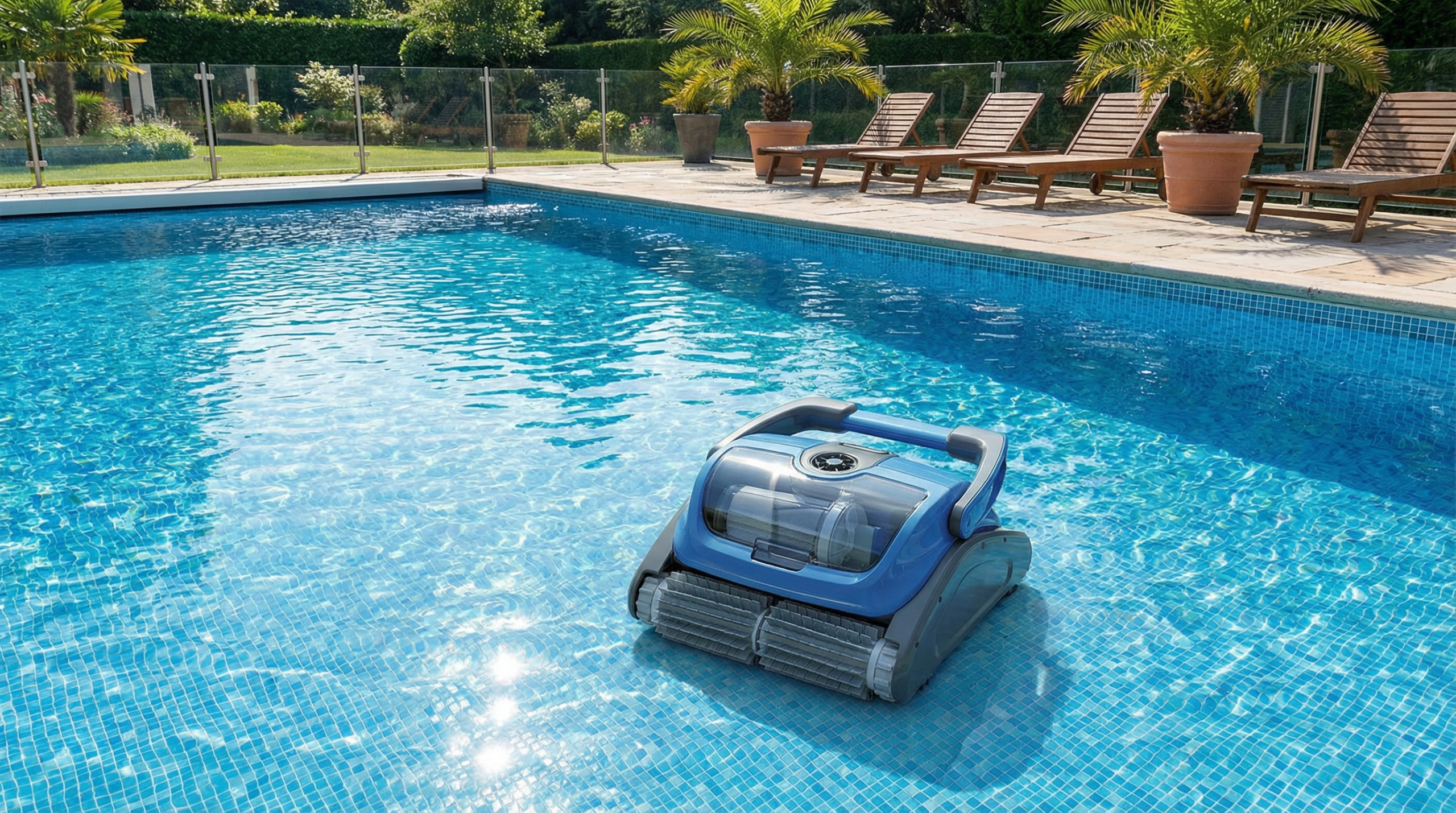
Quick Answer: The top pool cleaning robots for 2026 are the Dolphin Nautilus CC Plus ($399) for best value, Polaris P965iQ ($1,799) for premium features, Aiper Seagull SE ($229) for budget-conscious buyers, Beatbot AquaSense Pro ($2,499) for cutting-edge AI navigation, and Wybot Osprey 700 ($849) for commercial-grade performance. These automated cleaners eliminate manual pool maintenance while delivering superior cleaning results.
Why Pool Cleaning Robots Are Essential in 2026
This article contains affiliate links. TheRoboWire may earn a commission on qualifying purchases at no extra cost to you. See our affiliate disclosure for details.
Pool maintenance has evolved dramatically with the introduction of robotic pool cleaners. No longer do pool owners need to spend hours manually vacuuming, scrubbing walls, or dealing with cumbersome suction-side cleaners. The latest generation of pool robots combines artificial intelligence, advanced filtration, and energy-efficient operation to deliver hands-free pool cleaning that surpasses traditional methods.
The pool robot market reached $1.2 billion in 2025 and continues growing as homeowners recognize the time and cost savings these devices provide. Modern pool robots reduce chemical usage by up to 30% through superior debris removal and water circulation, while their energy-efficient motors consume 87% less power than traditional pool pumps during cleaning cycles.
Whether you have an above-ground pool, in-ground swimming pool, or commercial aquatic facility, robotic pool cleaners offer unmatched convenience and cleaning performance that keeps your pool sparkling clean year-round.
How Pool Cleaning Robots Work
Pool cleaning robots operate independently from your pool’s filtration system using their own motors, pumps, and filtration. These self-contained units move across pool surfaces using various drive systems:
- Track Drive Systems: Provide superior grip and climbing ability on all surfaces
- Wheel Drive Systems: Offer fast movement and efficient coverage patterns
- Hybrid Systems: Combine wheels and tracks for optimal versatility
Advanced models feature sophisticated navigation algorithms that map your pool and ensure complete coverage without random patterns. Built-in filtration systems capture debris from fine sediment to large leaves, while rotating brushes agitate surfaces to remove algae and stubborn dirt.
Top Pool Cleaning Robots for 2026
1. Dolphin Nautilus CC Plus – $399 (Best Overall Value)
The Dolphin Nautilus CC Plus continues to dominate the mid-range pool robot market with its proven CleverClean™ navigation system and exceptional cleaning performance. This model strikes the perfect balance between features, reliability, and affordability.
Key Features:
- CleverClean™ scanning and navigation
- Dual scrubbing brushes
- Large top-loading filter basket
- 2-hour cleaning cycle
- Weekly timer for automated scheduling
- 36-foot cable with swivel
- Lightweight design at 19.8 lbs
Pool Compatibility: In-ground pools up to 33 feet in length, suitable for all pool shapes and surfaces including tile, vinyl, and fiberglass.
Cleaning Performance: The CC Plus excels at floor cleaning and provides adequate wall climbing. Its dual brush system effectively removes algae and debris while the fine filtration captures particles as small as 2 microns. The CleverClean™ system ensures methodical coverage patterns that clean the entire pool floor systematically.
Pros: Excellent value, reliable performance, easy maintenance, quiet operation (quieter than most pool pumps)
Cons: No smartphone app, limited wall climbing compared to premium models, no waterline cleaning
2. Polaris P965iQ Sport – $1,799 (Premium Choice)
The Polaris P965iQ Sport represents the pinnacle of pool cleaning technology with its iQ Technology™ platform, four-wheel drive system, and comprehensive smartphone app control. This premium model delivers commercial-grade performance for residential pools.
Key Features:
- iQ Technology™ with smartphone app
- 4-Wheel Drive with ActivMotion Sensor™
- Vortex Vacuum™ technology
- Easy Lift System™ for removal
- 2.5-hour automatic cycle
- Remote spot cleaning capability
- Anti-tangle swivel cable (65 feet)
Pool Compatibility: In-ground pools up to 60 feet, all surface types, includes tile line cleaning capability.
Smartphone Integration: The iAquaLink app provides real-time monitoring, cycle scheduling, cleaning history, and manual remote control. Users can direct the robot to specific areas for spot cleaning or adjust cleaning intensity based on pool conditions.
Cleaning Performance: Superior debris pickup with Vortex Vacuum™ technology that maintains consistent suction regardless of debris load. The 4WD system provides excellent traction on vertical surfaces and the waterline, ensuring comprehensive cleaning coverage.
Pros: Advanced app control, superior climbing ability, excellent filtration, comprehensive coverage including waterline
Cons: High price point, complex features may overwhelm casual users, heavier weight (35 lbs)
3. Aiper Seagull SE – $229 (Best Budget Option)
The Aiper Seagull SE proves that effective pool cleaning doesn’t require a massive investment. This cordless pool robot offers surprising performance at an entry-level price point, making automated pool cleaning accessible to all pool owners.
Key Features:
- Cordless operation with lithium battery
- 90-minute runtime per charge
- Dual-drive motors
- Fine mesh filtration
- Lightweight design (11 lbs)
- Auto-parking when battery low
- IPX8 waterproof rating
Pool Compatibility: Above-ground and in-ground pools up to 860 sq ft, flat surfaces only (limited wall climbing).
Battery Performance: The 5000mAh lithium battery provides 90 minutes of continuous operation, sufficient for most residential pools. Fast charging takes 2.5 hours, and the robot automatically returns to the starting point when battery levels are low.
Cleaning Performance: Focuses primarily on floor cleaning with effective debris pickup for leaves, dirt, and small debris. The cordless design eliminates tangled cables and provides complete freedom of movement.
Pros: Very affordable, no cable to manage, lightweight, easy storage, good floor cleaning performance
Cons: Limited runtime, no wall cleaning, smaller filtration capacity, requires regular charging
4. Beatbot AquaSense Pro – $2,499 (Most Advanced)
The Beatbot AquaSense Pro represents the cutting edge of pool robotics with AI-powered navigation, advanced sensor arrays, and autonomous decision-making capabilities. This flagship model redefines what’s possible in automated pool maintenance.
Key Features:
- AI-powered ClariVision™ navigation
- 5-in-1 cleaning system
- Ultrasonic algae prevention
- Smart scheduling with weather integration
- Advanced mobile app with AI insights
- Self-diagnostic maintenance alerts
- 9-hour battery life (cordless)
Pool Compatibility: All pool types up to 3,200 sq ft, including complex shapes with steps, benches, and water features.
AI Technology: ClariVision™ uses computer vision to identify different types of debris, adjust cleaning patterns accordingly, and learn your pool’s optimal cleaning schedule based on usage patterns and environmental conditions.
Cleaning Performance: The 5-in-1 system includes surface skimming, floor vacuuming, wall scrubbing, waterline cleaning, and water clarification. Ultrasonic technology disrupts algae formation, reducing chemical requirements by up to 40%.
Pros: Revolutionary AI features, comprehensive cleaning, long battery life, predictive maintenance, weather-aware scheduling
Cons: Very expensive, complex setup, overkill for simple pools, requires premium app subscription for advanced features
5. Wybot Osprey 700 – $849 (Commercial Grade)
The Wybot Osprey 700 bridges the gap between residential and commercial pool cleaning with robust construction, powerful suction, and professional-grade filtration designed for heavy-duty use.
Key Features:
- Powerful dual motors (180W total)
- Triple filtration system
- Reinforced PVC tracks
- 3-hour deep cleaning cycle
- Anti-tangling 60ft cable
- All-surface climbing capability
- Commercial-grade components
Pool Compatibility: Large residential and commercial pools up to 75 feet, all surface materials including rough concrete.
Filtration System: Triple-layer filtration captures everything from fine sand to large debris. The system includes a fine mesh pre-filter, standard filter basket, and ultra-fine NanoFilters™ that trap particles down to 1 micron.
Cleaning Performance: Exceptional suction power handles heavy debris loads while aggressive brush action removes stubborn algae and biofilm. The reinforced track system provides reliable climbing on all surfaces including 90-degree walls.
Pros: Heavy-duty construction, powerful cleaning, excellent filtration, reliable wall climbing, suitable for large pools
Cons: No smartphone app, heavier weight, more expensive than basic models, louder operation
Pool Robot Comparison: Features and Specifications
| Model | Price | Pool Size | Cycle Time | Wall Climbing | App Control |
|---|---|---|---|---|---|
| Dolphin Nautilus CC Plus | $399 | Up to 33 ft | 2 hours | Limited | No |
| Polaris P965iQ Sport | $1,799 | Up to 60 ft | 2.5 hours | Excellent | Yes |
| Aiper Seagull SE | $229 | 860 sq ft | 90 minutes | No | No |
| Beatbot AquaSense Pro | $2,499 | 3,200 sq ft | Variable | Excellent | Advanced |
| Wybot Osprey 700 | $849 | Up to 75 ft | 3 hours | Excellent | No |
Key Factors When Choosing a Pool Robot
Pool Size and Shape
Match the robot’s capabilities to your pool dimensions. Small pools (under 500 sq ft) work well with basic models, while large or complex pools require advanced navigation and longer cables.
Surface Type
Different robots excel on different surfaces:
- Vinyl pools: Choose models with gentle brushes to avoid damage
- Fiberglass pools: Standard brushes work well, focus on navigation accuracy
- Concrete/Gunite: Aggressive brushes and strong suction handle rough surfaces
- Tile pools: Look for models with waterline cleaning capability
Filtration Requirements
Consider your pool’s debris load:
- Heavy debris: Large filter baskets with coarse filtration
- Fine particles: Multiple filtration stages with ultra-fine filters
- Algae problems: Models with scrubbing brushes and anti-algae features
Installation and Setup Guide
Initial Setup Steps
- Unpack and inspect: Check for shipping damage and included accessories
- Charge or connect: For cordless models, fully charge before first use
- Download apps: Install manufacturer apps for smart models
- Pool preparation: Remove large debris and ensure proper water level
- Cable management: Straighten cables and check for kinks
Optimal Operating Conditions
- Water temperature: Most robots operate best between 43-104°F
- pH levels: Maintain 7.0-7.6 for optimal brush and filter performance
- Chlorine levels: Keep free chlorine between 1-3 ppm
- Debris removal: Pre-clean large debris to prevent clogging
Maintenance and Care Tips
Daily Maintenance
- Empty filter baskets after each cleaning cycle
- Rinse filters with clean water
- Check for tangled cables or debris on brushes
- Store robot in shade when not in use
Weekly Maintenance
- Deep clean filters with mild soap solution
- Inspect brushes for wear or damage
- Check cable connections and integrity
- Clean robot exterior with soft brush
Seasonal Maintenance
- Replace worn brushes and filters
- Lubricate moving parts as recommended
- Store in climate-controlled environment during winter
- Professional service inspection for premium models
Cost Analysis: Robot vs. Traditional Cleaning
Pool robots require significant upfront investment but provide substantial long-term savings:
Traditional Cleaning Costs (Annual):
- Professional service: $1,200-$2,400
- Manual cleaning time: 156 hours (3 hours/week × 52 weeks)
- Additional chemicals: $200-$400
- Equipment replacement: $100-$200
Robot Cleaning Costs (Annual):
- Electricity: $50-$150
- Filter/brush replacement: $75-$200
- Maintenance: $0-$300
Most pool robots pay for themselves within 18-24 months through reduced service costs and chemical savings.
What size pool can robotic cleaners handle?
Modern robotic cleaners accommodate pools from small above-ground units (200 sq ft) to large commercial installations (over 3,000 sq ft). Entry-level models like the Aiper Seagull SE handle pools up to 860 sq ft, while premium units like the Beatbot AquaSense Pro clean pools up to 3,200 sq ft. Always match the robot’s specifications to your pool size for optimal performance.
How long do pool robots last?
Quality pool robots typically last 5-8 years with proper maintenance. Premium models like Dolphin and Polaris often exceed 10 years. Key factors affecting lifespan include usage frequency, water chemistry maintenance, proper storage, and regular cleaning of filters and brushes. Budget models may last 3-5 years but still provide excellent value given their lower cost.
Can pool robots damage pool surfaces?
Modern pool robots are designed to be gentle on all pool surfaces. Quality models use soft brushes and appropriate wheel materials that won’t scratch vinyl, fiberglass, or tile. However, always verify compatibility with your specific surface type and avoid using aggressive brush attachments on delicate materials like vinyl liners.
Do pool robots work in saltwater pools?
Yes, most current pool robots are designed for both chlorine and saltwater pools. Look for models specifically rated for saltwater use and constructed with corrosion-resistant materials. Saltwater pools may require more frequent maintenance of metal components, so choose robots with high-quality stainless steel or plastic construction for best longevity.
How often should I run my pool robot?
For optimal water quality, run your pool robot 2-3 times per week during swimming season. Heavy-use pools or those with significant debris may benefit from daily operation. Many robots include programmable timers for automatic scheduling. During winter months or periods of non-use, weekly cleaning cycles are usually sufficient.
What’s the difference between corded and cordless pool robots?
Corded robots like the Dolphin Nautilus CC Plus provide unlimited runtime and consistent power but require cable management. Cordless models like the Aiper Seagull SE offer complete freedom of movement and easier operation but have limited runtime (60-90 minutes) and require regular charging. Corded robots are better for large pools and thorough cleaning, while cordless units excel in convenience and ease of use.
Conclusion: Choosing Your Ideal Pool Robot
The pool robot market in 2026 offers exceptional choices across all price ranges and pool types. The Dolphin Nautilus CC Plus remains the best overall value for most pool owners, combining proven reliability with effective cleaning at a reasonable price. For those seeking premium features, the Polaris P965iQ Sport delivers professional-grade performance with comprehensive app control.
Budget-conscious buyers will find the Aiper Seagull SE provides surprising performance at an entry-level price, while the Beatbot AquaSense Pro represents the pinnacle of AI-powered pool maintenance for those wanting the latest technology. The Wybot Osprey 700 fills the niche for pool owners needing commercial-grade durability and performance.
When selecting a pool robot, prioritize models that match your pool size, surface type, and cleaning requirements. Consider long-term operating costs, maintenance requirements, and desired features like app control or advanced navigation. With proper selection and maintenance, a quality pool robot will provide years of reliable service while keeping your pool crystal clean with minimal effort.
The investment in a robotic pool cleaner pays dividends in time saved, reduced chemical usage, and consistently superior water quality that enhances your pool ownership experience throughout the swimming season.
