


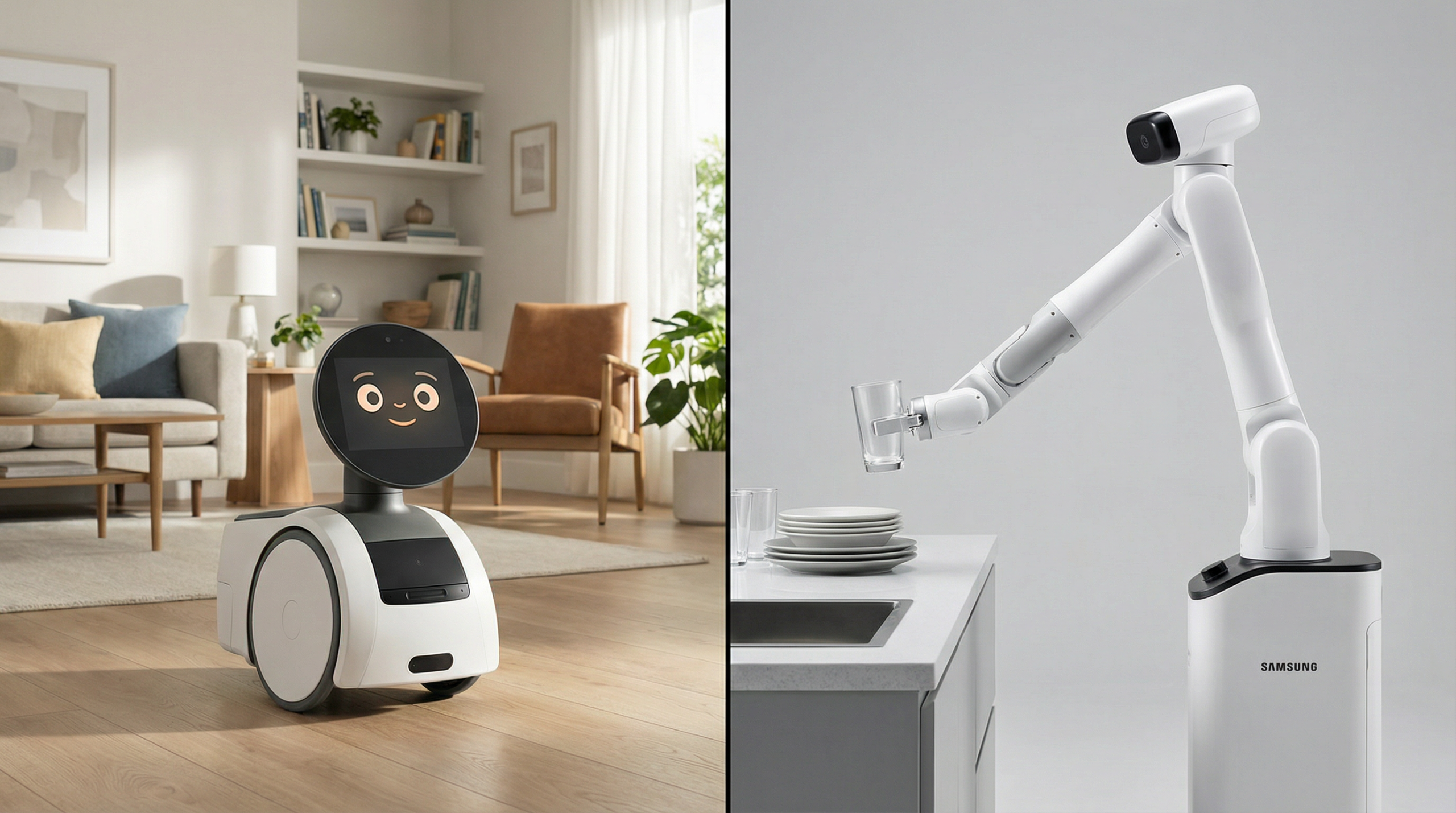
Quick Answer: Amazon Astro ($1,599) is available now with proven home security, entertainment, and Alexa integration, while Samsung Bot Handy remains in development with advanced manipulation capabilities. Astro excels in current real-world applications like monitoring, video calling, and smart home control, while Bot Handy promises future household task automation when released.
The Battle for Home Companion Supremacy
This article contains affiliate links. TheRoboWire may earn a commission on qualifying purchases at no extra cost to you. See our affiliate disclosure for details.
Home companion robots represent the next evolution in smart home technology, moving beyond single-purpose devices to comprehensive household assistants. Amazon and Samsung have emerged as the primary competitors in this space, each taking distinctly different approaches to home robotics.
Amazon Astro focuses on immediate practical applications—home security, entertainment, and smart home integration—using proven technology in a commercially available product. Samsung Bot Handy pursues advanced manipulation and task automation, promising revolutionary capabilities that remain largely conceptual.
This detailed comparison examines both robots across key categories including functionality, technology, pricing, and real-world utility to help you understand which approach better serves today’s smart home needs.
Amazon Astro: The Available Reality
Overview and Availability
Amazon Astro launched in late 2021 as an invitation-only product and became widely available in 2024. Currently priced at $1,599, Astro represents Amazon’s entry into home robotics, leveraging the company’s strengths in AI, cloud services, and smart home ecosystems.
Astro measures 17.1″ x 13.5″ x 23.6″ and weighs 20.25 pounds, making it a substantial but manageable presence in the home. The robot’s design emphasizes approachability with a rounded form factor, expressive display “face,” and quiet operation suitable for family environments.
Core Functionality
Home Security and Monitoring:
- Perimeter Guard technology patrols designated areas
- Person recognition identifies family members vs. strangers
- Real-time alerts sent to smartphones
- Remote monitoring through the Astro app
- Integration with Ring security ecosystem
Entertainment and Communication:
- 12.3″ HD touchscreen for video content
- Voice and video calling through Alexa Communication
- Music playback with room-following capability
- Interactive games and activities
- YouTube, Prime Video, and streaming service support
Smart Home Control:
- Alexa Built-in with mobile capabilities
- Visual ID for personalized responses
- Smart home device control throughout the house
- Routine automation and scheduling
- Drop-in communication between rooms
Technical Specifications
Navigation and Mobility:
- Advanced SLAM (Simultaneous Localization and Mapping)
- Time-of-flight sensors and computer vision
- Autonomous navigation and obstacle avoidance
- Carpet and hard floor compatibility
- Automatic charging dock return
AI and Processing:
- On-device processing for privacy-sensitive features
- Cloud integration for advanced AI capabilities
- Continuous learning and feature updates
- Edge inference for real-time responses
Samsung Bot Handy: The Ambitious Future
Development Status and Timeline
Samsung Bot Handy was first introduced at CES 2021 as a concept robot showcasing advanced AI and manipulation capabilities. As of 2026, Bot Handy remains in development without confirmed commercial availability or pricing, though Samsung continues demonstrating evolved prototypes at technology exhibitions.
The robot’s design emphasizes functionality over approachability, featuring a tall, utilitarian form with a sophisticated robotic arm capable of precise object manipulation. Current prototypes measure approximately 3 feet in height with a mobile base and articulated arm system.
Promised Capabilities
Household Task Automation:
- Object recognition and manipulation
- Dish loading/unloading from dishwashers
- Laundry folding and organization
- Table setting and clearing
- Light cleaning and organization tasks
AI and Learning:
- Advanced computer vision for object identification
- Machine learning adaptation to household routines
- Natural language processing for task commands
- Predictive task scheduling based on user behavior
Integration Features:
- Samsung SmartThings ecosystem connectivity
- Bixby voice assistant integration
- Samsung appliance coordination
- Mobile app control and monitoring
Technical Challenges
Bot Handy’s ambitious capabilities face significant engineering hurdles:
- Manipulation Complexity: Safely handling fragile household objects
- AI Recognition: Distinguishing between thousands of household items
- Safety Systems: Preventing accidents during physical tasks
- Cost Engineering: Making advanced robotics affordable for consumers
Head-to-Head Comparison
| Feature | Amazon Astro | Samsung Bot Handy |
|---|---|---|
| Availability | Available now | Development phase |
| Price | $1,599 | TBA (estimated $3,000+) |
| Primary Function | Security & Entertainment | Household Task Automation |
| Physical Manipulation | None | Advanced robotic arm |
| Display | 12.3″ HD touchscreen | Basic status indicators |
| Voice Assistant | Alexa Built-in | Bixby integration |
| Smart Home Integration | Extensive Amazon ecosystem | Samsung SmartThings focus |
Real-World Performance: Amazon Astro
User Experience
Current Astro owners report mixed but generally positive experiences. The robot excels in its core competencies—home monitoring, entertainment, and smart home control—while revealing limitations in advanced AI interactions and physical capabilities.
Strengths in Practice:
- Reliable home security patrols with accurate person recognition
- Excellent entertainment capabilities, especially for families with children
- Seamless integration with existing Alexa devices and routines
- Intuitive app control and monitoring features
- Generally reliable navigation, though occasional confusion in complex spaces
Common Limitations:
- No physical manipulation capabilities limit practical assistance
- Battery life of 1-3 hours depending on usage intensity
- Occasional navigation issues in cluttered or poorly lit areas
- Limited conversation capabilities beyond basic Alexa functions
- High price point for functionality delivered
Home Integration Success Stories
Users report particular success with Astro in several scenarios:
- Elderly Care: Remote monitoring and communication for aging relatives
- Pet Monitoring: Checking on pets while away from home
- Child Entertainment: Interactive games and educational content
- Security Patrols: Automated monitoring of specific home areas
Practical Applications and Use Cases
Amazon Astro: Current Reality
Daily Routine Integration:
Astro integrates into daily routines through scheduled patrols, entertainment following, and smart home automation. Users appreciate the robot’s ability to provide security peace-of-mind while offering entertainment value for family members.
Remote Monitoring:
The robot’s remote monitoring capabilities prove valuable for checking on homes, pets, or elderly family members. Real-time video streaming and two-way communication provide genuine utility for peace of mind.
Smart Home Hub:
As a mobile Alexa device, Astro brings voice control to any room, eliminating dead zones and providing consistent smart home access throughout the house.
Samsung Bot Handy: Future Potential
Household Automation Vision:
If successfully developed, Bot Handy could revolutionize household management through physical task automation. The ability to load dishwashers, fold laundry, and organize spaces would represent a significant leap in domestic robotics.
Elderly and Disability Assistance:
Physical manipulation capabilities could provide substantial assistance for users with mobility limitations or age-related challenges, offering independence support that current robots cannot provide.
Privacy and Security Considerations
Amazon Astro Privacy Features
- On-device processing for visual ID and basic navigation
- Encrypted data transmission to AWS cloud services
- User control over data sharing and storage preferences
- Physical camera/microphone shutoff switches
- Regular security updates and patches
Data Handling Concerns
Both robots raise privacy questions related to home monitoring and data collection:
- Visual Data: Continuous home mapping and person recognition
- Audio Recording: Always-listening capabilities for voice commands
- Behavioral Patterns: Learning household routines and preferences
- Cloud Storage: Remote data processing and storage implications
Cost Analysis and Value Proposition
Amazon Astro: Current Investment
Initial Cost: $1,599 plus optional accessories
Ongoing Costs: Potential subscription services, replacement parts
Value Comparison: Premium Echo device + basic security camera system
Astro’s pricing positions it as a premium smart home device rather than essential household appliance. The value proposition depends heavily on user priorities for security, entertainment, and smart home integration.
Samsung Bot Handy: Projected Economics
Estimated Pricing: Industry analysts project $3,000-$5,000 based on complexity
Value Potential: Could replace multiple household services if capabilities deliver as promised
Market Positioning: Luxury household automation for affluent early adopters
Future Outlook and Development
Amazon Astro Evolution
Amazon continues developing Astro with regular software updates adding new capabilities:
- Enhanced AI conversation abilities through improved language models
- Expanded entertainment content and interactive applications
- Deeper smart home integration with new device categories
- Potential hardware iterations with improved sensors and capabilities
Samsung Bot Handy Timeline
Samsung has not announced concrete commercial availability timelines, suggesting significant development challenges remain. Industry observers estimate potential consumer availability in 2027-2028, contingent on resolving technical and safety hurdles.
Which robot has better smart home integration?
Amazon Astro currently offers superior smart home integration through its mature Alexa ecosystem, supporting over 100,000 compatible devices across hundreds of brands. Samsung Bot Handy would integrate with SmartThings, which has fewer compatible devices but strong Samsung appliance integration. Astro’s established ecosystem gives it a significant current advantage.
Can these robots actually help with household chores?
Amazon Astro cannot perform physical household chores due to its lack of manipulation capabilities. Samsung Bot Handy promises extensive chore assistance including dish loading, laundry folding, and cleaning tasks, but these capabilities remain unproven in real-world applications. Currently, no companion robot offers reliable household chore assistance beyond monitoring and communication.
How do these robots handle navigation in complex homes?
Amazon Astro uses advanced SLAM technology with time-of-flight sensors and computer vision for reliable navigation in most home environments. It struggles occasionally in very cluttered spaces or areas with complex furniture arrangements. Samsung Bot Handy’s navigation capabilities remain largely theoretical, though demonstrations suggest similar SLAM-based systems with additional sensors for manipulation tasks.
What are the ongoing costs of owning these robots?
Amazon Astro has minimal ongoing costs beyond electricity (~$2-5 monthly). Optional Ring Protect plans cost $3-10 monthly for enhanced security features. Samsung Bot Handy’s ongoing costs are unknown but likely include software subscriptions, maintenance plans, and replacement parts for the complex robotic arm system, potentially $200-500 annually.
Are these robots suitable for homes with pets and children?
Amazon Astro is designed for family environments with pet and child recognition capabilities, quiet operation, and robust construction. However, the moving robot can initially startle pets. Samsung Bot Handy’s suitability with pets and children remains unclear given its powerful robotic arm, though Samsung emphasizes safety systems in development materials.
How reliable are these robots for daily use?
Amazon Astro shows good reliability for its intended functions, with most users reporting consistent performance after an initial learning period. Software updates regularly add features and fix issues. Samsung Bot Handy’s reliability cannot be assessed as it remains in development, though the complexity of physical manipulation tasks suggests potential reliability challenges compared to monitoring-focused robots like Astro.
Conclusion: Present Reality vs Future Promise
The comparison between Amazon Astro and Samsung Bot Handy illuminates the current state of home companion robotics—practical applications available today versus revolutionary capabilities promised for tomorrow.
Amazon Astro succeeds by focusing on achievable goals using proven technology. Its home security, entertainment, and smart home integration provide genuine value for users seeking those specific capabilities. While Astro doesn’t revolutionize household management, it delivers reliable performance in its intended roles and represents a solid entry point into home robotics.
Samsung Bot Handy’s ambitious vision of comprehensive household assistance represents the ultimate goal of home robotics—true automation of domestic tasks. However, the technical challenges of safe, reliable object manipulation in diverse home environments have kept these capabilities in development for years.
For 2026, Amazon Astro offers the better choice for consumers wanting a companion robot today. Its proven capabilities, regular updates, and established ecosystem provide immediate value despite limitations. Samsung Bot Handy remains an intriguing but unproven concept that may reshape home robotics if successfully commercialized.
The winner of this comparison depends on your timeline and expectations. Choose Astro if you want a capable home companion now; wait for Bot Handy if you’re willing to bet on future revolutionary household automation. The companion robot market continues evolving rapidly, with both approaches likely to influence the next generation of home robotics technology.
