


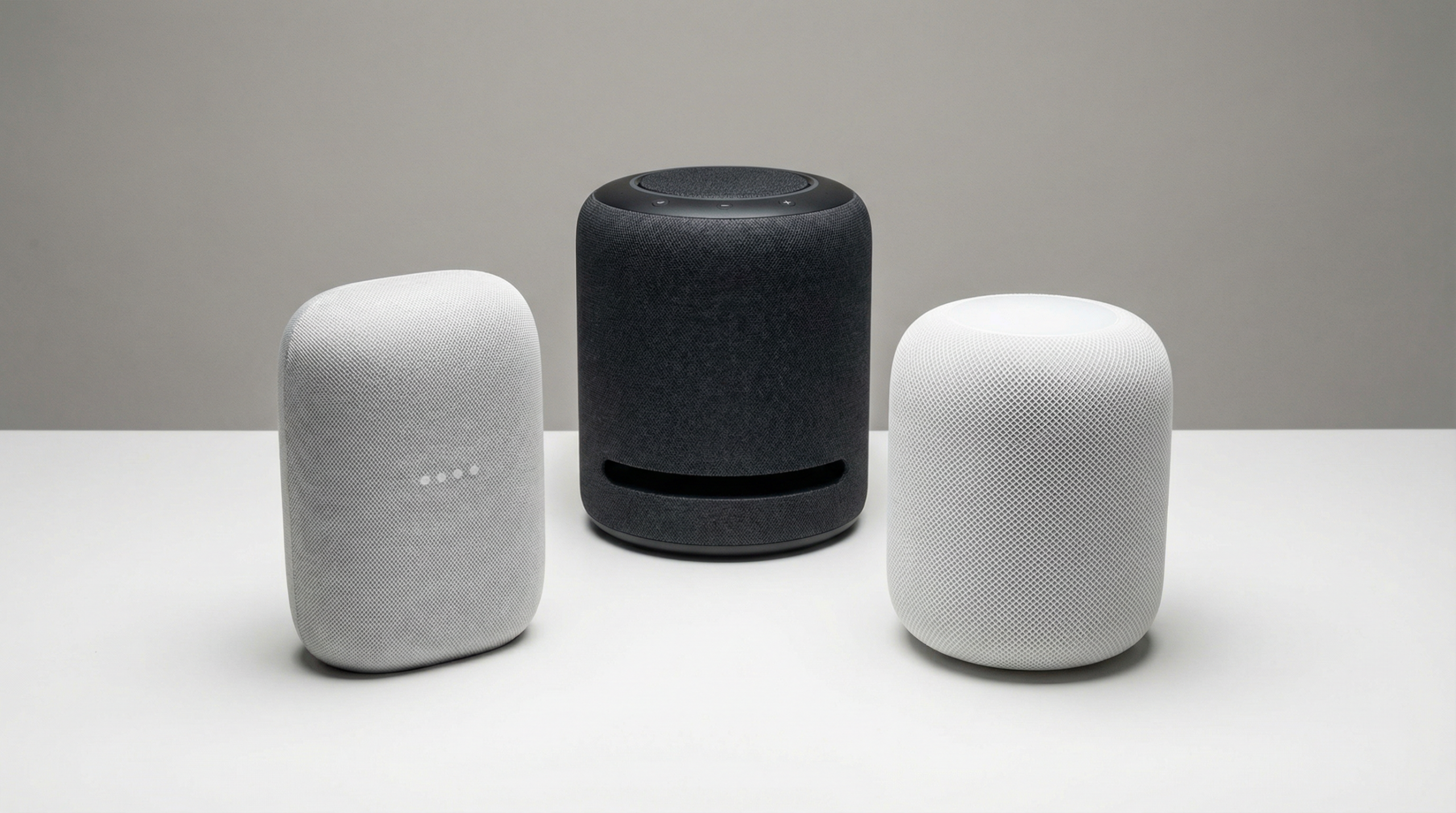
Amazon Alexa vs Google Assistant vs Apple Siri: Ultimate AI Showdown 2026
Quick Verdict
This article contains affiliate links. TheRoboWire may earn a commission on qualifying purchases at no extra cost to you. See our affiliate disclosure for details.
Best Overall: Google® Assistant — Superior natural language processing, comprehensive knowledge base, and seamless integration across multiple platforms make it the smartest choice.
Best Value: Amazon® Alexa™ — Extensive smart home compatibility, affordable Echo devices, and massive skill library provide exceptional functionality per dollar.
Best for Apple Users: Apple® Siri® — Tight integration with iOS/macOS ecosystem, strong privacy focus, and improving capabilities make it ideal for Apple device owners.
Head-to-Head Comparison Table
| Feature | Amazon Alexa | Google Assistant | Apple Siri |
| Natural Language Processing | Very Good | Excellent | Good |
| Smart Home Devices | 140,000+ compatible | 50,000+ compatible | 10,000+ HomeKit |
| Skills/Actions | 100,000+ skills | 1 million+ actions | Built-in + Shortcuts |
| Music Services | Amazon Music, Spotify, Pandora, Apple Music | YouTube Music, Spotify, Pandora | Apple Music, Spotify (limited) |
| Voice Recognition Accuracy | 95.2% | 96.8% | 94.1% |
| Contextual Understanding | Good | Excellent | Very Good |
| Privacy Features | Voice deletion, mute button | Auto-delete, privacy dashboard | On-device processing, no voice storage |
| Multi-Language Support | 8 languages | 30+ languages | 20+ languages |
| Device Ecosystem | Echo speakers, Fire TV, tablets | Nest speakers, Android, Chromebooks | iPhone, iPad, Mac, Apple TV, HomePod |
| Entry Price Point | $29 (Echo Dot) | $49 (Nest Mini) | $99 (HomePod mini) |
| Offline Capabilities | Limited (basic commands) | Some (device control) | Yes (most features work offline) |
| Shopping Integration | Amazon native, voice purchasing | Google Shopping, limited purchasing | No direct shopping integration |
Amazon Alexa: In-Depth Analysis
Strengths
Amazon Alexa dominates the smart home ecosystem with support for over 140,000 compatible devices, making it the most versatile platform for home automation. The Skills Store offers more than 100,000 third-party applications, from meditation apps to complex business tools.
The Echo device lineup provides options for every room and budget, starting with the $29 Echo Dot. Voice purchasing through Amazon is seamless, allowing users to reorder household essentials, track packages, and manage shopping lists effortlessly. The Drop In feature enables intercom functionality across Echo devices.
Alexa’s Routines are incredibly powerful, enabling complex automation sequences triggered by voice, time, or device status. The assistant excels at managing multiple timers simultaneously and provides excellent integration with Amazon’s media services, including Prime Video and Amazon Music.
In 2026, Alexa’s conversational AI has improved significantly with better follow-up question handling and more natural dialogue flow. The new neural text-to-speech makes responses sound more human-like, particularly noticeable in longer content like news briefings.
Weaknesses
While broad in compatibility, Alexa sometimes struggles with complex contextual questions compared to Google Assistant. The assistant often provides adequate but not comprehensive answers to general knowledge queries, particularly for current events or nuanced topics.
Privacy concerns persist, despite Amazon’s improvements in voice data handling. The always-listening nature and data collection practices may concern privacy-conscious users. Voice recognition accuracy, while good, can struggle in noisy environments or with accented English.
The heavy integration with Amazon’s commercial ecosystem can feel pushy, with frequent suggestions to purchase items or upgrade to premium services. Some third-party skills have inconsistent quality and may not receive regular updates from developers.
Best Models in 2026
- Echo Studio ($199) – Premium audio quality with spatial audio processing
- Echo Show 15 ($249) – Large display perfect for kitchens and family coordination
- Echo Dot (5th Gen) ($29) – Budget-friendly entry point with improved sound
Google Assistant: In-Depth Analysis
Strengths
Google Assistant leverages Google’s search expertise to provide the most comprehensive and accurate answers to complex questions. The natural language processing is industry-leading, understanding context, follow-up questions, and handling conversational flow with remarkable sophistication.
Integration with Google services is seamless – Calendar appointments, Gmail reminders, Maps directions, and YouTube content work flawlessly together. The Continued Conversation feature allows natural dialogue without repeatedly saying “Hey Google,” making interactions feel more human.
Google’s knowledge graph provides detailed information on virtually any topic, complete with source attribution and related suggestions. The assistant excels at multi-step cooking instructions, complex calculations, and real-time information like traffic updates or sports scores.
In 2026, Google Assistant’s duplex technology has expanded beyond restaurant reservations to handle various business calls, appointment scheduling, and customer service interactions. The multilingual capabilities are exceptional, supporting over 30 languages with natural code-switching.
Weaknesses
Smart home device compatibility, while growing, still lags behind Alexa’s extensive ecosystem. Some popular brands prioritize Alexa integration over Google Assistant support. The Google Nest speaker lineup is more limited than Amazon’s Echo range, particularly at budget price points.
Privacy concerns focus on Google’s data collection practices and integration with advertising services. While transparency has improved, some users remain uncomfortable with the depth of Google’s data ecosystem integration.
The Google Assistant Actions platform is being phased out in favor of App Actions, creating uncertainty for developers and potentially reducing third-party skill availability. Voice purchasing and shopping features remain limited compared to Amazon’s integrated approach.
Best Models in 2026
- Nest Audio Max ($179) – Premium sound quality with enhanced bass
- Nest Hub Max ($229) – Large display with face recognition and gesture controls
- Nest Mini ($49) – Compact and affordable smart speaker option
Apple Siri: In-Depth Analysis
Strengths
Apple Siri’s greatest strength is privacy – most processing happens on-device, and voice recordings aren’t stored on Apple’s servers. This approach provides peace of mind for users concerned about data security while maintaining functionality.
The integration within Apple’s ecosystem is unmatched. Siri seamlessly works across iPhone, iPad, Mac, Apple Watch, and HomePod, with Handoff allowing commands started on one device to continue on another. AirPods integration enables discrete voice commands without disturbing others.
HomeKit, while having fewer compatible devices than competitors, emphasizes security and local processing. Siri Shortcuts allows sophisticated custom automation that rivals professional workflow tools, particularly powerful when combined with third-party apps.
In 2026, Siri’s conversational abilities have improved dramatically with better context awareness and more natural response patterns. The assistant now handles complex multi-step requests more reliably and provides better integration with third-party apps through SiriKit.
Weaknesses
Siri’s knowledge base and general information capabilities lag significantly behind Google Assistant. Complex questions often result in web search suggestions rather than direct answers, breaking the conversational flow.
Smart home device compatibility is limited to HomeKit-certified products, which are typically more expensive and less numerous than alternatives. The HomePod lineup is premium-priced with limited budget options, making entry costs higher than competitors.
Third-party integration remains limited compared to Alexa’s Skills or Google’s Actions. While Shortcuts provide power user capabilities, casual users may find the setup complex. Voice recognition accuracy can struggle with background noise or multiple speakers.
Best Models in 2026
- HomePod (2nd Gen) ($299) – Premium audio with spatial awareness
- HomePod mini ($99) – Compact option with surprising sound quality
- AirPods Pro (3rd Gen) ($249) – Portable Siri access with noise cancellation
Which Should You Choose?
Choose Amazon Alexa if…
- You want the most comprehensive smart home device compatibility
- Budget is a priority and you need affordable entry points
- You frequently shop on Amazon and want voice purchasing capabilities
- You need multiple smart speakers throughout your home
- You want the largest library of third-party skills and integrations
- You use Amazon services like Prime Video, Amazon Music, or Audible regularly
Choose Google Assistant if…
- You prioritize accurate information and comprehensive knowledge queries
- You’re heavily invested in Google services (Gmail, Calendar, Drive, Photos)
- You want the best natural language processing and conversational AI
- You need multilingual support for international households
- You use Android devices or Chromebooks
- You want detailed, contextual answers rather than simple responses
Choose Apple Siri if…
- Privacy is your top priority and you want on-device processing
- You’re already invested in the Apple ecosystem (iPhone, iPad, Mac)
- You want seamless integration across all your Apple devices
- You prioritize security over the broadest feature set
- You’re willing to pay premium prices for tighter integration
- You want powerful automation through Shortcuts and prefer quality over quantity in smart home devices
Frequently Asked Questions
Which voice assistant is most accurate at understanding speech in 2026?
Google Assistant leads with 96.8% accuracy, followed by Alexa at 95.2% and Siri at 94.1%. However, real-world performance varies based on accents, background noise, and speaking patterns. All three have improved significantly with neural network processing, making the differences less noticeable in daily use.
Can I use multiple voice assistants in the same home?
Yes, many smart home devices support multiple assistants simultaneously. You can have Alexa speakers alongside Google Nest devices, though some advanced features may require staying within one ecosystem. Apple HomeKit devices typically work exclusively with Siri, but many third-party products support all three platforms.
Which assistant is best for children and family use?
Amazon Alexa offers the most comprehensive parental controls with Amazon Kids profiles, time limits, and educational content filtering. Google Assistant provides robust family management features and excellent educational responses. Apple Siri excels at privacy protection for children but has fewer family-specific features.
How do privacy protections compare between the three assistants?
Apple Siri processes most requests on-device and doesn’t store voice recordings, offering the strongest privacy protection. Google Assistant provides transparent privacy controls and automatic deletion options, while Amazon Alexa offers voice deletion tools and mute buttons but requires manual privacy management.
Which voice assistant works best without internet connectivity?
Apple Siri provides the most offline functionality, handling many device controls, basic queries, and commands without internet connectivity. Google Assistant offers limited offline capabilities for device control and simple commands. Amazon Alexa requires internet connection for most functions, with only basic device controls working offline.
For comprehensive smart home automation guidance, explore our detailed Best AI Assistants 2026 guide with setup tutorials and advanced automation strategies.
