


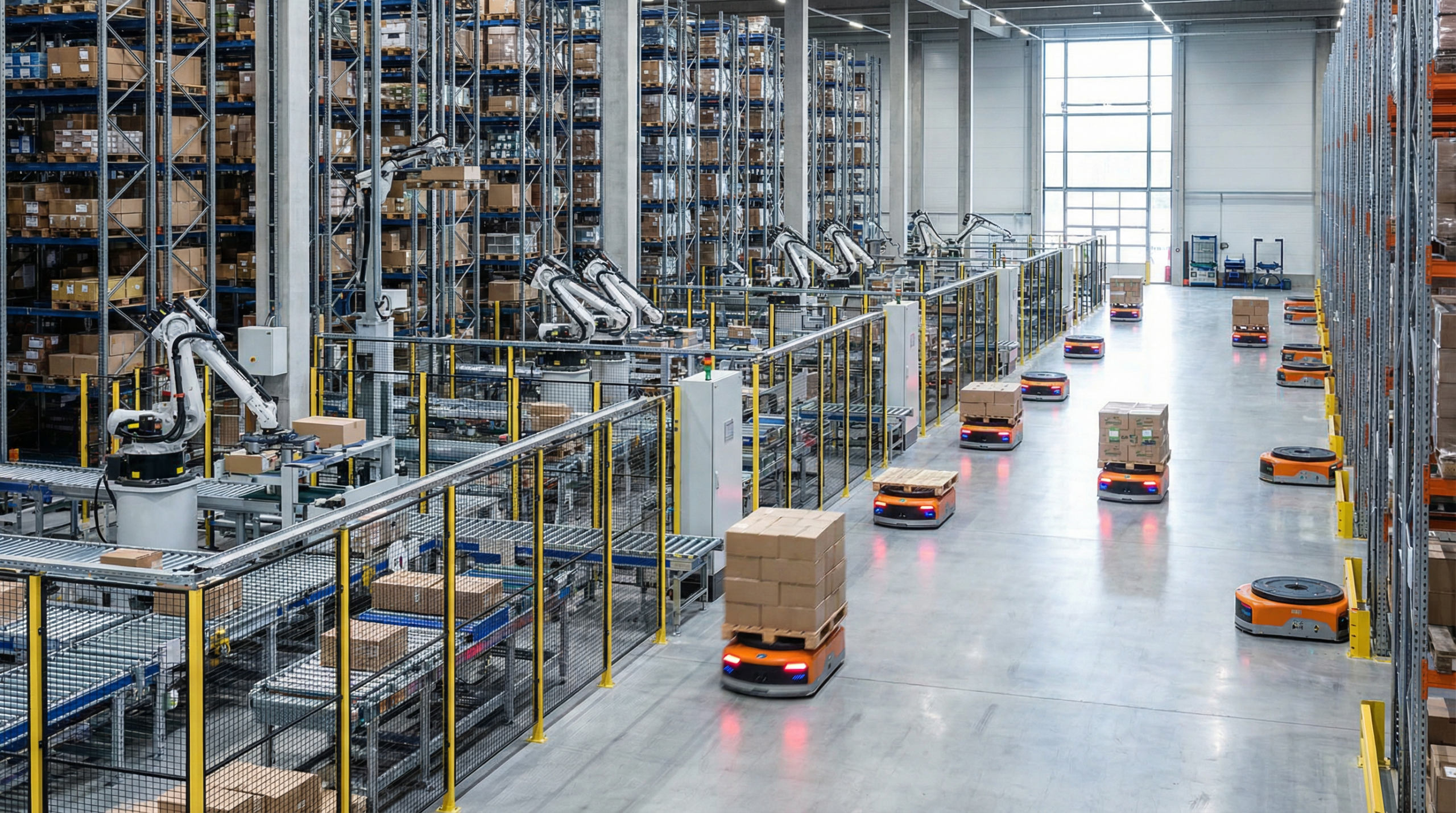
Quick Answer: Warehouse robotics reached $8.2 billion in 2025, led by Amazon’s 500,000+ robots, Locus Robotics’ 350 deployments, and AutoStore’s 1,300 systems. Key technologies include Amazon’s Proteus AMR, Geek+’s shelf-moving robots, and 6 River Systems’ collaborative picking bots, delivering 40-70% productivity gains.
The Warehouse Automation Revolution
This article contains affiliate links. TheRoboWire may earn a commission on qualifying purchases at no extra cost to you. See our affiliate disclosure for details.
Warehouse automation transformed from experimental technology to competitive necessity, driven by e-commerce growth, labor shortages, and customer expectations for same-day delivery. The global warehouse robotics market reached $8.2 billion in 2025, with 45% annual growth as retailers race to automate fulfillment operations.
This comprehensive analysis examines leading warehouse robot technologies, deployment strategies, and ROI metrics from Amazon’s massive automation push to emerging solutions from specialized robotics companies reshaping logistics worldwide.
Market Leaders and Technologies
| Company | Robot Type | Installations | Key Customers | Productivity Gain |
|---|---|---|---|---|
| Amazon Robotics | Drive Units, AMRs, Robotic Arms | 500,000+ | Amazon fulfillment | 50-75% |
| Locus Robotics | Collaborative AMRs | 350 sites | DHL, FedEx, Verst | 40-60% |
| AutoStore | Grid-based storage/retrieval | 1,300 systems | Best Buy, Puma, ASDA | 60-80% |
| Geek+ | Shelf-moving AMRs | 20,000+ robots | Nike, Walmart, Decathlon | 45-65% |
| 6 River Systems (Shopify) | Collaborative picking bots | 200+ deployments | GXO, XPO, Lovesac | 35-50% |
Amazon’s Robotics Empire
Massive Scale Deployment
Amazon operates over 500,000 robots across 185+ fulfillment centers worldwide, representing the largest warehouse robotics deployment in history. The company’s $13.7 billion robotics division develops proprietary solutions exclusively for Amazon operations.
Core Technologies
Proteus Autonomous Mobile Robots (AMRs):
Launched in 2022, Proteus robots navigate dynamically around human workers using advanced computer vision and SLAM (Simultaneous Localization and Mapping) technology. Unlike earlier cage-restricted robots, Proteus operates safely in human work areas.
Specifications:
- Payload: 1,500 pounds
- Navigation: LiDAR and computer vision
- Battery life: 10-12 hours continuous operation
- Safety features: Real-time human detection and avoidance
Sparrow Robotic Arm:
Amazon’s newest picking robot uses computer vision and suction technology to handle individual items. Sparrow identifies and picks millions of product SKUs, advancing Amazon’s goal of fully automated fulfillment.
Performance metrics:
- Pick rate: 1,200+ items per hour
- Accuracy: 99.5% successful picks
- SKU recognition: 65% of Amazon’s catalog
- Deployment: 25 fulfillment centers by late 2025
Drive Units (Kiva Legacy):
Amazon’s original warehouse robots move entire shelves to human pickers, eliminating walking time and increasing pick density. Over 350,000 Drive Units operate in “Amazon Robotics Fulfillment Centers.”
Operational Impact
Amazon’s robotics deployment delivers measurable results:
- Productivity gain: 50-75% increase in items per hour
- Storage efficiency: 40% more inventory in same space
- Order fulfillment: Reduced from hours to minutes
- Safety improvement: 15% reduction in workplace injuries
- Cost reduction: $300 million annually in operational savings
Locus Robotics: Collaborative Innovation
Human-Robot Collaboration
Locus Robotics pioneered collaborative warehouse automation where robots work alongside human workers rather than replacing them. Their AMRs guide workers to pick locations, optimizing routes and increasing efficiency.
LocusBot Specifications:
- Payload: 60-100 pounds
- Runtime: 12+ hours on single charge
- Speed: 5.6 mph maximum
- Navigation: LiDAR, cameras, and proprietary mapping
- Fleet size: Up to 2,000 robots per facility
Customer Success Stories
DHL Implementation:
DHL deployed Locus robots in 18 facilities across North America, achieving:
- 2.5x productivity improvement in picking operations
- 50% reduction in training time for new workers
- 15% improvement in order accuracy
- ROI achieved within 18 months
Verst Logistics Partnership:
This third-party logistics provider uses Locus robots for multiple clients:
- 60% increase in picks per hour
- 30% reduction in labor requirements
- Ability to handle 3x seasonal volume spikes
- Flexible deployment across different product categories
AutoStore: Dense Storage Revolution
Grid-Based Innovation
AutoStore’s patented cube storage system maximizes warehouse density using robots that operate on top of a grid structure. This design achieves the highest storage density in the industry while maintaining rapid access to inventory.
System Components:
- Grid structure: Aluminum framework holding storage bins
- Robots: Operate on top of grid, lift bins for retrieval
- Ports: Workstations where humans pick from bins
- Bins: Standardized containers holding inventory
Robot Specifications (R5+ model):
- Lifting capacity: 35kg (77 lbs)
- Speed: 4.1 m/s maximum
- Battery life: 1.5+ hours continuous operation
- Dig depth: Up to 24 bins deep
- Fleet size: 300+ robots per system
Deployment Examples
Best Buy Transformation:
Best Buy installed AutoStore in multiple distribution centers:
- Storage density increased 400%
- Order fulfillment speed improved 500%
- Labor requirements reduced 40%
- Same-day delivery capability enabled
- System handles 150,000+ SKUs efficiently
PUMA European Hub:
Sportswear giant PUMA’s German distribution center achieves:
- 1.2 million items stored in compact footprint
- 99.9% order accuracy
- 50,000+ orders processed daily
- Integration with existing WMS and ERP systems
Geek+: Global Scaling
Shelf-Moving Technology
Geek+ specializes in robots that move entire storage shelves to picking stations, similar to Amazon’s approach but available for external customers. Their solutions serve diverse industries from fashion to pharmaceuticals.
Popular Models:
RoboShuttle:
- Payload: 300-800kg depending on model
- Navigation: QR codes and visual SLAM
- Fleet management: Centralized AI optimization
- Charging: Automatic wireless charging stations
PopPick:
- Compact design for small-item picking
- Payload: 300kg shelf capacity
- Ideal for e-commerce and pharmacy applications
- Easy integration with existing shelving
Major Deployments
Nike Asian Operations:
Nike deployed Geek+ robots across multiple Asian facilities:
- 70% improvement in picking efficiency
- Handling 1 million+ orders during peak seasons
- Multi-floor operations with automated lifts
- Integration with global inventory management
Walmart China Partnership:
Walmart China uses Geek+ for fresh food and general merchandise:
- Temperature-controlled operations for perishables
- Mixed-case picking for store replenishment
- 99.5% order accuracy maintained
- Rapid deployment across 20+ facilities
6 River Systems (Shopify): E-commerce Focus
Chuck Robot Technology
Acquired by Shopify in 2019, 6 River Systems developed Chuck robots specifically for e-commerce fulfillment. These collaborative AMRs work alongside human pickers in traditional warehouse layouts.
Chuck Specifications:
- Payload: 50 pounds
- Runtime: 8-10 hours per shift
- Navigation: Computer vision and LiDAR
- Display: Tablet interface for worker interaction
- Deployment: Starts with 5-10 robots per facility
E-commerce Optimization
Chuck robots excel in environments with:
- High SKU velocity and seasonality
- Mixed product sizes and weights
- Rapid order processing requirements
- Existing warehouse infrastructure
- Variable labor availability
Typical Results:
- 35-50% productivity improvement
- 25% reduction in walking time
- Improved order accuracy through guided picking
- Better worker satisfaction and retention
Emerging Technologies and Innovations
Boston Dynamics Stretch
Boston Dynamics entered warehouse robotics with Stretch, a mobile robot designed for truck unloading and palletizing operations.
Capabilities:
- Unloads boxes from trailers using computer vision
- Handles boxes up to 50 pounds
- Mobile base navigates dock environments
- Advanced gripper technology for varied box sizes
- Deployment at DHL and other logistics providers
Zebra Technologies Solutions
Zebra expanded beyond scanning technology into autonomous mobile robots for warehouse applications.
Fetch AMRs:
- Collaborative picking and material transport
- Integration with Zebra’s data capture ecosystem
- Enterprise software for fleet management
- Focus on healthcare and retail sectors
GreyOrange Ranger Series
GreyOrange develops AI-powered robots for goods-to-person fulfillment.
Ranger Specifications:
- Payload: 20-300kg depending on model
- Navigation: Proprietary GreyMatter™ AI
- Integration: APIs for WMS and inventory systems
- Deployment: Major retailers across Asia and Europe
ROI Analysis and Implementation Costs
Investment Breakdown
| Solution Type | Initial Investment | Annual Operating Cost | Typical ROI Timeline | Productivity Gain |
|---|---|---|---|---|
| Amazon-style Drive Units | $2-5 million | $300,000-$500,000 | 2-3 years | 60-75% |
| Collaborative AMRs | $500,000-$2 million | $150,000-$300,000 | 18-24 months | 40-60% |
| AutoStore Grid System | $3-8 million | $400,000-$800,000 | 2-4 years | 60-80% |
| Robotic Picking Arms | $1-3 million | $200,000-$400,000 | 2-3 years | 70-90% |
Cost Factors
Hardware costs: Robots, charging stations, software licenses
Installation: System integration, facility modifications, testing
Training: Worker education, management processes
Maintenance: Regular service, software updates, replacement parts
Implementation Challenges and Solutions
Technical Challenges
Facility Integration:
Existing warehouses often require significant modifications:
- Floor reinforcement for heavy robot traffic
- WiFi infrastructure upgrades for robot communication
- Charging station installation and electrical upgrades
- Safety systems and emergency protocols
System Integration:
Robots must integrate with existing warehouse management systems:
- API development for real-time inventory updates
- Custom workflow programming
- Quality control and exception handling
- Performance monitoring and optimization
Operational Challenges
Workforce Transition:
Employee adaptation requires careful change management:
- Training programs for human-robot collaboration
- Job role evolution rather than replacement
- Performance metrics adjustment
- Safety protocol education
Scalability Planning:
Successful deployments plan for growth:
- Modular system design for expansion
- Robot fleet management capabilities
- Seasonal capacity planning
- Technology upgrade paths
Industry Sector Applications
E-commerce Fulfillment
Online retailers drive warehouse robotics adoption:
- Amazon: Full automation across 185+ centers
- Walmart: Automated micro-fulfillment centers
- Target: Robotics in supply chain modernization
- Shopify: Chuck robots for merchant fulfillment
Third-Party Logistics (3PL)
3PL providers leverage robotics for competitive advantage:
- DHL: Locus robots in 18+ North American facilities
- FedEx: Collaborative robots for package sorting
- XPO Logistics: Multiple robotic solutions across facilities
- C.H. Robinson: AutoStore for high-density storage
Retail and Fashion
Apparel and general merchandise benefit from flexibility:
- Nike: Geek+ robots for global distribution
- PUMA: AutoStore for European operations
- UNIQLO: Automated picking in Japanese facilities
- Best Buy: AutoStore for omnichannel fulfillment
Future Trends and Predictions
Technology Evolution
AI and Machine Learning:
Advanced algorithms will enable:
- Predictive maintenance reducing downtime
- Dynamic route optimization for maximum efficiency
- Autonomous decision-making for exception handling
- Demand forecasting integration with inventory
Computer Vision Advances:
Improved perception capabilities will enable:
- Universal item picking without pre-programming
- Quality inspection and damage detection
- Real-time inventory tracking and counting
- Enhanced human-robot safety systems
Market Projections
Industry analysts project:
- Market size reaching $23 billion by 2030
- 50%+ of large warehouses deploying robotics
- Collaborative robots becoming dominant category
- Full lights-out facilities for specific applications
Strategic Implementation Guide
Assessment Framework
- Operational Analysis: Current productivity, labor costs, error rates
- Facility Evaluation: Space utilization, infrastructure requirements
- Volume Planning: Seasonal variations, growth projections
- Technology Selection: Solution matching to specific needs
- ROI Modeling: Comprehensive cost-benefit analysis
Pilot Program Best Practices
- Start with non-critical operations to minimize risk
- Select measurable applications with clear baselines
- Plan for 6-month pilot duration minimum
- Include worker feedback and adaptation metrics
- Develop scaling strategy before pilot completion
Frequently Asked Questions
How much warehouse space can robotics save compared to traditional operations?
Dense storage solutions like AutoStore can increase storage capacity by 300-400% in the same footprint by eliminating aisles and using vertical space efficiently. Goods-to-person systems like Amazon’s approach typically increase storage density by 40-60% while significantly improving picking productivity. The exact savings depend on current layout efficiency and robot system type.
What’s the typical ROI timeline for warehouse robotics investments?
ROI timelines vary significantly by solution type and implementation scale. Collaborative AMRs typically achieve ROI in 18-24 months due to lower upfront costs. Dense storage systems like AutoStore require 2-4 years due to higher initial investment but deliver greater long-term benefits. Amazon-scale automated facilities may take 2-3 years but achieve 60-75% productivity improvements.
Can warehouse robots work effectively with existing warehouse management systems?
Yes, modern warehouse robots are designed for WMS integration through standard APIs and protocols. Leading solutions like Locus, AutoStore, and Geek+ provide extensive integration capabilities with major WMS platforms including Manhattan Associates, SAP, and Oracle. However, older legacy systems may require middleware or custom development for full integration.
How do warehouse robots handle seasonal demand fluctuations?
Robotic systems excel at handling seasonal peaks through scalable deployment. Collaborative AMRs can increase fleet size temporarily during peak seasons. Dense storage systems maintain efficiency regardless of volume. Amazon scales from 350,000 robots during normal operations to over 500,000 during holiday seasons. The key advantage is maintaining productivity without proportional labor increases.
What safety considerations are important when implementing warehouse robots?
Safety requirements vary by robot type and operation mode. Collaborative robots working with humans require advanced sensor systems, speed limiting, and emergency stop capabilities. Traditional automated systems need safety barriers and restricted access zones. Key considerations include worker training, emergency protocols, maintenance safety procedures, and compliance with OSHA and local safety regulations. Most modern systems achieve better safety records than manual operations.
