


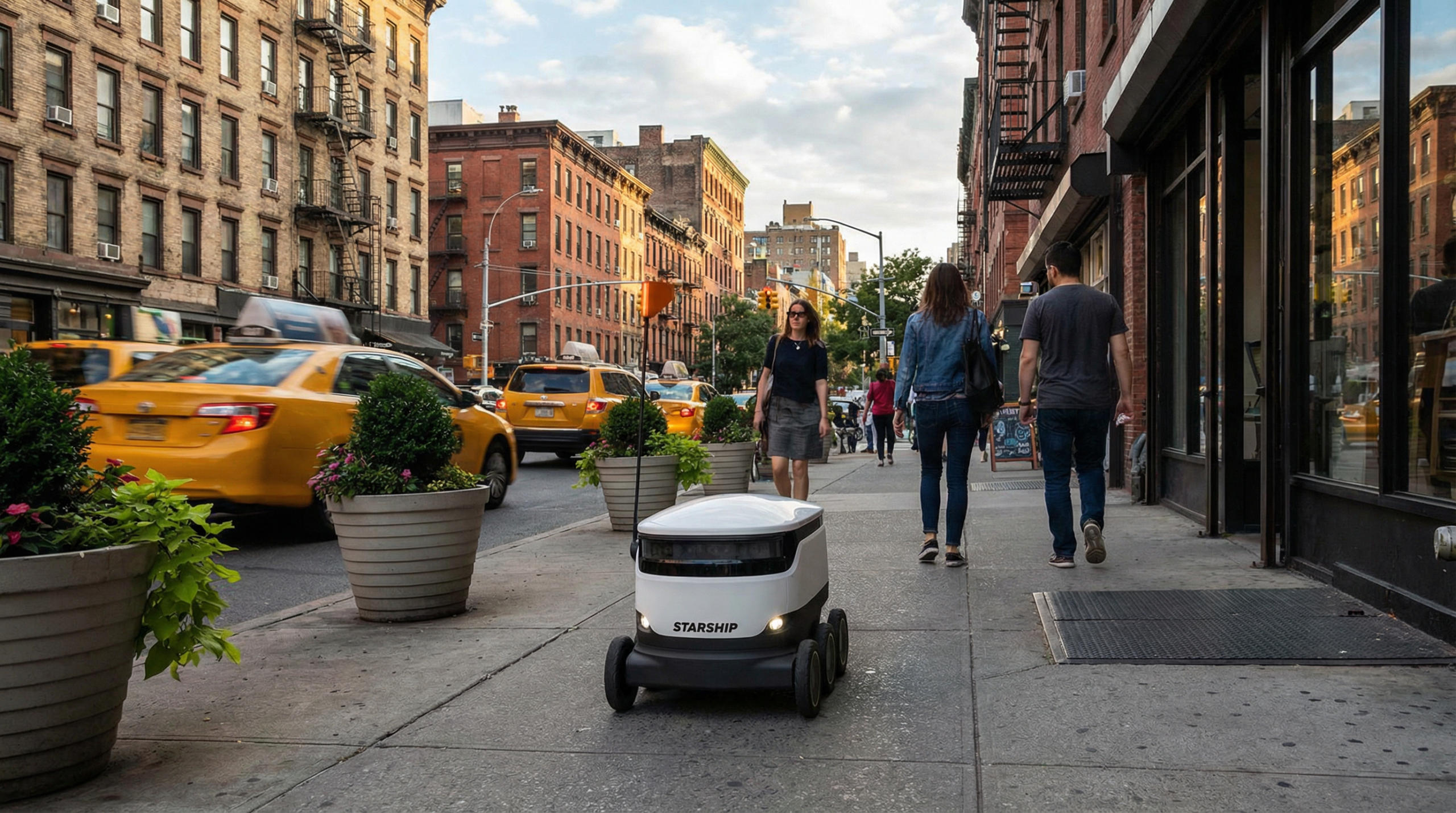
Quick Answer: Robot Delivery Market 2026
Robot delivery services are expanding rapidly across 100+ cities globally, led by Starship Technologies, Nuro™, Amazon® Scout, Kiwibot, and Serve Robotics. The market reached $1.2 billion in 2025 and is projected to hit $4.8 billion by 2030, driven by labor shortages, urbanization, and autonomous technology advances.
Robot Delivery Market Overview
The last-mile delivery robotics industry has matured from experimental pilots to commercial deployments at scale. Labor shortages, rising delivery costs, and consumer demand for contactless delivery have accelerated adoption across food service, retail, and logistics sectors.
Market dynamics include:
- Global Market Size: $1.2 billion in 2025, 32% CAGR through 2030
- Active Cities: 100+ cities with operational robot delivery services
- Daily Deliveries: Over 50,000 autonomous deliveries per day globally
- Cost Reduction: 40-60% lower than human delivery in dense urban areas
- Customer Satisfaction: 89% positive rating for robot delivery experiences
Starship Technologies: Pioneer and Market Leader
Founded in 2014 by Skype co-founders, Starship Technologies has become the dominant force in sidewalk robot delivery, completing over 6 million autonomous deliveries worldwide.
Technology and Specifications:
| Feature | Starship Robot |
|---|---|
| Size | 22″ x 20″ x 26″ (55 x 50 x 65 cm) |
| Weight | 100 lbs (45 kg) loaded |
| Cargo Capacity | 22 lbs (10 kg) |
| Speed | 4 mph (6.4 km/h) maximum |
| Range | 4-mile (6.4 km) radius |
| Battery Life | 18+ hours continuous operation |
| Navigation | AI + GPS + 10 cameras |
Global Deployment:
- United States: 50+ universities and corporate campuses
- United Kingdom: 15 cities including London suburbs
- Estonia: Nationwide service in Tallinn
- Germany: Pilot programs in Hamburg and Düsseldorf
- Finland: Commercial service in Helsinki
Starship’s business model focuses on dense deployment areas like university campuses, corporate offices, and residential neighborhoods, achieving delivery costs as low as $1.50 per trip.
Nuro: Revolutionizing Road-Based Delivery
Nuro™ has pioneered purpose-built autonomous delivery vehicles that operate on public roads, targeting grocery and retail delivery at scale.
R3 Vehicle Specifications:
- Size: Compact car footprint with custom cargo compartments
- Payload: 500+ lbs (227 kg) across multiple orders
- Speed: Up to 45 mph (72 km/h) on public roads
- Range: 80+ miles (128 km) per charge
- Safety: External airbags and crumple zones
- Security: Lockable compartments with customer-specific access
Commercial Partnerships:
- FedEx®: Multi-year partnership for package delivery in Houston
- Walmart®: Grocery delivery pilot programs in multiple states
- CVS®: Prescription and health product delivery
- 7-Eleven®: Convenience store product delivery
Nuro received the first commercial deployment permit for autonomous delivery vehicles from the U.S. Department of Transportation in 2020.
Amazon Scout: E-commerce Giant’s Delivery Solution
Amazon® Scout represents the company’s effort to automate last-mile delivery for its massive e-commerce operation, focusing on suburban residential delivery.
Technical Features:
- Cooler-sized autonomous delivery device
- Electric-powered with 8-hour battery life
- AI navigation with obstacle avoidance
- Secure package compartment with customer access via app
- Weather-resistant design for year-round operation
Deployment Strategy: Amazon is testing Scout in select neighborhoods in Washington, California, Georgia, and Tennessee, focusing on single-family residential areas with favorable weather conditions and sidewalk infrastructure.
Kiwibot: Campus and Urban Food Delivery
Colombian startup Kiwibot has carved out a niche in food delivery for universities and urban areas, particularly popular in Latin American markets.
Robot Specifications:
- Capacity: 8-12 meals per delivery run
- Speed: 3 mph (4.8 km/h) on sidewalks
- Range: 2-mile (3.2 km) delivery radius
- Features: LED eyes for personality, app-based unlocking
Market Presence:
- Berkeley, California (UC Berkeley campus)
- Miami, Florida (downtown area)
- Bogotá, Colombia (multiple neighborhoods)
- Medellín, Colombia (university districts)
Serve Robotics: Sidewalk Delivery at Scale
Spun out of Postmates (acquired by Uber®), Serve Robotics focuses on short-distance food delivery in dense urban environments.
Generation 3 Robot Features:
- Lidar-based navigation system
- 4G/5G connectivity for real-time monitoring
- Theft-resistant design with locking mechanisms
- Temperature-controlled cargo bay for food delivery
- Human operator assistance via telepresence when needed
Commercial Operations: Serve operates in Los Angeles with plans for expansion to San Francisco, New York, and other major metropolitan areas in 2026.
Regulatory Landscape and Urban Integration
Robot delivery services navigate complex regulatory environments that vary significantly by jurisdiction:
Permitting Requirements:
- Business licenses for commercial operation
- Sidewalk use permits from local authorities
- Insurance coverage for autonomous operation
- Safety certifications from transportation departments
Operational Restrictions:
- Speed limits (typically 3-6 mph)
- Weight restrictions for sidewalk use
- Time-of-day limitations in some areas
- Prohibited zones (emergency routes, certain sidewalks)
Cities like San Francisco, Austin, and Washington D.C. have developed comprehensive frameworks for robot delivery regulation.
Technology and Innovation Trends
Key technological advances driving the robot delivery revolution include:
AI and Machine Learning: Advanced computer vision for obstacle detection, path planning, and navigation in complex urban environments.
5G Connectivity: Ultra-low latency communication enabling real-time remote assistance and fleet coordination.
Battery Technology: Improved energy density extending operational range and reducing charging frequency.
Modular Design: Swappable cargo compartments optimized for different delivery types (food, packages, groceries).
Economic Impact and Cost Analysis
Robot delivery offers significant economic advantages over traditional delivery methods:
Cost Comparison (per delivery):
- Human delivery driver: $8-12 including wages, benefits, vehicle costs
- Robot delivery: $2-4 including amortization, electricity, maintenance
- Potential savings: 50-70% reduction in delivery costs
Operating Economics:
- Initial robot cost: $15,000-$25,000 per unit
- Operational lifespan: 3-5 years with regular maintenance
- Daily delivery capacity: 15-30 deliveries per robot
- Break-even point: 12-18 months in high-density areas
Challenges and Limitations
Despite rapid growth, robot delivery services face several operational challenges:
Technical Limitations:
- Weather sensitivity (rain, snow, extreme temperatures)
- Stair and elevator access in multi-story buildings
- Theft and vandalism in some urban areas
- Navigation challenges in construction zones
Market Barriers:
- Limited deployment areas due to sidewalk infrastructure
- Regulatory approval processes in new markets
- Consumer acceptance and trust building
- Competition from human delivery services
Frequently Asked Questions
How fast can robot delivery services operate?
Most sidewalk robots operate at 3-6 mph for safety reasons, while road-based vehicles like Nuro can travel up to 45 mph. Typical delivery times are 15-30 minutes for short distances under 2 miles.
What happens if a delivery robot gets stuck or stolen?
All major robot delivery services have remote monitoring and human operators who can provide assistance. Robots include GPS tracking, security cameras, and locking mechanisms. Companies also maintain insurance coverage for theft or damage incidents.
Which cities have the best robot delivery services?
Leading robot delivery cities include San Francisco, Los Angeles, Washington D.C., London, Tallinn (Estonia), and various university towns. Success factors include favorable regulation, good sidewalk infrastructure, and dense delivery demand.
How much does robot delivery cost compared to traditional delivery?
Robot delivery typically costs $1-3 per delivery for consumers, similar to or slightly less than traditional delivery fees. The main savings come from reduced labor costs for delivery companies, potentially leading to lower prices over time.
Future Outlook and Market Predictions
The robot delivery industry is positioned for explosive growth through 2030:
Market Projections:
- Global market to reach $4.8 billion by 2030
- 1 million active delivery robots worldwide by 2028
- 500+ cities with operational robot delivery by 2027
- 30% of urban deliveries automated in dense metros by 2030
Technology improvements, regulatory standardization, and consumer acceptance will drive mainstream adoption, fundamentally transforming last-mile delivery economics and urban logistics.
