


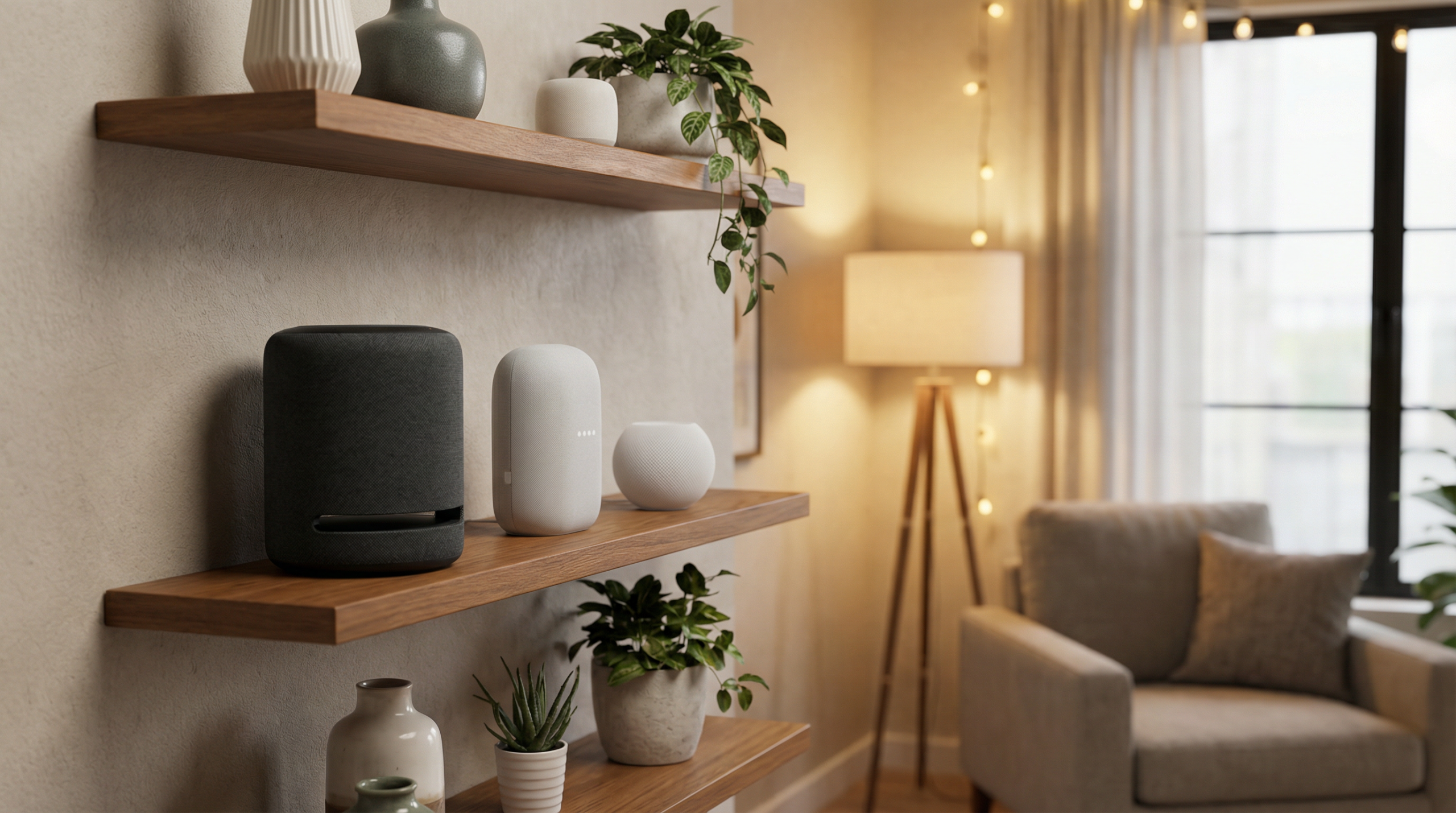
Quick Answer: The Amazon Echo (5th gen) leads in voice recognition and smart home integration for $99.99, Google Nest Audio excels at answering questions for $99.99, while Apple HomePod 2 delivers superior audio quality for $299. Your choice depends on your ecosystem and budget priorities.
Complete Smart Speaker Comparison Guide
This article contains affiliate links. TheRoboWire may earn a commission on qualifying purchases at no extra cost to you. See our affiliate disclosure for details.
Smart speakers have evolved from simple voice-activated devices to sophisticated home automation hubs. In 2026, the battle between Amazon Alexa®, Google Assistant™, and Apple Siri® continues to intensify, each offering distinct advantages for different user needs.
Top Smart Speakers Tested and Ranked
1. Amazon Echo (5th Generation) – Best Overall
Price: $99.99
Audio: Premium speakers with spatial audio
Smart Home: 100,000+ compatible devices
Voice Recognition: Far-field technology with 7 microphones
Amazon’s latest Echo delivers exceptional voice recognition accuracy, even in noisy environments. The improved audio driver system provides rich, room-filling sound that rivals dedicated speakers. With Zigbee built-in and Matter compatibility, it serves as an excellent smart home hub.
Best for: Smart home enthusiasts, multi-room audio, voice shopping
2. Apple HomePod 2 – Best Audio Quality
Price: $299
Audio: High-excursion woofer, 5 tweeters, spatial audio
Smart Home: HomeKit exclusive
Voice Recognition: Advanced beamforming with 6-mic array
Apple’s HomePod 2 sets the benchmark for smart speaker audio quality. The computational audio technology automatically adapts to room acoustics, while Apple Music® integration provides lossless audio streaming. However, the $299 price point limits its appeal.
Best for: Apple ecosystem users, audiophiles, premium experience
3. Google Nest Audio – Best Information Assistant
Price: $99.99
Audio: 75mm woofer, 19mm tweeter
Smart Home: Works with Google, 50,000+ devices
Voice Recognition: 3 far-field microphones
Google’s Nest Audio excels at answering complex questions and providing contextual information. The integration with Google Search™ and YouTube Music™ makes it superior for information queries and music discovery. Sound quality improved significantly over previous generations.
Best for: Information seekers, Google ecosystem users, families
4. Amazon Echo Pop – Best Budget Option
Price: $39.99
Audio: Directional speaker, enhanced bass
Smart Home: Full Alexa® compatibility
Voice Recognition: 4 microphones
The Echo Pop proves that good smart speakers don’t require premium pricing. Despite its compact size and budget-friendly cost, it delivers surprising audio performance and full Alexa® functionality. Perfect for bedrooms, kitchens, or first-time smart speaker buyers.
5. Sonos Era 100 – Best for Music Lovers
Price: $249
Audio: Dual tweeters, mid-woofer, Trueplay tuning
Smart Home: Works with Alexa®, Google Assistant™
Voice Recognition: 3 far-field microphones
Sonos Era 100 prioritizes music reproduction over smart features. The proprietary Trueplay technology optimizes sound for room acoustics, while support for multiple voice assistants provides flexibility. Premium build quality justifies the higher price.
6. Google Nest Mini – Compact Performance
Price: $49.99
Audio: 40mm driver, machine learning-enhanced
Smart Home: Google ecosystem integration
Voice Recognition: 3 microphones
The Nest Mini offers Google Assistant™ functionality in a space-saving design. While audio quality isn’t premium, it’s adequate for voice responses and casual music playback. The fabric design blends well with home décor.
7. Apple HomePod Mini – Compact Apple Integration
Price: $99
Audio: Full-range driver, dual passive radiators
Smart Home: HomeKit exclusive
Voice Recognition: 3-mic array
HomePod Mini delivers impressive audio quality for its size, with computational audio that maximizes the small driver. Intercom functionality across Apple devices adds convenience, though HomeKit limitations restrict smart home options.
Key Features Comparison
| Model | Price | Audio Quality | Voice Recognition | Smart Home Devices | Music Services |
|---|---|---|---|---|---|
| Echo (5th Gen) | $99.99 | Excellent | Outstanding | 100,000+ | Amazon Music, Spotify, Apple Music |
| HomePod 2 | $299 | Premium | Excellent | HomeKit only | Apple Music, limited others |
| Nest Audio | $99.99 | Good | Excellent | 50,000+ | YouTube Music, Spotify, Pandora |
| Echo Pop | $39.99 | Good | Good | 100,000+ | Amazon Music, Spotify, Apple Music |
| Sonos Era 100 | $249 | Premium | Good | Varies by assistant | 100+ services |
Smart Home Integration Analysis
Amazon Alexa® supports the broadest range of smart home devices, with over 100,000 compatible products including lights, thermostats, security cameras, and appliances. The built-in Zigbee hub eliminates the need for additional bridges with compatible devices.
Google Assistant™ works with approximately 50,000 smart home products, with strong integration for Google Nest™ devices and excellent voice control for Chromecast™-enabled TVs and displays.
Apple HomeKit offers fewer compatible devices but emphasizes security and privacy. The Home app provides intuitive control, and HomeKit Secure Video protects camera feeds with end-to-end encryption.
Audio Quality Deep Dive
Audio performance varies significantly across models. The HomePod 2 leads with computational audio that analyzes room acoustics in real-time, adjusting frequency response for optimal sound. The high-excursion woofer delivers impressive bass for the form factor.
Amazon’s Echo (5th gen) improved substantially over previous generations, with spatial audio processing and premium drivers that handle various music genres effectively. Bass response is particularly strong.
Google Nest Audio focuses on balanced sound with clear vocals and adequate bass. While not audiophile-grade, it excels for spoken content and casual music listening.
Privacy and Security Considerations
Privacy approaches differ significantly between manufacturers. Amazon stores voice recordings by default but allows deletion through voice commands or the app. Physical mute buttons provide hardware-level microphone control.
Google processes voice data to improve Assistant responses but offers auto-deletion options. The Nest Audio includes a hardware mute switch and LED indicators for microphone status.
Apple emphasizes on-device processing for Siri® requests when possible, reducing cloud dependency. Personal requests require authentication, and voice recordings aren’t stored by default.
Multi-Room Audio Performance
Amazon’s multi-room audio supports grouping Echo devices for synchronized playback across rooms. The system maintains impressive synchronization even with mixed Echo models.
Google’s speaker groups work well with Nest devices and support Chromecast™-enabled speakers from other manufacturers, expanding flexibility.
Apple’s multi-room audio requires HomePod or AirPlay 2-compatible speakers, limiting options but ensuring seamless integration within the Apple ecosystem.
Voice Recognition Accuracy
Testing reveals Amazon Alexa® leads in noisy environments, correctly interpreting commands even with background music or conversations. The 7-microphone array and advanced signal processing contribute to superior performance.
Google Assistant™ excels at understanding natural language and context, making it easier to ask follow-up questions without repeating the wake word.
Apple Siri® improved significantly in 2026, with better accent recognition and contextual understanding, though it still lags in smart home device compatibility.
Buying Recommendations by Use Case
- First-time buyers: Echo Pop ($39.99) offers excellent value with full Alexa® functionality
- Smart home enthusiasts: Echo (5th gen) ($99.99) provides the best device compatibility
- Apple users: HomePod 2 ($299) integrates seamlessly with iPhone and Mac
- Music lovers: Sonos Era 100 ($249) delivers superior audio quality
- Information seekers: Google Nest Audio ($99.99) excels at answering questions
- Budget-conscious: Nest Mini ($49.99) provides Google Assistant™ affordably
- Compact spaces: HomePod Mini ($99) offers good audio in small rooms
Future-Proofing Considerations
Matter support ensures long-term smart home compatibility across platforms. Amazon and Google speakers already support Matter, while Apple provides updates for existing devices.
Voice assistant AI capabilities continue evolving, with 2026 updates bringing improved conversational abilities and contextual understanding across all platforms.
Frequently Asked Questions
Which smart speaker has the best voice recognition?
Amazon Echo (5th generation) currently leads in voice recognition accuracy, especially in noisy environments. Its 7-microphone array and advanced signal processing allow reliable wake word detection and command understanding even with background noise, music, or multiple conversations.
Can I use multiple smart speakers from different brands together?
While you can have different brands in the same home, they won’t integrate seamlessly. Amazon Alexa® speakers work best with other Echo devices, Google Assistant™ speakers group with Nest products, and HomePods integrate within Apple’s ecosystem. Matter support may improve cross-brand compatibility in the future.
What’s the difference between smart speakers and smart displays?
Smart speakers focus on voice interaction and audio playback, while smart displays add touchscreens for visual information, video calls, and media consumption. Smart speakers typically offer better audio quality per dollar, while displays provide additional functionality like recipe viewing and home security camera feeds.
How much internet bandwidth do smart speakers use?
Smart speakers use minimal bandwidth for voice commands (approximately 1-2 MB per hour). However, music streaming can consume 50-150 MB per hour depending on quality settings. Most home internet connections easily support multiple smart speakers without noticeable impact.
Do smart speakers work without internet?
Most smart speaker functions require internet connectivity, including voice commands, music streaming, and smart home control. Some models offer limited offline capabilities like timers and alarms, but core features depend on cloud processing for voice recognition and command execution.
