


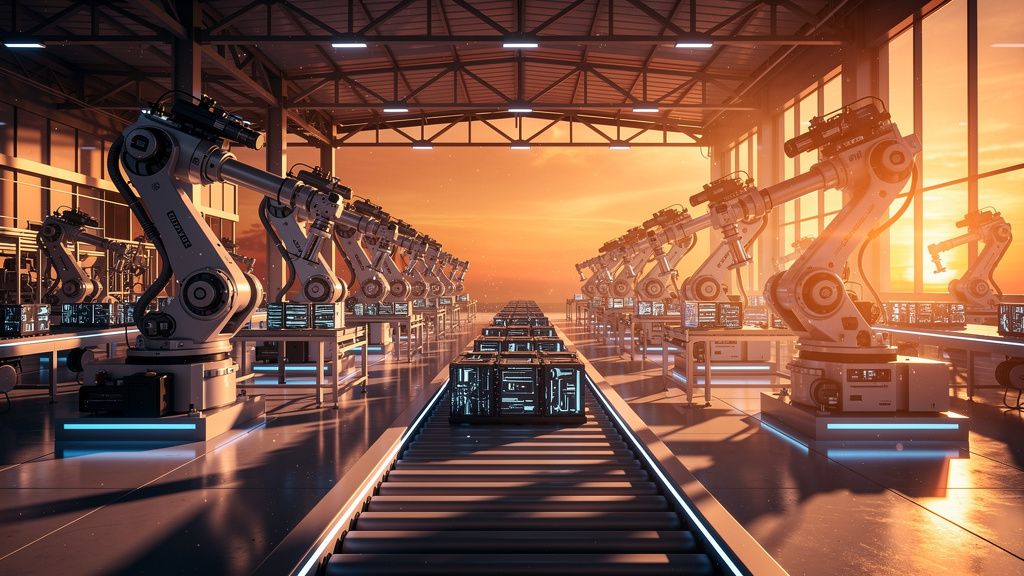
Industrial robots are reshaping factory floors worldwide: 542,000 units were installed globally in 2024, the market hit a record $16.7 billion, and cobots alone are now an $11.3 billion segment growing at 28% annually. Here’s everything you need to know about factory automation in 2026.
TL;DR — Key Takeaways:
- Global industrial robot installations reached 542,000 units in 2024 — more than double from a decade ago — with projections of 700,000+ by 2028
- The “Big Four” manufacturers (FANUC, ABB, KUKA, Yaskawa) dominate, but collaborative robots from Universal Robots and others are closing the gap fast
- Cobots start at $25,000 and offer 12–24 month ROI, making automation accessible to SMEs for the first time
- AI-driven control systems deliver 31% average efficiency gains while cutting unplanned downtime by 43%
- Smart manufacturing adoption now stands at 47% globally — up 12 percentage points year-over-year
The Industrial Robot Market in 2026: Record Numbers
The factory automation market tells a clear story: robots aren’t optional anymore. According to the International Federation of Robotics (IFR), 542,000 industrial robots were installed worldwide in 2024 — the fourth consecutive year above the 500,000 mark and the second-highest count in history.
The total operational stock of industrial robots now stands at 4.66 million units, up 9% from the previous year. The global market value of industrial robot installations reached an all-time high of $16.7 billion, according to the IFR’s January 2026 trends report.
Markets and Markets projects the industrial control and factory automation market will hit $435.24 billion by 2030, growing at a CAGR of 9.6%. Robot installations alone are expected to surpass 700,000 units annually by 2028.
Who’s Installing the Most Robots?
China dominates with 295,000 installations in 2024 — 54% of the global total. Domestic Chinese manufacturers surpassed foreign suppliers for the first time, capturing 57% of their home market. Here’s the full top-10 breakdown:
| Rank | Country | Installations (2024) | Key Industry |
|---|---|---|---|
| 1 | China | 295,000 | Broad manufacturing |
| 2 | Japan | 44,500 | Electronics & automotive |
| 3 | United States | 34,200 | Automotive & general industry |
| 4 | South Korea | 30,600 | Electronics & automotive |
| 5 | Germany | 26,982 | Automotive manufacturing |
| 6 | India | 9,100 | Automotive sector |
| 7 | Italy | 8,783 | Automotive & machinery |
| 8 | Mexico | 5,600 | Automotive exports |
| 9 | Spain | 5,100 | Automotive production |
| 10 | France | 4,900 | Industrial automation |
Source: International Federation of Robotics, World Robotics 2025 Report
The global average robot density has risen to 162 robots per 10,000 employees — more than double the 74 per 10,000 recorded seven years ago.
The Big Four: FANUC, ABB, KUKA, and Yaskawa
Four manufacturers account for the bulk of industrial robot installations worldwide. Each has distinct strengths depending on your application, budget, and factory environment.
FANUC (Japan) controls over 16% of the world’s total robot installations and more than 1 million installed units. Their M-20iD/25 (25 kg payload, 1,831 mm reach, ±0.02 mm repeatability) is the industry all-rounder. FANUC’s reputation is built on uptime — they have extremely low failure rates and the deepest integrator network in North America. Price range: $45,000–$150,000 for industrial arms; CRX cobots from $43,000–$61,000.
ABB (Switzerland) pairs broad hardware with strong software through its RobotStudio simulation platform and ABB Ability digital suite. Their IRB family covers payloads from 3 kg to 800 kg with reach up to 4.2 meters and ±0.02 mm repeatability. ABB announced plans to spin off its robotics unit by 2026, a move expected to sharpen focus and speed product cycles. Price range: $25,000–$120,000+ for industrial arms; GoFa and SWIFTI cobots from $35,000–$60,000.
KUKA (Germany) dominates the high-payload automotive segment. Their KR QUANTEC series handles 120–1,300 kg payloads with reach up to 4.2 meters. The LBR iiwa cobot, with 7-axis torque-sensor design, is the benchmark for sensitive collaborative work. Price range: $50,000–$150,000+ for industrial arms; cobots from $40,000–$65,000.
Yaskawa (Japan) specializes in high-speed arc welding, packaging, and assembly. Their GP25 (25 kg payload, ~1,730 mm reach, ±0.02 mm repeatability) is designed for harsh environments with IP65/67 protection. Yaskawa offers some of the best value in the market. Price range: $30,000–$90,000.
| Brand | Example Model | Payload | Reach | Repeatability | Best For |
|---|---|---|---|---|---|
| FANUC | M-20iD/25 | 25 kg | 1,831 mm | ±0.02 mm | High-uptime, set-and-forget reliability |
| ABB | IRB 6700 | 3–800 kg | Up to 4.2 m | ±0.02 mm | Global rollouts, multi-site programs |
| KUKA | KR QUANTEC | 120–1,300 kg | Up to 4.2 m | ±0.04 mm | Heavy automotive, high-payload tasks |
| Yaskawa | GP25 | 25 kg | ~1,730 mm | ±0.02 mm | Welding, harsh environments, value |
Collaborative Robots: The $11.3 Billion Game Changer
Cobots are the fastest-growing segment in industrial robotics. The collaborative robot market reached $11.3 billion in valuation with 28% annual growth, and over 210,000 cobot units were shipped in the last four quarters alone. Industry analysts predict cobot adoption will surpass traditional industrial robots by 2028.
What makes cobots different? They work alongside humans without traditional safety barriers, they’re far easier to program (often with no-code interfaces), and they cost a fraction of full industrial systems.
Universal Robots leads the cobot market with the UR10e and UR20 (12.5–25 kg payload, up to 1,750 mm reach, ±0.05 mm repeatability). Pricing ranges from $30,000–$65,000. Their Polyscope software and massive accessory ecosystem make deployment fast — often in days rather than weeks.
FANUC CRX Series bridges the gap between cobot simplicity and industrial-grade durability. The CRX-10iA/L ($50,723, 10 kg payload, 1,418 mm reach) is the most popular choice, while the CRX-30iA ($60,868, 30 kg, 1,889 mm reach) offers the best price-per-kilogram ratio.
Budget options like Techman Robot ($25,000–$45,000 with built-in vision) and Chinese brands like JAKA and Dobot ($15,000–$40,000) are making automation accessible to shops that couldn’t afford it just a few years ago.
| Brand | Price Range | Key Strength | Best For |
|---|---|---|---|
| Universal Robots | $30,000–$65,000 | Easiest setup, huge ecosystem | Assembly, machine tending |
| FANUC CRX | $35,000–$90,000+ | Industrial durability | Welding, palletizing, harsh environments |
| ABB GoFa/SWIFTI | $40,000–$75,000 | Precision, dual-arm dexterity | Electronics, medical assembly |
| Techman Robot | $25,000–$45,000 | Built-in vision system | Packaging, quality control |
| JAKA/Dobot | $15,000–$40,000 | Lowest cost entry point | Budget automation, simple tasks |
AI and Smart Manufacturing: The Real Revolution
Hardware is only half the story. The IFR identified AI-powered autonomy as the number one robotics trend for 2026, and the real-world numbers back it up.
AI-driven control systems now deliver an average 31% efficiency gain in automotive assembly. Predictive maintenance algorithms reduce unplanned downtime by 43% by analyzing over 10,000 sensor data points per second. Most manufacturers see ROI within 8–11 months. On top of that, AI optimization cuts energy use by an average of 18%.
Edge computing deployments surged 56% year-over-year, reducing latency to under 5 milliseconds. This means machines make decisions locally — no cloud dependency. As of early 2026, 72% of new automation projects specify edge-native components.
Digital twin technology is cutting commissioning time in half. Virtual commissioning before physical installation reduces on-site setup time by an average of 52% (6–8 weeks saved per project) and drops startup error rates by 67%.
Predictive quality analytics have pushed average defect rates down to just 0.7% — a 74% improvement over traditional statistical process control — saving an average of $1.2 million in scrap costs per plant annually.
The IFR’s top 5 robotics trends for 2026 also include IT/OT convergence (connecting factory-floor operations with IT systems), humanoid robots entering logistics and warehousing, and increasing cybersecurity focus as more robots go online.
How Much Does Factory Automation Actually Cost?
This is the question every plant manager asks first. The answer depends heavily on what you’re automating and how complex your setup is.
Entry-level cobot cell: $40,000–$65,000 total (cobot + gripper + safety scanner + basic programming + training). Typical ROI: 18–24 months. Good for pick-and-place, packaging, or basic machine tending.
Mid-size industrial setup: $150,000–$250,000 (2 industrial robots + safety cell + task-specific integration + training). Typical ROI: 12–18 months. Best for welding operations, palletizing lines, or multi-station assembly.
Enterprise automation cell: $500,000–$1,500,000 (6+ robots + conveyors + vision systems + full integration). Typical ROI: 24–36 months. Delivers lights-out production capability, 3x throughput, and 99.5% quality consistency.
Key cost drivers include payload capacity (a 5 kg robot costs significantly less than a 50 kg one), reach, precision requirements, end-of-arm tooling ($1,000–$10,000), vision systems ($3,000–$15,000), and integration services which can add 20–50% to total cost.
The Robotics-as-a-Service (RaaS) model is emerging as an alternative: instead of buying outright, companies subscribe to usage-based robotic services covering installation, maintenance, and updates. The global RaaS market is expected to reach $7.8 billion by 2030, growing 16% annually.
Pros and Cons of Factory Automation in 2026
Pros:
- Massive efficiency gains: 31% average improvement with AI-driven systems
- Addresses labor shortages: Manufacturing turnover rates are brutal; robots don’t quit
- Consistent quality: 0.7% defect rates with predictive analytics vs. traditional 2.7%
- Faster ROI than ever: Cobot cells pay for themselves in 12–24 months
- Scalability: Start with one cobot, expand modularly as needs grow
- 24/7 operation: No breaks, no overtime, no night-shift premiums
Cons:
- Upfront investment: Even entry-level systems require $40,000+ capital
- Integration complexity: Underestimated integration costs are the #1 hidden expense
- Skills gap: Operators need retraining; 38% of manufacturers cite this as their top challenge
- Spare parts risk: Unexpected downtime from delayed replacement parts can erase savings
- Cybersecurity exposure: OT cybersecurity incidents rose 210% since 2023
- Not one-size-fits-all: High-mix, low-volume production still challenges most robotic systems
Your Factory Automation Checklist for 2026
Ready to automate? Here’s your action plan:
- Audit your bottlenecks. Identify the 2–3 tasks with the highest labor cost, error rate, or throughput constraint. These are your automation candidates.
- Match robot to application. Don’t overbuy: a $37,000 cobot handles 80% of typical manufacturing tasks. Only go heavy-duty if your payload or precision demands it.
- Budget for the full system. The robot arm is 40–60% of total cost. Add tooling, vision, safety, integration, and training from day one.
- Start with one cell, prove ROI. Deploy a single cobot cell, measure results for 3–6 months, then scale. Companies that pilot before scaling report 2x better ROI outcomes.
- Plan your spare parts strategy. Keep critical components (servo amplifiers, teach pendants, encoder cables) in stock. Unexpected downtime is the biggest hidden cost in robotics.
FAQ: Industrial Robots and Factory Automation
How many industrial robots are installed globally?
As of 2024, 4.66 million industrial robots are in operational use worldwide, with 542,000 new units installed that year alone, according to the IFR World Robotics 2025 Report.
What is the cheapest industrial robot in 2026?
Entry-level SCARA robots start around $12,000–$15,000 (like the FANUC SR-3iA at approximately $12,800). For 6-axis cobots, Chinese brands like JAKA and Dobot offer models starting at $15,000, while mainstream cobots from Universal Robots and Standard Bots start at $30,000–$37,000.
Are cobots replacing traditional industrial robots?
Not replacing — complementing. Cobots excel at flexible, human-adjacent tasks, while traditional robots handle high-speed, high-payload operations. The IFR projects cobot adoption will surpass traditional robots by 2028 in terms of new installations.
What industries use the most industrial robots?
Automotive leads with a 29.7% share of the global robot stock, followed by electrical/electronics at 26%, metal fabrication at 11.1%, plastics and chemicals at 5.6%, and industrial machinery at 5%.
How long does it take for a robot to pay for itself?
Typical ROI timelines range from 12–18 months for industrial welding cells to 18–24 months for cobot-based packaging or machine tending. AI-driven predictive maintenance systems often see ROI within 8–11 months.
What are the IFR’s top robotics trends for 2026?
The IFR identified five trends: AI-powered robot autonomy, IT/OT convergence in smart factories, humanoid robots entering logistics, expanded cybersecurity measures, and new fields of business beyond traditional manufacturing.
Is factory automation worth it for small businesses?
Yes. Modular cobots and RaaS models have dropped the entry barrier significantly. A small packaging operation can automate for $45,000–$65,000 total and eliminate an entire shift’s labor cost. SMEs represent 60% of global industrial output but only 20% of robot adoption — the gap is closing fast.
What’s the biggest hidden cost of industrial robots?
Unexpected downtime caused by delayed spare parts replacement. Companies that maintain a critical parts inventory and conduct preventive maintenance report 40% lower total cost of ownership.
Bottom Line
Factory automation in 2026 isn’t a question of “if” — it’s “how fast.” With cobots starting under $25,000, AI delivering 31% efficiency gains, and global robot density doubling in seven years, the economics have never been clearer. Whether you’re a small shop automating your first CNC machine tending operation or a multinational scaling across continents, the tools are here and they’re getting cheaper by the quarter.
The manufacturers who move now won’t just cut costs — they’ll build the operational resilience to survive whatever market disruption comes next. The ones who wait? They’ll be paying premium prices to catch up.
This article may contain affiliate links. TheRoboWire may earn a commission at no extra cost to you.
