


What Exactly Is a Cobot?
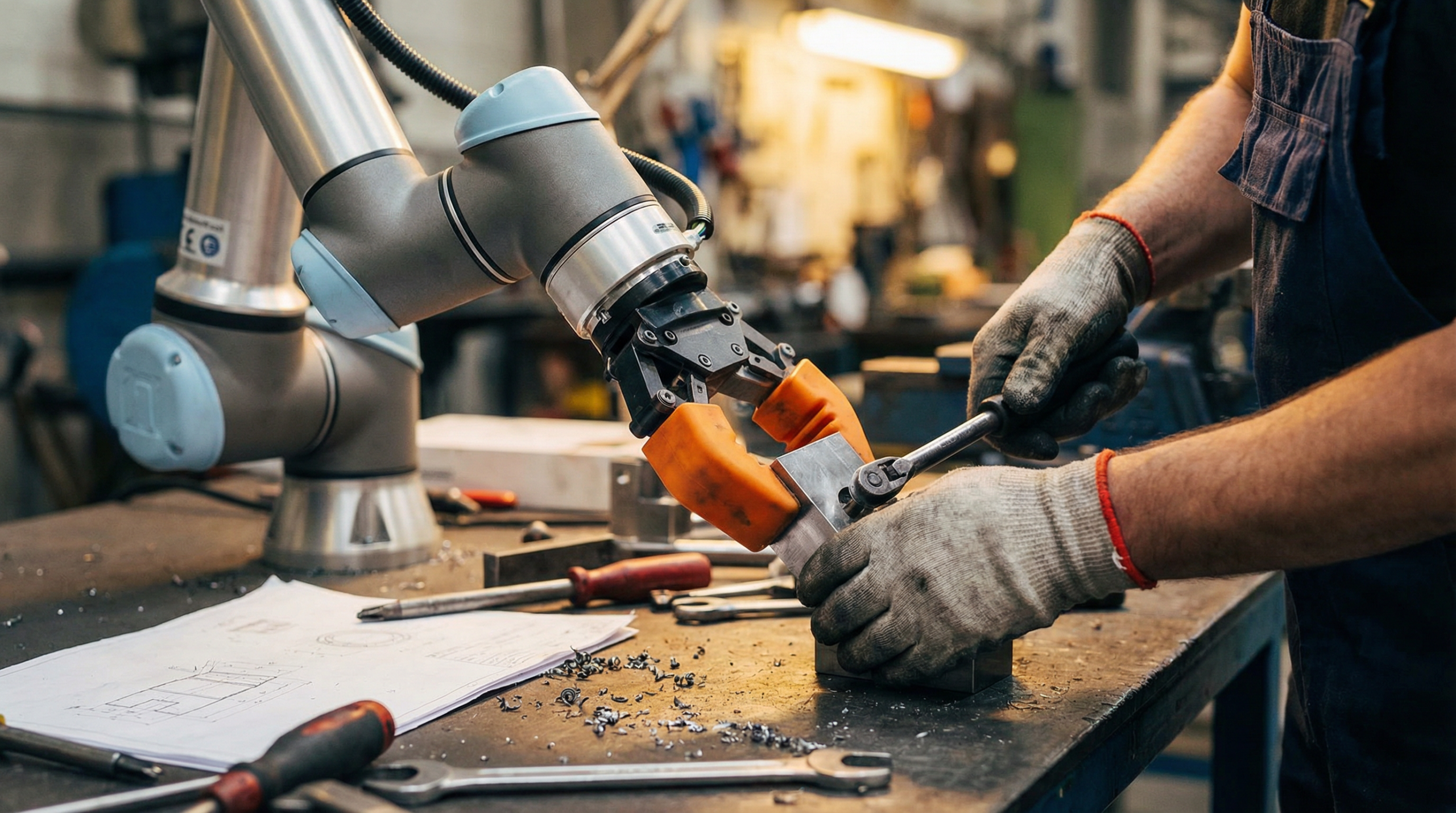
A collaborative robot — or cobot — is a robot designed to work alongside humans in a shared workspace, without the safety cages and barriers that traditional industrial robots require. While conventional industrial robots operate in fenced-off cells where human entry triggers an emergency stop, cobots use advanced sensors, force limiting, and intelligent control systems to operate safely in close proximity to people.
The distinction matters enormously. Traditional industrial robots are powerful, fast, and dangerous — they operate behind barriers because a collision with a human could be fatal. Cobots sacrifice some speed and power for safety, using force-torque sensors, rounded designs, and compliant actuators to ensure that any contact with a human is immediately detected and results in a safe stop or gentle push rather than injury.
Since Universal Robots introduced the first commercially viable cobot (the UR5) in 2008, the market has exploded. The global cobot market reached approximately $2.2 billion in 2025 and is projected to exceed $9 billion by 2030. Cobots are no longer a niche technology — they’re a fundamental part of modern manufacturing, logistics, healthcare, and even food service.
How Cobots Differ from Traditional Industrial Robots
Safety Design
Traditional industrial robots like those from FANUC, ABB, and KUKA are designed for maximum speed and payload in controlled environments. They can move at speeds exceeding 2 meters per second and handle payloads of hundreds of kilograms. Safety is achieved through physical separation — fences, light curtains, and locked access gates.
Cobots are designed with safety as a primary requirement, governed by ISO/TS 15066, the international standard for collaborative robot safety. This standard specifies four collaborative operation modes:
- Safety-rated monitored stop: The robot stops when a human enters the collaborative workspace
- Hand guiding: A human physically guides the robot through tasks
- Speed and separation monitoring: The robot slows or stops based on proximity to humans
- Power and force limiting: The robot limits its force output to safe levels if contact occurs
Most modern cobots implement power and force limiting as their primary safety mode. They use rounded joints with no pinch points, force-torque sensors in every joint, padded surfaces in some designs, and collision detection algorithms that stop motion within milliseconds.
Ease of Programming
Traditional robots require specialized programming by trained engineers using proprietary languages (RAPID for ABB, KRL for KUKA, INFORM for Yaskawa). Programming a new task can take days or weeks and typically requires the production line to stop.
Cobots are designed for easy programming, often by the same workers who will work alongside them. Common programming methods include:
- Hand guiding (lead-through): Physically move the robot arm through the desired path, and the robot records and reproduces the motion
- Graphical interfaces: Tablet-based apps with drag-and-drop programming — no coding required
- Visual programming: Flowchart-style interfaces where users connect functional blocks
- AI-assisted programming: Natural language instructions (“pick up the part from the left bin and place it in the fixture”) are being developed by several manufacturers
This ease of programming means cobots can be redeployed to different tasks in hours rather than days, making them ideal for high-mix, low-volume production environments.
Cost and ROI
Traditional industrial robot systems typically cost $100,000-$500,000+ when including the robot, safety infrastructure, programming, and integration. Cobots start at approximately $25,000-$50,000 for the robot arm, with simpler installation requirements and minimal safety infrastructure costs. Total deployment costs including end-of-arm tooling and integration typically range from $50,000-$150,000.
The ROI for cobots is compelling. Most manufacturers report payback periods of 12-18 months, compared to 2-4 years for traditional robot installations. The faster redeployment capability means a single cobot can serve multiple roles over its lifetime, further improving the return on investment.
Major Cobot Manufacturers in 2026
Universal Robots (UR)
The company that created the cobot category remains the market leader with approximately 50% market share. Universal Robots, a Danish company now owned by Teradyne, offers four models: the UR3e (3 kg payload, tabletop applications), UR5e (5 kg, light assembly and machine tending), UR10e (12.5 kg, heavier tasks), and UR20 (20 kg, palletizing and heavy-duty applications).
UR’s strength lies in its ecosystem. The UR+ platform offers hundreds of certified accessories — grippers, vision systems, force sensors, and software — that plug into UR cobots with minimal integration effort. The extensive user community and training resources (Universal Robots Academy offers free online courses) make UR the default choice for companies new to cobots.
FANUC CRX Series
FANUC, the world’s largest industrial robot manufacturer, entered the cobot market with the CRX series. These cobots benefit from FANUC’s decades of reliability engineering and its massive global service network. The CRX series ranges from 5 kg to 25 kg payload capacity.
FANUC’s advantage is reliability — the company’s industrial robots are known for extraordinarily long mean time between failures (MTBF). For manufacturers already using FANUC industrial robots, adding CRX cobots integrates smoothly into existing systems and maintenance programs.
ABB GoFa and SWIFTI
ABB offers two distinct cobot lines. GoFa is a true collaborative robot designed for direct human-robot interaction, with payload capacities from 5 to 12 kg. SWIFTI is a hybrid concept — an industrial robot with collaborative features that can operate at higher speeds when humans aren’t present and switch to collaborative mode when they approach.
This hybrid approach is significant because it addresses one of the biggest cobot limitations: speed. When the workspace is clear of humans, SWIFTI operates at industrial speeds. When a human enters the area, it slows to collaborative speeds. This gives manufacturers the best of both worlds.
Doosan Robotics
South Korean manufacturer Doosan has gained significant market share with competitive pricing and a wide model range. The A-Series (up to 6 kg), M-Series (up to 15 kg), and H-Series (up to 25 kg) cover most collaborative applications. Doosan’s cobots are known for their smooth motion quality and relatively low noise levels.
Techman Robot
Taiwan-based Techman (a subsidiary of Quanta Computer) differentiates itself with built-in vision systems on every cobot. The integrated camera and vision processing capability eliminates the need for separate vision systems, reducing cost and complexity. Techman cobots can perform visual inspection, part identification, and vision-guided picking out of the box.
Chinese Manufacturers
Several Chinese manufacturers — including AUBO Robotics, JAKA Robotics, and Han’s Robot — offer cobots at significantly lower price points than Western competitors. While these robots may lack some features and the extensive ecosystems of established players, they’re making cobot technology accessible to smaller businesses and developing market applications.
Common Cobot Applications
Machine Tending
One of the most common cobot applications is loading and unloading CNC machines, injection molding machines, press brakes, and other manufacturing equipment. The cobot picks up a raw part, places it in the machine, waits for the cycle to complete, removes the finished part, and repeats. This task is repetitive, ergonomically challenging for humans, and perfectly suited for cobots.
The economics are straightforward: a machine that currently runs one shift (because no one wants to stand and load parts for eight hours) can run two or three shifts with a cobot. The machine’s utilization increases from 33% to 66-99%, and the human operator is freed for higher-value work.
Assembly
Cobots excel at repetitive assembly tasks: screwdriving, adhesive dispensing, component insertion, and wire harnessing. The consistency of robotic motion ensures uniform quality, while the force-torque sensing enables precise force control — essential for tasks like press-fitting components or torquing screws to exact specifications.
In automotive and electronics assembly, cobots often work alongside humans in a split-task arrangement. The cobot handles the repetitive, precision-critical steps while the human handles the complex, judgment-based steps. This division of labor plays to the strengths of both.
Palletizing and Packaging
The UR20 and other high-payload cobots have opened up palletizing as a major cobot application. Stacking boxes on pallets is physically demanding and a leading cause of workplace back injuries. A cobot palletizer can handle the lifting while operating safely alongside workers who manage other aspects of the packaging line.
Companies like Robotiq and OnRobot offer turnkey palletizing kits for cobots that include the gripper, software, and configuration — making deployment straightforward even for companies with no robotics experience.
Quality Inspection
Equipped with cameras and vision software, cobots can perform visual inspection tasks with greater consistency than human inspectors. The cobot moves a camera to precise positions around a part, captures images, and AI-based vision software identifies defects. This is particularly valuable in industries with strict quality requirements like automotive, aerospace, and medical devices.
Welding
Collaborative welding is a growing application. The cobot performs the actual welding (MIG, TIG, or spot welding) while a human worker sets up the parts and fixtures. Welding cobots are particularly popular in job shops and small manufacturers where production runs are too short to justify a traditional robotic welding cell but manual welding creates ergonomic and quality challenges.
Laboratory and Healthcare
Cobots are increasingly used in clinical and research laboratories for liquid handling, sample preparation, and test execution. Their precision and repeatability improve result quality, while their safety features allow them to operate in the same space as lab technicians. In surgical settings, cobots assist with precise positioning and tool manipulation under the surgeon’s guidance.
Food and Beverage
Hygienic-rated cobots with food-grade surfaces and washdown capability are entering food processing and packaging. Tasks include pick-and-place of food items, packaging, labeling, and quality sorting. The food industry’s chronic labor shortages make it a prime candidate for cobot adoption.
Implementing Cobots: A Practical Guide
Step 1: Identify the Right Application
The best cobot applications share these characteristics: the task is repetitive and consistent, cycle times are measured in seconds to minutes (not milliseconds — those need traditional robots), the payload is within cobot range (typically under 25 kg), the task creates ergonomic risk or is difficult to staff, and the task doesn’t require speeds beyond cobot capability (typically under 1 m/s).
Step 2: Risk Assessment
Even though cobots are designed for safety, a proper risk assessment is required for every installation. This should evaluate potential hazards from the end-of-arm tooling (a rounded cobot arm is safe, but attach a sharp tool and the risk changes), the parts being handled (sharp edges, hot surfaces, hazardous materials), the workspace layout, and the interaction patterns between the cobot and workers.
Step 3: Choose the Right Cobot
Consider payload (what’s the heaviest thing the cobot needs to lift?), reach (how far does the arm need to extend?), precision (what tolerances are required?), speed (how fast does the task need to be?), environment (cleanroom, food-grade, or standard industrial?), and ecosystem (what grippers, sensors, and software are available?).
Step 4: Plan the Integration
Even simple cobot installations require planning for end-of-arm tooling selection and design, fixture design for part positioning, communication with existing machines (if machine tending), safety assessment and documentation, and operator training.
Step 5: Deploy and Optimize
Start with the cobot performing the task reliably, then optimize cycle time, quality, and workflow integration. Most companies find that their first cobot deployment takes longer than expected, but subsequent deployments go much faster as organizational learning accumulates.
The ROI of Cobots: Real Numbers
Case Study: Small Machine Shop
A 20-person machine shop purchased a UR10e cobot ($35,000) with a pneumatic gripper ($4,000) for CNC machine tending. Total installation cost including integration: $55,000. The cobot enabled a second unattended shift, increasing machine utilization from 40% to 80%. Additional revenue from increased output: approximately $8,000/month. Payback period: 7 months.
Case Study: Electronics Assembly
An electronics manufacturer deployed three Doosan M-Series cobots for PCB testing. Total cost: $180,000. The cobots replaced a tedious manual testing process that had high error rates and difficulty retaining workers. Quality improved by 35% (fewer missed defects), throughput increased by 50%, and worker satisfaction improved because employees moved to more engaging roles. Payback period: 14 months.
Industry Average
According to industry data from the International Federation of Robotics, the average cobot deployment achieves ROI within 12-18 months, increases productivity by 30-50% for the specific task, reduces quality defects by 25-40%, and improves worker satisfaction scores in the deployed area by 15-25% (as workers move from repetitive tasks to supervisory and creative roles).
Challenges and Limitations
Speed Limitations
The biggest limitation of cobots is speed. To maintain safe force levels during potential collisions, cobots typically operate at maximum speeds of 0.5-1.5 m/s — significantly slower than traditional industrial robots that can exceed 5 m/s. For high-volume, high-speed applications, traditional robots remain the better choice.
Payload Constraints
Most cobots max out at 20-25 kg payload. While this covers a wide range of applications, heavy-duty tasks like large automotive body panel handling still require traditional robots or specialized heavy-payload cobots that are just entering the market.
Integration Complexity
While cobots are easier to deploy than traditional robots, “easy” is relative. Companies without automation experience may still struggle with gripper selection, fixture design, and process optimization. The growing ecosystem of system integrators and turnkey solutions is addressing this challenge, but expert guidance is still valuable for first-time deployments.
Perception Gaps
Some workers fear cobots will replace their jobs. While cobots do change job roles, they rarely eliminate positions entirely — they more commonly shift workers from repetitive tasks to supervisory, quality control, and multi-machine management roles. Clear communication about the purpose of cobot deployment and investment in worker retraining is essential for successful adoption.
The Future of Cobots
AI Integration
The next frontier for cobots is AI-driven adaptability. Current cobots follow pre-programmed paths precisely. Future cobots will use vision and AI to adapt to variations in real-time — picking randomly oriented parts from a bin, adjusting assembly techniques based on part condition, and learning new tasks from human demonstration with minimal programming.
Mobile Cobots (MoCobots)
Mounting cobots on autonomous mobile robots (AMRs) creates mobile manipulation platforms that can navigate a facility, position themselves at workstations, and perform tasks. Companies like OTTO Motors (with KUKA integration) and Mobile Industrial Robots (with UR) are leading this convergence.
Human-Robot Teaming
Research in human-robot interaction is advancing toward cobots that can read human intentions through gesture and gaze tracking, proactively assist humans by predicting what tool or part they’ll need next, communicate their own status and intentions through intuitive visual and audio cues, and adapt their behavior to different human workers’ preferences and styles.
Democratization
As prices continue to fall and ease of use improves, cobots will become accessible to smaller businesses. Robotics-as-a-Service (RaaS) models, where companies pay monthly fees instead of large upfront investments, are lowering the barrier further. This democratization will bring automation benefits to businesses that could never justify traditional robot systems.
Getting Started with Cobots
If you’re considering cobots for your operation, start small. Identify one clear, well-defined task that meets the criteria outlined above. Contact a few cobot distributors or system integrators for demonstrations and proposals. Plan for a 3-6 month deployment timeline for your first cobot. Budget for training — not just for the person programming the cobot, but for everyone who will work alongside it.
The cobot revolution isn’t about replacing humans with machines. It’s about creating partnerships where humans handle complexity, judgment, and creativity while robots handle repetition, precision, and physical strain. The companies that master this partnership will define the future of work.
