


This article may contain affiliate links. TheRoboWire may earn a commission at no extra cost to you.
Looking for your first drone but don’t want to blow a thousand dollars on something you might crash into a tree? Good news: the best beginner drones under $500 in 2026 are genuinely impressive — we’re talking 4K video, 30+ minute flights, and obstacle avoidance that actually works. No more choosing between “cheap toy” and “second mortgage.”
We’ve tested and researched the top options so you don’t have to wade through hundreds of Amazon listings. Here’s what’s actually worth your money.
TL;DR — Quick Verdict
- Best overall beginner drone: DJI Flip ($369) — best balance of features, portability, and video quality
- Best budget pick: DJI Neo ($199) — palm-launch simplicity, unbeatable price
- Best camera under $500: DJI Mini 4 Pro ($459) — pro-grade features at a beginner-friendly weight
- Best non-DJI alternative: Potensic Atom 2 ($289) — strong 4K performer with GPS return
What to Look for in a Beginner Drone
Before diving into specific models, here’s what actually matters when you’re starting out:
- Weight under 250g: No FAA registration required in the US (and similar exemptions in the EU). This is a huge deal — it means fly-and-go with minimal paperwork.
- Obstacle avoidance: Your first flights will be shaky. Sensors that prevent crashes are worth every penny.
- Flight time: Marketing says 38 minutes, real-world is usually 25-30. Anything advertised above 25 minutes is solid.
- GPS return-to-home: Lose signal or battery gets low? The drone flies itself back. Non-negotiable for beginners.
- 4K video: Standard in 2026, even at budget prices. Don’t settle for 1080p unless the drone excels at something else (like the HoverAir X1’s hands-free operation).
Best Beginner Drones Under $500 — Full Comparison
| Drone | Price | Video | Flight Time | Weight | Obstacle Avoidance |
|---|---|---|---|---|---|
| DJI Flip | $369 | 4K/60fps HDR | 31 min | 249g | Downward |
| DJI Mini 4 Pro | $459 | 4K/60fps HDR | 34 min | 249g | Omnidirectional |
| DJI Neo 2 | $259 | 4K/60fps | 20 min | 145g | Omnidirectional |
| DJI Neo | $199 | 4K/30fps | 18 min | 135g | None |
| DJI Mini 4K | $299 | 4K HDR | 31 min | 249g | Downward |
| DJI Mini 3 | $419 | 4K HDR / 48MP | 38 min | 249g | Downward |
| Potensic Atom 2 | $289 | 4K EIS | 32 min | 249g | None |
| Potensic Atom SE | $199 | 4K EIS | 31 min | 249g | None |
| Holy Stone HS720 | $249 | 4K | 26 min | 460g | None |
Top Picks — Detailed Reviews
1. DJI Flip — Best Overall for Beginners ($369)
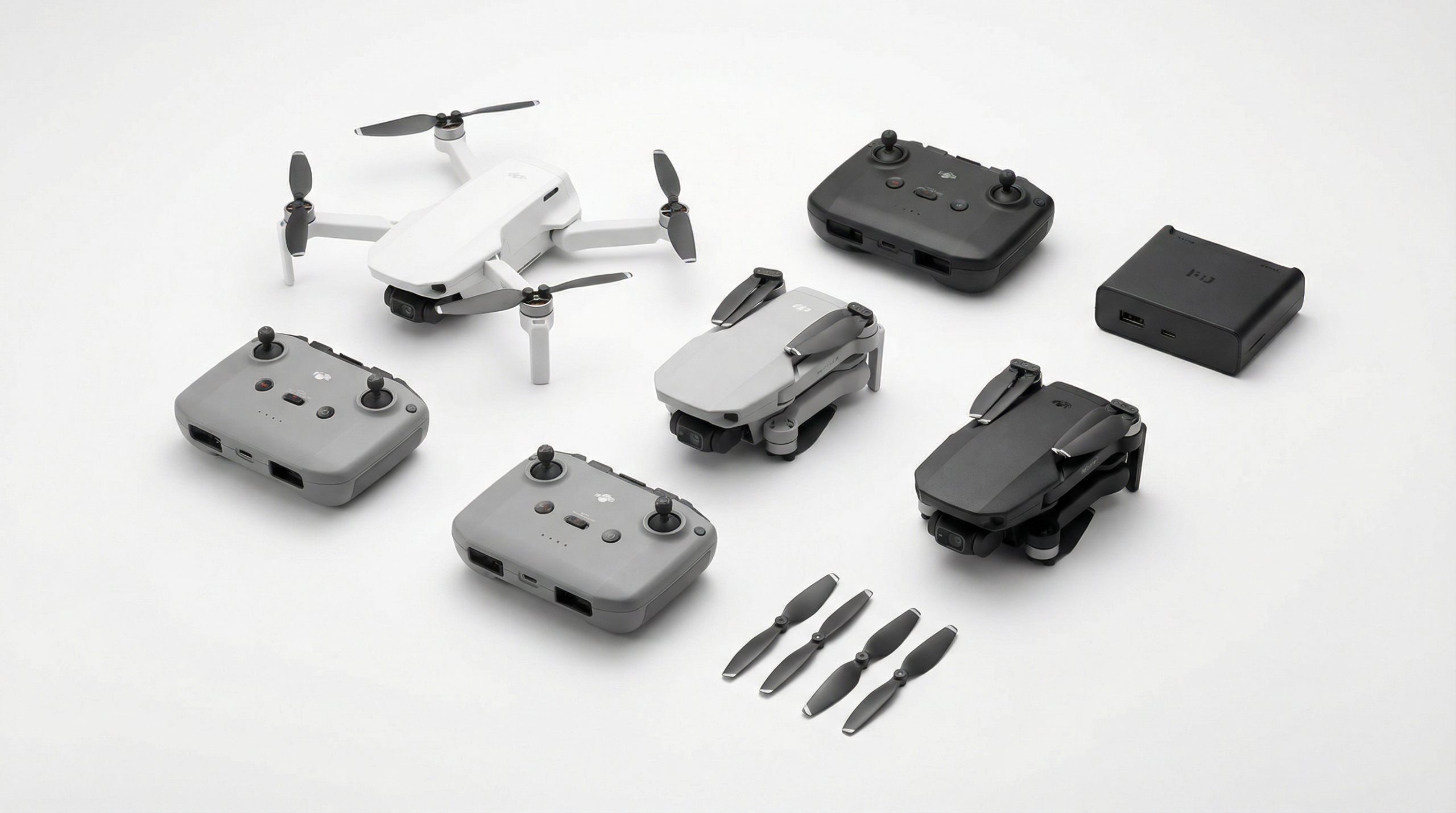
The DJI Flip is the drone we’d recommend to most people who ask “what should I buy first?” It’s pocket-sized, shoots 4K/60fps HDR video with a 3-axis gimbal, and has a 31-minute flight time. The built-in propeller guards mean you can fly indoors without destroying your lampshade.
What makes it special: DJI’s Helix and Boomerang shooting modes let you capture cinematic footage with zero skill. Point, tap, and the drone does the work. The 3-axis mechanical gimbal (not electronic stabilization) means buttery smooth video even in moderate wind.
Real-world notes: Expect about 25 minutes of actual flight time. The Fly More Combo ($469) adds two extra batteries and a charging hub — worth it if you plan to shoot more than casual clips.
Pros:
- Truly pocket-sized and foldable
- 3-axis gimbal for pro-level stabilization
- Built-in prop guards for safe indoor flying
- QuickShots and creative modes for effortless content
Cons:
- Downward-only obstacle sensing (no side or forward sensors)
- Creative modes have a slight learning curve
2. DJI Mini 4 Pro — Best Camera Under $500 ($459)
Pushing the top of our budget, the Mini 4 Pro is the one to get if camera quality is your priority. It features omnidirectional obstacle avoidance — sensors on all sides — which is a game-changer for beginners. You’d need to actively try to crash this thing.
What makes it special: The 1/1.3″ CMOS sensor captures significantly more light than smaller-sensor competitors. Low-light footage looks noticeably better, and the 48MP photos are genuinely sharp enough for large prints. ActiveTrack 360° means the drone can follow a subject while keeping it perfectly framed.
Real-world notes: The standard battery gives about 28 minutes of real flight. With the Intelligent Flight Battery Plus, you get closer to 40 minutes — but this pushes the drone over 250g, requiring FAA registration.
Pros:
- Omnidirectional obstacle avoidance (safest option here)
- Excellent low-light video and 48MP stills
- ActiveTrack 360° for automated subject tracking
- True vertical shooting for social media content
Cons:
- Most expensive option on this list
- Extended battery crosses 250g registration threshold
- Was briefly out of stock in the US due to FCC import restrictions (now back)
3. DJI Neo 2 — Best for Content Creators ($259)
The Neo 2 takes everything that made the original Neo fun and adds omnidirectional obstacle avoidance and 4K/60fps recording. At just 145g, it’s lighter than a smartphone and can be controlled with voice commands or hand gestures — no controller needed.
What makes it special: The gesture and voice control system is genuinely impressive. Wave your hand, and it follows you. Say “take off,” and it goes. This makes it perfect for solo creators who need a flying camera but don’t want to fumble with a controller mid-shoot.
Real-world notes: The 20-minute flight time is the main trade-off. Carry at least two batteries if you’re shooting anything serious. The 49GB internal storage means you won’t need a microSD card for most sessions.
Pros:
- Voice and gesture control — truly hands-free
- Omnidirectional obstacle avoidance at this price is remarkable
- 49GB internal storage
- Ultra-light at 145g
Cons:
- 20-minute flight time is below average
- Needs the DJI Fly app for full feature access
- No mechanical gimbal (EIS only)
4. DJI Neo — Best Under $200 ($199)
At $199, the original DJI Neo is the cheapest way to get into the DJI ecosystem. It launches from your palm, shoots 4K/30fps video, and weighs just 135g. It’s essentially a selfie drone that punches above its weight.
What makes it special: Palm takeoff and landing. No controller required out of the box (though adding the DJI RC-N3 significantly improves range from 50m to 6km). For casual selfies, group shots, and quick aerial clips, nothing beats its simplicity.
Pros:
- Unbeatable price for a DJI product
- Palm takeoff — beginner-proof
- Built-in propeller guards
- 4.7/5 stars on Amazon with 10,000+ ratings
Cons:
- Only 50m range without a separate controller
- 18-minute flight time
- No obstacle avoidance
- Basic tracking compared to Neo 2
5. Potensic Atom 2 — Best Non-DJI Alternative ($289)
If you want to avoid the DJI ecosystem entirely, the Potensic Atom 2 is the strongest alternative under $500. It delivers 4K video with electronic image stabilization, a 32-minute flight time, and GPS return-to-home — all for under $300.
What makes it special: The Atom 2 runs noticeably quieter than most DJI drones at this price, thanks to its brushless motor design. The ShakeVanish EIS is surprisingly effective, producing stable footage that rivals some gimbal-equipped competitors.
Pros:
- 32-minute flight time at a competitive price
- Very quiet motors
- Foldable and under 250g
- GPS return-to-home and follow-me mode
Cons:
- No obstacle avoidance sensors
- App has occasional glitches (per user reports)
- EIS not as smooth as a mechanical gimbal
6. DJI Mini 4K — Best Budget DJI With Long Flight Time ($299)
The Mini 4K sits between the Neo and the Flip in DJI’s lineup. You get 4K HDR video and a 31-minute flight time in a package that weighs exactly 249g. It’s the simplest “real” drone DJI makes — QuickShots mode handles the cinematography for you.
Pros:
- 31-minute flight at $299 — excellent value
- 4K HDR recording
- QuickShots for automated cinematic moves
- Under 250g
Cons:
- No vertical shooting mode
- Downward-only obstacle sensing
- Real battery life closer to 25 minutes
A Note on the FCC Drone Ban (2026)
You may have heard about the Countering CCP Drones Act and its potential impact on Chinese-made drones in the US market. Here’s what you need to know: all drones currently sold in the US have existing FCC clearance and are 100% legal to buy and fly. The legislation targets future FCC approvals for new models from companies like DJI, not existing products.
That said, if you’re on the fence about buying a DJI drone, now is arguably the best time. Current models remain fully supported, and DJI has committed to firmware updates for existing products regardless of future regulatory changes. For the latest updates, check the FAA’s drone page.
Beginner Drone Buying Tips
Get the Fly More Combo
Every single drone on this list benefits from extra batteries. The Fly More combo (usually $50-$100 more) typically includes 2-3 batteries, a charging hub, and a carrying case. One battery isn’t enough for a serious afternoon of flying.
Start in an Open Field
Your first flights should be in an open area with no trees, buildings, or people. Even drones with obstacle avoidance aren’t perfect — wind, GPS drift, and pilot error happen. Give yourself room to make mistakes.
Learn the Rules
Under 250g = no FAA registration needed (in the US), but you still need to follow recreational flying rules: stay below 400 feet, keep the drone in visual line of sight, and never fly near airports. Check local drone laws if you’re outside the US.
Insurance Isn’t Crazy
DJI Care Refresh ($39-$79/year depending on model) covers crashes, water damage, and flyaways. For a $300-$500 investment, it’s worth considering — especially for your first year.
FAQ
Do I need a license to fly a drone under $500?
In the US, recreational drone pilots don’t need a license. If your drone weighs under 250g (most on this list), you don’t even need to register it with the FAA. You do need to follow basic airspace rules and pass the free TRUST (The Recreational UAS Safety Test) online exam.
Is DJI still safe to buy in 2026?
Yes. Despite ongoing legislative discussions about Chinese drone manufacturers, all currently sold DJI products have FCC clearance and are legal to purchase and operate. DJI remains the market leader in consumer drones with the best software, hardware, and support ecosystem.
What’s the real difference between a $200 drone and a $450 drone?
Three things: obstacle avoidance (the cheap ones usually have none), gimbal quality (mechanical vs. electronic stabilization), and camera sensor size (bigger = better low-light and dynamic range). A $200 drone like the DJI Neo is fantastic for selfies and casual clips. A $450 drone like the Mini 4 Pro produces footage you could use professionally.
Bottom Line
The beginner drone market in 2026 is the best it’s ever been. You can get genuinely impressive 4K footage from a sub-250g drone that fits in your jacket pocket. Our top recommendation for most beginners is the DJI Flip at $369 — it nails the balance between camera quality, ease of use, and portability.
On a tighter budget? The DJI Neo at $199 or the Potensic Atom SE at $199 are legitimate options that won’t leave you feeling like you compromised. And if camera quality matters most, stretch for the DJI Mini 4 Pro at $459 — you’ll thank yourself later.
For a broader look at drones across all price ranges, check out our Best Drones 2026: Complete Buyer’s Guide. Thinking about home security cameras and robots? We’ve got you covered there too.
Whatever you choose — get out there and fly. The learning curve is shorter than you think, and the views are worth it. 🚁
