


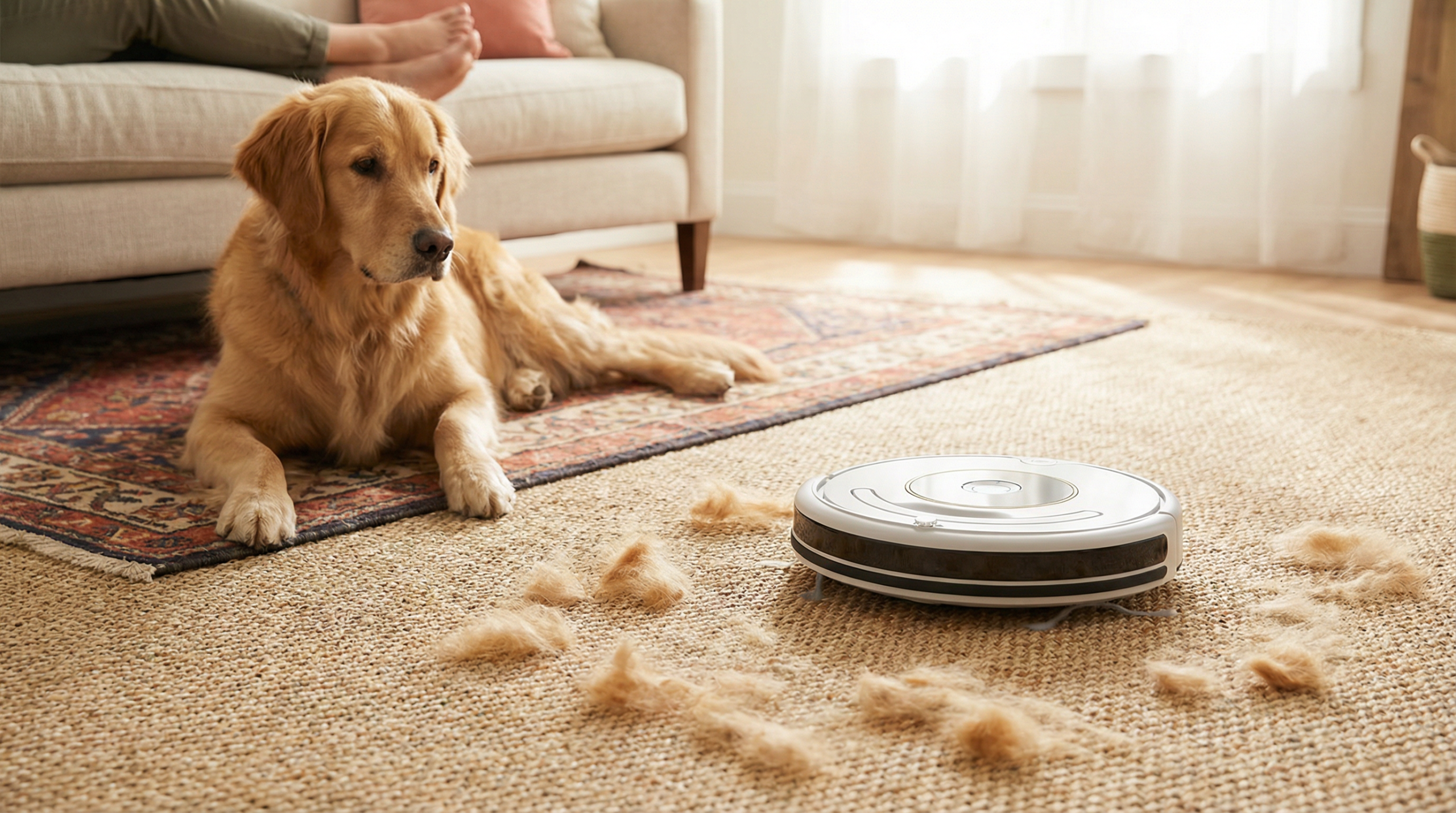
The Pet Hair Problem: Why Regular Robot Vacuums Fall Short
If you share your home with dogs, cats, or any shedding pet, you already know the struggle. Pet hair gets everywhere — embedded in carpets, floating across hardwood floors, clinging to furniture, and somehow finding its way into places your pet has never been. A robot vacuum seems like the perfect solution: set it to clean daily, and pet hair never accumulates.
But here’s the catch — not every robot vacuum handles pet hair well. Cheap models get tangled, clogged, and overwhelmed. The wrong brush design wraps hair into an unusable mess. Undersized dustbins fill up before the job is done. And some robots simply don’t have enough suction to pull hair out of carpet fibers.
In this guide, we’ll explain exactly what makes a robot vacuum great for pet hair, test the top contenders, and help you find the right one for your furry household.
What Makes a Robot Vacuum Good for Pet Hair?
Tangle-Free Brush Design
This is the single most important feature for pet owners. Traditional bristle brushes are a nightmare with pet hair — long strands wrap around the brush roll, requiring frequent manual removal with scissors. The best pet-hair robot vacuums use rubber extractors or silicone rollers that resist tangling.
iRobot’s dual rubber extractors are the gold standard for tangle-free cleaning. The counter-rotating rubber rollers agitate carpet fibers to loosen debris while channeling hair directly into the dustbin. Roborock’s DuoRoller system combines a rubber roller with a bristle section — effective for cleaning but more prone to hair wraps. Ecovacs and Dreame have introduced their own anti-tangle designs with varying effectiveness.
Strong Suction Power
Pet hair embeds itself deep in carpet fibers, requiring strong suction to extract. For pet-heavy homes, look for robots with at least 5,000 Pa of suction on boost mode. Premium models like the Roborock S8 MaxV Ultra offer 10,000 Pa, while some newer models push even higher. The automatic carpet boost feature — which increases suction when carpet is detected — is essential for pet owners.
Large Dustbin and Self-Emptying Dock
Pet hair is voluminous. A standard 300-400 ml dustbin fills up quickly in a shedding household. A self-emptying dock is nearly essential for pet owners — it automatically empties the robot’s dustbin into a larger bag or container that holds 30-60 days of debris. Without one, you’ll be emptying the dustbin daily or even multiple times per day during heavy shedding seasons.
HEPA Filtration
Pet allergens — dander, saliva proteins, and pollen carried in on fur — are a major concern for allergy sufferers. HEPA or HEPA-equivalent filters capture 99.97% of particles as small as 0.3 microns, preventing the robot from blowing allergens back into the air as it cleans. This is particularly important if anyone in your household has pet allergies.
Pet-Specific Smart Features
Modern robot vacuums offer several features specifically useful for pet owners. Pet waste avoidance uses cameras and AI to detect and avoid pet accidents on the floor — potentially saving you from a catastrophic smearing incident. Pet-specific cleaning schedules increase cleaning frequency during heavy shedding seasons. Some apps even track pet activity patterns and suggest optimal cleaning times.
Top Robot Vacuums for Pet Hair in 2026
1. iRobot Roomba Combo j9+ — Best Overall for Pet Hair
Price: ~$1,099 | Suction: ~3,500 Pa (est.) | Dustbin: 400 ml (self-emptying)
The Roomba Combo j9+ remains the top choice for pet owners for one reason above all others: its dual rubber extractors virtually never tangle. In months of daily cleaning in a multi-pet household, you’ll rarely need to remove hair from the brushes. The extractors agitate carpet fibers effectively, pulling embedded pet hair that other robots leave behind.
The self-emptying Clean Base holds up to 60 days of debris in an enclosed bag, keeping pet hair sealed away. The robot’s PrecisionVision Navigation identifies and avoids pet waste on the floor, a feature that has worked reliably in real-world testing. Dirt Detective AI learns which rooms get the most pet traffic and prioritizes them.
The retractable mop pad is useful for cleaning pet paw prints and tracked-in dirt from hard floors. It automatically lifts when carpet is detected, so you can vacuum and mop in a single run without worrying about wet carpets.
Why it’s great for pets: Tangle-free rubber extractors, pet waste avoidance, large sealed disposal bags, AI-driven cleaning prioritization.
Limitations: Lower suction than some competitors, mop is adequate but not outstanding for heavy cleaning.
2. Roborock S8 MaxV Ultra — Best for Mixed Floors with Pets
Price: ~$1,199 | Suction: 10,000 Pa | Dustbin: 400 ml (self-emptying)
If your home has a mix of hard floors and carpets, the Roborock S8 MaxV Ultra offers the most complete cleaning solution. Its 10,000 Pa suction pulls pet hair from deep carpet fibers, and the Reactive AI 2.0 system reliably detects and avoids pet waste, shoes, and other floor obstacles.
The dual VibraRise mopping pads handle the mud, drool, and paw prints that come with pet ownership. The dock washes the mop pads with hot water after every cleaning session, preventing the musty smell that can develop with pet-related messes. The FlexiArm side brush extends along walls and corners, capturing the pet hair tumbleweeds that tend to collect there.
The main brush does accumulate some hair — more than Roomba’s rubber extractors — but the DuoRoller design makes it relatively easy to clean. Weekly brush maintenance is recommended in heavy-shedding households.
Why it’s great for pets: Massive suction power, excellent mopping for paw prints and drool, hot-water mop washing, great obstacle avoidance.
Limitations: Brush requires more frequent cleaning than Roomba, larger dock footprint.
3. Ecovacs Deebot X2 Omni — Best for Large Pet Households
Price: ~$1,099 | Suction: 8,000 Pa | Dustbin: 400 ml (self-emptying)
The Deebot X2 Omni’s square design gives it an edge in corner cleaning — exactly where pet hair tends to accumulate. The YIKO voice assistant allows hands-free control (useful when your hands are full with a pet), and the AI-powered obstacle avoidance system works well in cluttered pet-friendly homes.
The dual spinning mop pads provide effective hard floor cleaning, and the dock handles auto-emptying, mop washing with hot water, and drying. The robot’s relatively slim profile (under 4 inches) lets it clean under furniture where pet hair hides.
Why it’s great for pets: Square design cleans corners well, slim profile reaches under furniture, strong suction, comprehensive dock.
Limitations: Brush can tangle with long pet hair, some users report occasional navigation issues in very cluttered rooms.
4. Dreame L20 Ultra — Best Mopping for Pet Messes
Price: ~$1,099 | Suction: 7,000 Pa | Dustbin: 350 ml (self-emptying)
Dreame’s L20 Ultra features the MopExtend system, where the mop pad extends sideways to reach along walls and into corners — areas where pet messes often occur. The extending mop is genuinely useful for cleaning dried paw prints and pet accidents from baseboards.
The auto-mop lifting (10.5mm) keeps carpets dry while mopping hard floors, and the dock includes hot-water mop washing and drying. Suction at 7,000 Pa is strong enough for most pet hair situations, though not quite as powerful as the Roborock S8 MaxV Ultra.
Why it’s great for pets: Extending mop reaches edges where pet messes accumulate, strong suction, effective hot-water dock cleaning.
Limitations: Mop extension can occasionally bump small obstacles, slightly smaller dustbin.
5. Shark Matrix Plus 2-in-1 — Best Budget for Pet Owners
Price: ~$500 | Suction: ~3,000 Pa (est.) | Dustbin: Self-emptying dock included
For pet owners who want a self-emptying robot vacuum without the flagship price, the Shark Matrix Plus delivers solid performance. Shark has deep expertise in pet-hair cleaning from its upright vacuum line, and this translates well to their robot vacuums.
The anti-wrap brush roll uses a comb-like system to actively remove hair from the brush during operation, reducing maintenance significantly. The self-emptying base holds 30 days of debris. Navigation is methodical and reliable, though not as sophisticated as LiDAR-based competitors.
Why it’s great for pets: Anti-wrap technology, self-emptying dock included at budget price, Shark’s pet-cleaning expertise.
Limitations: No mopping function, less advanced navigation, fewer smart features.
How to Set Up Your Robot Vacuum for Pet Hair Success
Optimal Cleaning Schedule
For homes with pets, daily cleaning is strongly recommended. Many pet owners run their robot once or twice per day — once during the day while at work, and once in the evening. During heavy shedding seasons (spring and fall for most breeds), consider running the robot three times per day in high-traffic areas.
Schedule runs for times when pets are calm or in a separate room. Some pets are anxious around robot vacuums, especially at first. Gradual introduction — running the robot while the pet is nearby but at a distance — helps most animals acclimate within a few days.
Room Prioritization
Use your robot’s app to prioritize rooms where pets spend the most time. The living room, bedroom (if pets sleep there), and entryway typically need the most attention. Set these rooms for daily or multiple daily cleanings, while less-trafficked areas can be cleaned every other day.
No-Go Zones
Set up no-go zones around pet food bowls and water dishes to prevent the robot from disturbing them or tracking wet food across the floor. If your pet has a specific resting spot with a bed or blanket, consider whether the robot should clean that area (it should — pet beds are hair magnets — but your pet may not appreciate being disturbed).
Maintenance Schedule for Pet Households
- Daily: Check for and remove any large hair clumps around the brush roll (if using a bristle brush)
- Weekly: Clean the filter by tapping out accumulated dust and pet dander. Wipe sensors with a dry cloth.
- Bi-weekly: Remove and clean the brush roll thoroughly. Check side brushes for hair tangles.
- Monthly: Replace the filter if using washable filters (every 2-3 months for HEPA). Check wheels for hair buildup.
- Quarterly: Replace side brushes. Inspect the dustbin seal for pet hair that may prevent proper closure.
Pet Hair on Furniture: Can a Robot Help?
Robot vacuums only clean floors, but tackling floor-level hair prevents it from migrating to furniture. However, for upholstered furniture, you’ll need complementary tools. Robot vacuums can dramatically reduce the overall pet hair in your home, which means less settles on furniture, but they won’t eliminate it entirely.
Consider pairing your robot vacuum with a handheld pet hair vacuum (like the Dyson V15 or Shark Pet Pro) for furniture and stairs. Some pet owners also use lint rollers, rubber gloves, or specialized pet hair removal brushes on upholstery.
Dealing with Pet Accidents
The nightmare scenario for any robot vacuum owner with pets: the robot runs over a pet accident and spreads it across your entire home. Modern robot vacuums address this with AI-powered obstacle avoidance. The Roomba j9+ and Roborock S8 MaxV Ultra both include pet waste detection that works reliably in testing.
However, no system is 100% perfect. Tips to minimize risk:
- Run the robot after you’ve done a visual check of the floors
- If you have a puppy in training, consider scheduling runs only when you’re home
- Use the robot’s scheduling feature to clean during times when accidents are least likely
- Keep the robot’s camera/sensor array clean for optimal detection
Multi-Pet Households: Special Considerations
Homes with multiple pets generate significantly more hair and dander. Here are additional recommendations:
- Self-emptying dock is mandatory: Without one, you’ll be emptying the dustbin multiple times daily
- Consider two robots: For large homes with multiple pets, two robots (one per floor or one for each half of the house) can dramatically improve results
- Increase filter replacement frequency: Double the recommended interval in multi-pet homes
- Look for larger dustbin models: Every extra ml of capacity counts when dealing with multiple shedders
- Mopping matters more: Multiple pets mean more tracked-in dirt, paw prints, and general floor grime
Allergies and Air Quality
For allergy sufferers living with pets, a robot vacuum with HEPA filtration is essential but not sufficient on its own. The robot captures allergens from floors, but you should also consider an air purifier for ongoing airborne allergen reduction, regular washing of pet bedding in hot water, keeping pets out of bedrooms if allergies are severe, and grooming pets regularly to reduce shedding at the source.
The combination of a HEPA-filtered robot vacuum running daily and a quality air purifier can reduce airborne pet allergens by up to 80%, according to allergy research studies.
Our Verdict: Which Robot Vacuum Should Pet Owners Buy?
For carpet-heavy homes: Roomba Combo j9+. The tangle-free rubber extractors are unmatched for pulling pet hair from carpet without maintenance hassles.
For mixed floors: Roborock S8 MaxV Ultra. Dominant suction power plus excellent mopping handles every floor type and every pet mess.
For budget pet owners: Shark Matrix Plus. Self-emptying dock, anti-wrap brush, and solid cleaning at half the price of flagships.
For large homes with multiple pets: Consider two robots — one for each level or zone. The Ecovacs Deebot X2 Omni or Dreame L20 Ultra offer strong performance at mid-flagship pricing, making a two-robot setup more financially feasible.
No matter which robot you choose, the key to pet hair success is consistency. Run it daily, maintain it according to schedule, and pair it with complementary cleaning tools for furniture and upholstery. Your home will never be completely hair-free — that’s the deal we make when we live with pets — but a good robot vacuum makes the daily battle dramatically easier.
