


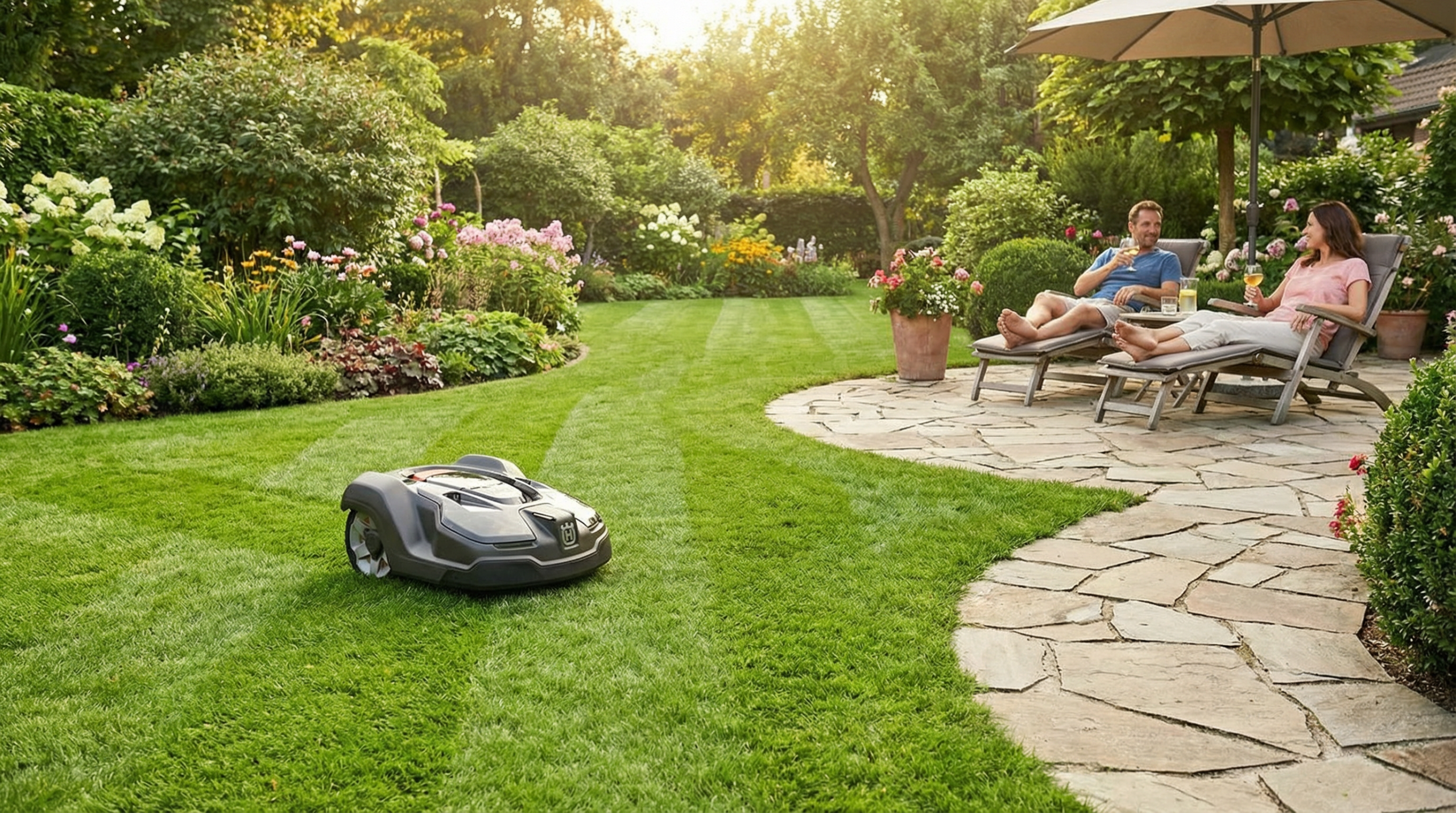
Why Robot Lawn Mowers Are Taking Over Yards in 2026
Robot lawn mowers have quietly gone from niche gadgets to mainstream yard care tools. Sales have grown over 30% year-over-year since 2023, driven by dramatic improvements in technology, dropping prices, and a simple truth: nobody actually enjoys mowing the lawn. In 2026, these autonomous machines can handle complex yard layouts, navigate slopes, avoid obstacles, and keep your grass at a consistent height — all without you lifting a finger.
This complete guide covers everything you need to know before buying a robot lawn mower: how they work, what to look for, the best models available, installation requirements, and whether one makes sense for your yard.
How Robot Lawn Mowers Work
The Cutting System
Unlike traditional mowers that use a single large blade spinning at high speed, most robot mowers use three small, razor-sharp blades attached to a spinning disc. These blades cut grass with a scissor-like action, trimming just a few millimeters at a time. This mulching approach means the tiny clippings fall into the lawn and decompose, naturally fertilizing the soil. The result is a healthier, denser lawn with fewer weeds — without bagging or raking.
The cutting width varies by model, typically ranging from 7 inches (18 cm) for small yard models to 14 inches (36 cm) or more for commercial units. Cutting height is adjustable, usually between 0.8 inches (20 mm) and 3 inches (80 mm), depending on the model.
Navigation Methods
Robot mowers use several navigation approaches, and this is where the biggest technology shift has happened in recent years:
Boundary Wire Systems (Traditional): A perimeter wire is buried 1-2 inches underground or laid on the surface around the mowing area. The mower uses this wire as a guide to stay within bounds. This is the most proven technology, used by brands like Husqvarna, Worx, and Gardena. Installation takes 2-4 hours for an average yard.
RTK-GPS (Wire-Free): Newer models from brands like Luba, Mammotion, and Segway use Real-Time Kinematic GPS positioning combined with onboard sensors for centimeter-accurate navigation. No boundary wire needed — you define the mowing area in an app by walking the perimeter with the mower or using a satellite map. This is the fastest-growing segment of the market.
Vision-Based Navigation: Some cutting-edge models use cameras and AI to navigate, similar to robot vacuums. These systems can identify lawn areas versus flower beds, driveways, and other surfaces without any physical boundary markers.
Charging and Runtime
Robot mowers operate on rechargeable lithium-ion batteries. When the battery runs low, the mower automatically returns to its charging station, recharges (typically 60-90 minutes), and then resumes mowing where it left off. Most models can mow for 60-120 minutes per charge, covering 500-2,000 square feet per session depending on the model and conditions.
Key Features to Consider
Yard Size Capacity
This is the most important specification. Robot mowers are rated for maximum yard size, typically measured in square feet or square meters. Common tiers include:
- Small yards (up to 2,500 sq ft / 250 m²): Entry-level models. Ideal for urban gardens and small suburban yards. Price range: $500-$800.
- Medium yards (2,500-5,000 sq ft / 250-500 m²): Mid-range models with longer battery life and wider cutting decks. Price range: $800-$1,500.
- Large yards (5,000-10,000 sq ft / 500-1,000 m²): Advanced models with multiple zone support and faster mowing speeds. Price range: $1,500-$2,500.
- Extra-large yards (10,000+ sq ft / 1,000+ m²): Premium and commercial-grade models. Price range: $2,500-$5,000+.
Always buy a model rated for at least 20% more area than your actual lawn size. Slopes, complex layouts, and thick grass all reduce effective coverage.
Slope Handling
If your yard has hills, slope capability is critical. Most robot mowers handle slopes of 15-20 degrees (27-36%). Higher-end models with all-wheel drive can manage slopes up to 35-45 degrees (70-100%). For reference, a slope you can comfortably walk up is typically 15-20 degrees. If you need to lean forward to climb it, you’re looking at 25+ degrees.
Rain Sensors and Weather Handling
Most robot mowers include rain sensors that send the mower back to its station when rain is detected. Mowing wet grass isn’t ideal — it clumps, clogs the blades, and leaves uneven results. Some premium models can handle light rain and have weather-resistant designs, but it’s generally best to let the mower wait for dry conditions.
Obstacle Detection and Safety
Modern robot mowers use a combination of bump sensors, ultrasonic sensors, and in some cases cameras to detect and avoid obstacles. When the mower hits something, it stops, backs up, and takes a different path. Higher-end models can detect obstacles before contact and navigate around them smoothly.
Safety is a primary concern, especially for families with children and pets. All robot mowers have lift sensors that immediately stop the blades when the mower is picked up. The small blade design also reduces injury risk compared to traditional mowers — the blades retract on contact with solid objects. However, supervision is still recommended when children or pets are in the yard during mowing.
Multi-Zone Support
If your lawn has separate sections (front yard, back yard, side strips), you need multi-zone support. Some wire-based systems use guide wires to direct the mower between zones. GPS-based models handle multiple zones more elegantly, allowing you to map each area separately in the app and schedule different mowing times for each zone.
Noise Levels
One of the biggest advantages of robot mowers is their quiet operation. Most models produce 55-65 dB of noise — comparable to normal conversation. This means you can run them at night or early morning without disturbing neighbors, which is impossible with traditional gas mowers that typically produce 90+ dB.
Top Robot Lawn Mower Brands in 2026
Husqvarna Automower
Husqvarna is the pioneer and market leader in robot mowing, having launched the first commercial robot mower in 1995. The Automower lineup ranges from the entry-level 305 (suitable for small yards) to the professional 550 EPOS (for grounds up to 13,000 m²).
Husqvarna’s key advantages include exceptional build quality, proven reliability over decades, dealer networks for professional installation, and the EPOS satellite navigation system for wire-free mowing on premium models. The Automower Connect app provides scheduling, GPS tracking, and smart home integration through IFTTT, Alexa, and Google Home.
The downside is price — Husqvarna mowers are typically the most expensive option, and many models still require boundary wire installation. Professional installation adds $300-$800 to the upfront cost.
Worx Landroid
Worx positions the Landroid as the most accessible robot mower, with competitive pricing and a modular design. The Landroid series is popular with DIY homeowners who prefer self-installation and customization.
The Landroid’s modular approach is unique — you can add accessories like an anti-collision system (ACS), off-road wheels for rough terrain, a voice control module, and a GPS tracking module. The Find My Landroid feature combines GPS and cellular connectivity for theft tracking.
Worx mowers offer good value but tend to have shorter lifespans than Husqvarna and may struggle on complex, hilly terrain.
Mammotion Luba / YUKA
Mammotion has disrupted the market with RTK-GPS navigation that eliminates boundary wires entirely. The Luba series (Luba AWD 1000, 3000, 5000) offers all-wheel drive, centimeter-accurate navigation, and multi-zone support at competitive prices.
The YUKA series goes further by adding a sweeping function — it can collect leaves and debris while mowing. Setup is remarkably simple: place the RTK antenna, walk the perimeter with the mower to map the boundary, and you’re done. No wire burial, no professional installation needed.
Mammotion’s main limitation is brand maturity — as a newer player, long-term reliability data is limited. The RTK antenna also requires a clear view of the sky, which can be challenging in heavily wooded yards.
Segway Navimow
Segway entered the robot mower market with the Navimow series, which also uses RTK-GPS for wire-free navigation. The Navimow offers a clean design, intuitive app experience, and competitive pricing. The latest models support yard areas up to 5,000 m² and slopes up to 45%.
Segway’s strength lies in its user-friendly setup process and polished app interface. The virtual boundary system works well, and the mower can handle reasonably complex yard layouts. OTA updates keep adding features post-purchase.
Gardena SILENO
Part of the Husqvarna Group, Gardena targets European gardens with the SILENO lineup. These compact mowers are designed for smaller yards (up to 2,000 m²) and feature excellent build quality at mid-range prices. The SILENO City is one of the most popular robot mowers for urban gardens in Europe.
Installation: What to Expect
Boundary Wire Installation
For wire-based systems, installation involves:
- Planning the layout: Map your yard, identify mowing areas and obstacles (trees, flower beds, paths)
- Laying the perimeter wire: The wire can be pegged to the surface (it grows into the lawn over 4-6 weeks) or buried 1-2 inches deep using a cable-laying machine
- Placing the charging station: Needs a flat surface, preferably shaded, with access to a power outlet
- Connecting guide wires: For multi-zone setups, guide wires direct the mower between areas
- Configuring the schedule: Set mowing times and zones in the app
DIY installation for a typical yard takes 3-6 hours. Professional installation runs $300-$800 depending on yard size and complexity.
Wire-Free (GPS) Installation
GPS-based systems are dramatically simpler:
- Place the RTK base station: Mount it on a pole or wall with a clear view of the sky
- Map the boundary: Walk the perimeter with the mower or define it in the app using a satellite map
- Mark no-go zones: Define areas the mower should avoid in the app
- Place the charging station: Same as wire systems
- Configure and go: Set schedule and preferences in the app
GPS installation typically takes 30-60 minutes, and you can adjust boundaries anytime without physical modifications.
Maintenance Requirements
Robot mowers require minimal maintenance compared to traditional mowers:
- Blade replacement: Every 1-3 months depending on use. Blade sets cost $8-$20. Most models use snap-on blades that take seconds to swap.
- Cleaning: Rinse the underside with a garden hose weekly or bi-weekly. Remove grass buildup from the cutting disc.
- Battery: Batteries typically last 3-5 years before needing replacement. Replacement batteries cost $100-$300.
- Boundary wire (if applicable): Occasionally needs repair if cut by edging tools or garden work. Repair kits are inexpensive.
- Winter storage: Clean the mower, charge the battery to 50-75%, and store indoors during the off-season.
Robot Mower vs Traditional Mowing: Cost Analysis
Upfront Cost
A quality robot mower costs $800-$2,500 for residential models. Add $300-$800 for professional installation with wire-based systems. Total upfront: $800-$3,300.
A quality push mower costs $300-$600. A riding mower costs $1,500-$4,000+. No installation needed.
Annual Operating Cost
Robot mower electricity costs approximately $15-$30 per year. Blade replacements add $30-$60 per year. Total annual cost: $45-$90.
A gas push mower costs approximately $50-$100 per year in fuel and maintenance. A lawn service costs $150-$300 per month ($1,800-$3,600 per year).
Time Savings
The average homeowner spends 70 hours per year mowing and maintaining their lawn. A robot mower reduces this to approximately 5 hours per year (maintenance tasks only). At an average wage value of $25/hour, that’s $1,625 in time savings annually.
Break-Even Analysis
Compared to a lawn service: A $1,500 robot mower pays for itself in 6-10 months. Compared to DIY mowing: Break-even takes 2-3 years when factoring in time savings. If you value your weekend time, the payback is essentially immediate.
Common Concerns and Myths
“The lawn won’t look as good”
Actually, the opposite is true. Robot mowers cut frequently (daily or every other day), removing only a small amount of growth each time. This promotes denser, healthier grass and a more consistent appearance. The mulching action returns nutrients to the soil. Many users report their lawn looks better than ever after switching to a robot mower.
“They can’t handle complex yards”
Modern robot mowers handle narrow passages (as narrow as 24 inches), islands (trees, flower beds), multiple zones, and moderate slopes. GPS models in particular can navigate complex layouts with ease. Very steep slopes (above 45%) and extremely rough terrain remain challenging.
“They’re unsafe for kids and pets”
While no outdoor machine is completely risk-free, robot mowers have multiple safety features: lift sensors that stop blades instantly, bump sensors for obstacle avoidance, and small blade designs that retract on contact with solid objects. Scheduling mowing during times when children and pets are indoors adds an extra layer of safety.
“They’ll get stolen”
Most modern robot mowers include GPS tracking, PIN codes, alarms, and geofencing that renders the mower useless if removed from the programmed area. Some models have cellular connectivity for real-time tracking. Theft is uncommon but does happen — insurance coverage for robot mowers is available through most homeowner policies.
Our Top Picks for 2026
Best Overall: Husqvarna Automower 450X NERA
Wire-free EPOS navigation, handles up to 5,000 m², 45% slope capability, exceptional build quality. ~$3,500.
Best Value: Mammotion Luba AWD 3000
RTK-GPS navigation, all-wheel drive, 3,000 m² capacity, 75% slope handling, no wire installation. ~$1,600.
Best for Small Yards: Gardena SILENO City 250
Compact, quiet, reliable, up to 250 m², easy DIY wire installation. ~$700.
Best Wire-Free Budget: Segway Navimow i108E
RTK-GPS, 800 m² capacity, excellent app, easy setup, good slope handling. ~$1,000.
Best for Complex Yards: Husqvarna Automower 430X NERA
Handles narrow passages, multiple zones, and complex layouts with proven reliability. ~$2,800.
Is a Robot Lawn Mower Right for You?
A robot lawn mower makes sense if you have a lawn of at least 500 square feet, value your time on weekends, want a consistently great-looking lawn with minimal effort, and are comfortable with a $800+ upfront investment. The technology has matured to the point where reliability concerns are minimal for established brands.
It might not be the right choice if your yard has extreme slopes (above 45%), is heavily wooded with no GPS visibility, or is very small (under 500 sq ft) where a quick manual mow takes only minutes.
The bottom line: robot lawn mowers in 2026 are no longer a luxury toy — they’re a practical tool that saves time, improves lawn health, and pays for itself within a few years. The hardest part is choosing which one to buy.
