


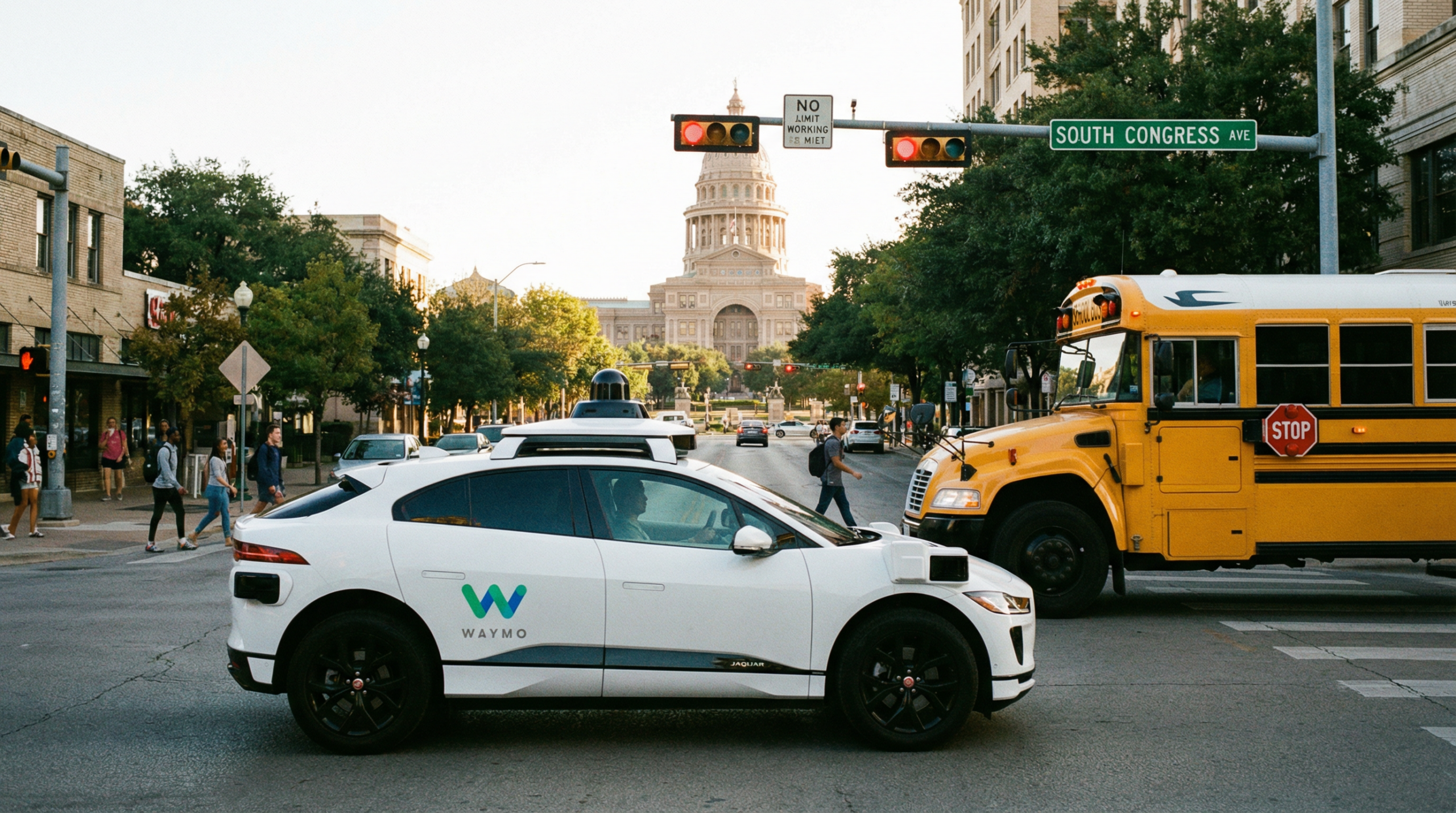
A Waymo robotaxi illegally passed a stopped school bus in Austin, Texas while children were boarding — and federal investigators have launched a probe into the incident. The twist: the autonomous vehicle did exactly what it was supposed to do. It stopped and asked for help. The human operator got it wrong.
The Incident
On January 12, 2026, at approximately 7:55 a.m., a Waymo-operated 2024 Jaguar I-Pace equipped with autonomous driving technology approached a stopped Austin ISD school bus with its red signals active and stop arm extended — the universal signal that all traffic must stop.
According to the NTSB investigation report, the autonomous vehicle correctly identified the situation as an edge case and stopped. It then asked its remote human safety operator: “Is this a school bus with active signals?”
The human operator responded: “No.”
The Waymo vehicle proceeded, illegally passing the school bus while students were loading. Worse, because the Waymo was first in line and chose to move, it effectively signaled to five other human drivers behind it that it was safe to proceed. All six vehicles passed the bus illegally.
This wasn’t an isolated incident. Austin ISD officials have documented 19 separate instances of Waymo robotaxis “illegally and dangerously” passing school buses since the 2025-2026 school year. A similar incident was captured on video in Atlanta in September 2025, and Waymo subsequently issued a software recall.
Why It Matters
This incident is a masterclass in why “human-in-the-loop” isn’t the safety silver bullet the autonomous vehicle industry portrays it as.
The AI system worked correctly — it recognized the ambiguous situation, stopped, and escalated to a human. The safety protocol functioned as designed. But the remote operator, potentially watching multiple vehicles from a distant control center, made the wrong call. The geographical disconnect between a remote operator and the physical reality of a school bus in Austin, Texas is exactly the kind of failure mode that’s hard to engineer away.
Under Texas Transportation Code Section 545.066, drivers must remain stopped until a school bus deactivates its signals. This applies to autonomous vehicle operators too. The legal liability question — does the blame fall on Waymo as the fleet operator, or the remote operator who made the wrong call? — will likely set precedent for the entire AV industry.
There’s a deeper irony here. Autonomous driving is marketed as a solution to human error. But Waymo’s safety architecture deliberately keeps humans in the loop for edge cases. When that human fails, you get the worst of both worlds: a machine that defers to humans who aren’t present enough to make good decisions.
The fact that the Waymo vehicle was first in line compounds the problem. Human drivers increasingly treat autonomous vehicles as “smart” traffic leaders. When the robot moves, people follow. That social dynamic turns a single operator error into a six-vehicle safety violation in front of schoolchildren.
The Bottom Line
Waymo’s Austin school bus incident isn’t an argument against autonomous vehicles — it’s an argument against complacent human oversight. The AI asked the right question. The human gave the wrong answer. As AVs scale to more cities and more edge cases, the industry needs to reckon with a hard truth: the humans monitoring these systems need to be at least as reliable as the AI they’re supervising. Right now, they’re not.
