


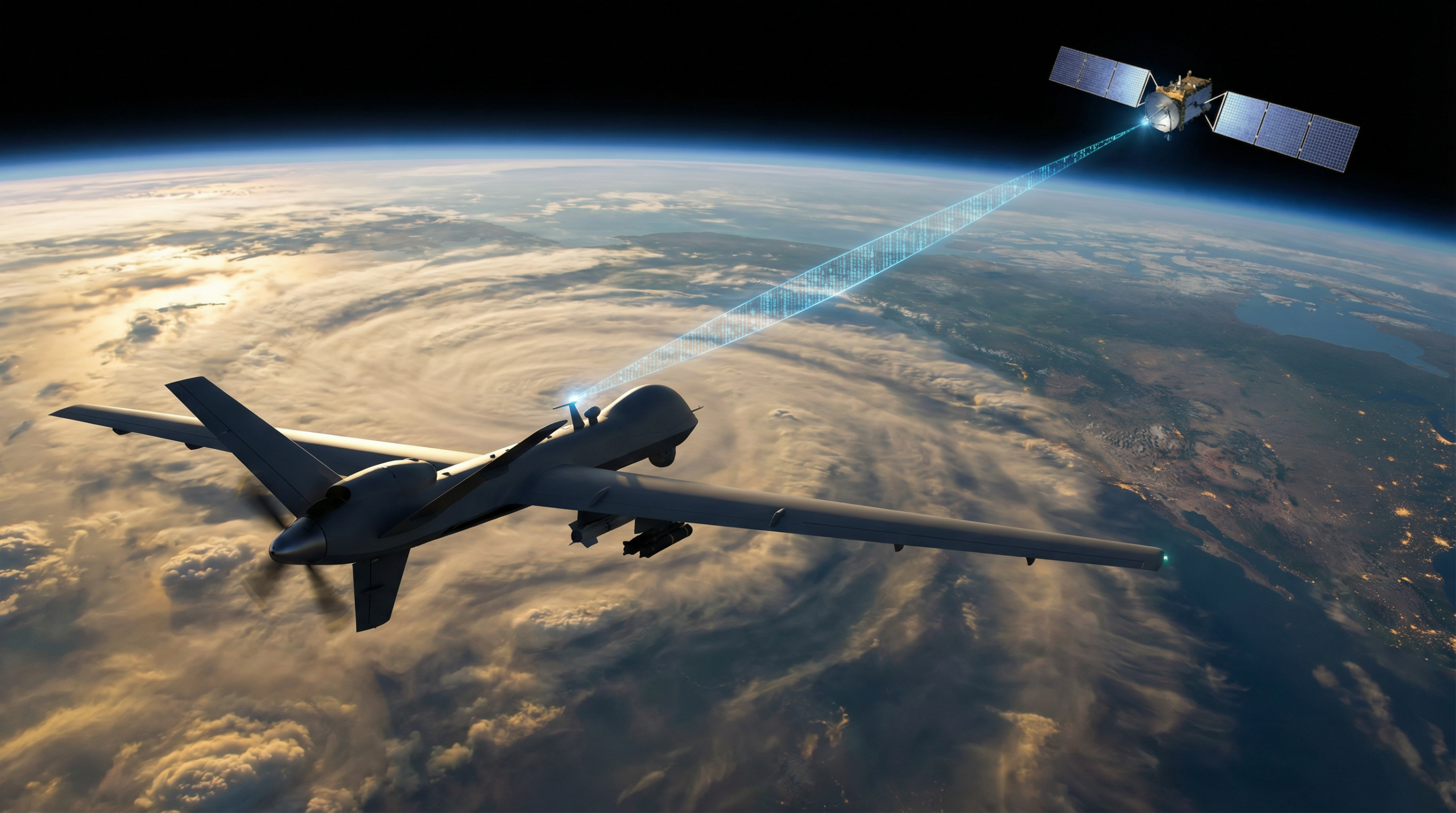
Galaxy 1 Communications and Viasat have partnered to scale satellite connectivity for drones operating beyond visual line of sight. The deal pairs Viasat’s Velaris satellite communications service with Galaxy 1’s Distribution Partner-as-a-Service (DPaaS) model — and it could accelerate the commercial drone industry’s biggest bottleneck: reliable BVLOS connectivity.
The Partnership: More Than a Reseller Deal
This isn’t a typical distribution agreement. Galaxy 1’s DPaaS model wraps provisioning, billing, compliance oversight, and system integration into a single managed layer on top of Viasat’s existing Velaris satellite platform.
The offering delivers four core capabilities:
- Partner onboarding and ecosystem growth — structured pathways for new drone operators to get connected
- Infrastructure and commercial enablement — multi-layered billing and provisioning for operators, service providers, and developers
- API-based service integration — orchestration between flight planning, IoT platforms, and Velaris connectivity
- End-to-end service delivery — cybersecurity, monitoring, and compliance-ready reporting through Galaxy 1’s IBIS and Remote Terminal Manager (RTM) platforms
The RTM and IBIS platforms provide real-time terminal visibility and secure lifecycle management — tools that directly address the compliance requirements regulators demand for BVLOS operations in controlled airspace.
“Advanced Air Mobility represents one of the most transformative shifts in aviation, and connectivity is at the heart of making it safe, efficient, and scalable,” said Martyn Durrant, Chief Commercial Officer of Galaxy 1 Communications.
Why It Matters
BVLOS is where the money is in commercial drones. Inspecting pipelines, delivering packages, surveying agricultural land — these operations require drones to fly far beyond what a human operator can see. And they all need one thing: uninterrupted, reliable connectivity.
Cellular networks cover most populated areas, but they fall apart over rural farmland, offshore rigs, and remote infrastructure corridors — precisely the places where commercial drones create the most value. Satellite connectivity fills that gap, but until now, getting it set up for a drone fleet has been a complex, expensive, multi-vendor headache.
That’s the problem DPaaS solves. By abstracting the complexity of satellite provisioning, compliance documentation, and system integration into a managed service, Galaxy 1 and Viasat lower the barrier for drone operators to go from proof-of-concept to scaled commercial deployment.
The timing matters. Regulators worldwide are gradually opening airspace for BVLOS operations, but they demand robust command-and-control links. Viasat, which completed its acquisition of Inmarsat in May 2023 and operates in 24 countries, brings global satellite infrastructure. Galaxy 1 brings 20+ years of managed connectivity experience. Together, they offer drone operators a compliance-ready package rather than a DIY satellite integration project.
The Bottom Line
Satellite connectivity for drones isn’t new, but making it easy to deploy at scale is. The Galaxy 1-Viasat partnership targets the operational friction that keeps many commercial drone programs stuck in pilot phase. For delivery, inspection, and agriculture drone operators eyeing BVLOS expansion, this managed connectivity model could be the missing piece between a successful test flight and a profitable fleet operation.
